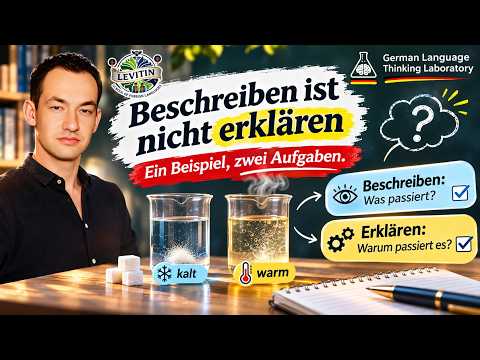
Beschreiben vs. Erklären in German: What’s the Difference?
Lesson language: German
German level: Intermediate (B1–B2)
Topic: German school task verbs (Aufgabenoperatoren)
Focus: Understanding instructions, describing observations and explaining causes
What is the difference between beschreiben and erklären in German?
Both verbs appear frequently in German school assignments, science lessons and academic instructions. But they require different kinds of answers.
In this German-language video lesson, we explore the difference through a simple experiment: sugar dissolving in cold and warm water.
Beschreiben — What happens?
You describe what you observe.
Der Zucker löst sich im warmen Wasser schneller als im kalten Wasser.
Erklären — Why does it happen?
You explain the process behind the observation.
Bei höherer Temperatur bewegen sich die Teilchen im Wasser schneller. Dadurch kann sich der Zucker unter vergleichbaren Bedingungen schneller lösen.
The subject is the same. The knowledge is related. But the task is different.
What you will learn
- How to recognise beschreiben and erklären in German instructions.
- Why describing an observation is different from explaining its cause.
- How to connect German language skills with biology, chemistry and other school subjects.
- Why a factually correct answer may still be incomplete if it does not fulfil the instruction.
- How to choose the appropriate response instead of simply writing more information.
This lesson is particularly relevant for students attending German-speaking schools, multilingual learners, international families and anyone developing academic German skills.
Continue learning: Articles and research
1. German school task verbs explained in English
Why Students Know the Answer but Still Lose Marks: German School Task Verbs Explained
Explore six important German school operators: nennen, beschreiben, erklären, begründen, vergleichen and beurteilen. Learn why knowing the subject is not always enough to produce the answer an assignment requires.
2. A deeper German-language analysis
Nennen ist nicht erklären: Wie Aufgabenoperatoren unser Denken steuern
An independent investigation into how German instruction verbs shape thinking, reasoning and the structure of an answer.
3. Knowledge, instructions and effective communication
The Student Was Right. The Answer Was Wrong.
Discover why knowing the correct information and giving the appropriate response are not always the same thing.
German learning and school subjects
Want to develop your German beyond vocabulary and grammar exercises?
Explore individual online German lessons at Levitin Language School.
You can also explore related learning pathways:
- Learn German Through School Subjects — connect German with academic knowledge and classroom communication.
- Learn Biology and Geography in German — develop subject-specific language and understanding.
- Learn Math in German — work with mathematical language, instructions and reasoning.
- School Support in Switzerland — explore challenges faced by students whose knowledge may not be fully reflected in their school results.
For families navigating Swiss education, read Swiss German or Standard German for School? What Immigrant Families Actually Need to Know.
Individual online learning
Levitin Language School provides individual online learning in languages, academic subjects and selected combinations of language and subject learning.
Whether the challenge involves understanding German instructions, communicating in class, explaining scientific processes or using German more confidently, the learning approach can be adapted to the student’s actual needs.
Find a tutor and explore individual lessons.
To discuss your learning goals, contact Tymur Levitin directly on Telegram. Please include the learner’s age or school level, current German proficiency and the specific difficulties they want to address.
Levitin Language School — Learn the language. Understand the task. Use your knowledge.
Educational content by Tymur Levitin | Levitin Language School | German Language Thinking Laboratory