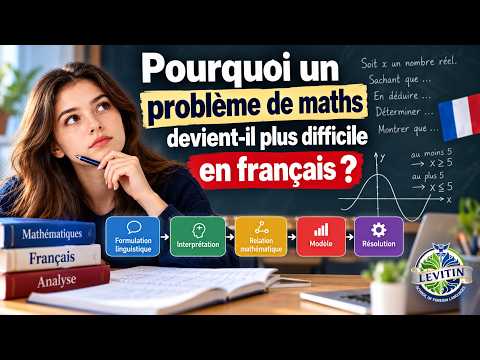
Being good at mathematics does not automatically mean being able to solve a mathematical problem written in French.
Between reading the problem and solving it, another process takes place:
linguistic formulation → interpretation → mathematical relation → model → solution
This French Language + Subject article explores how expressions such as soit, sachant que, en déduire, déterminer, montrer que, au moins and au plus function not merely as mathematical vocabulary, but as instructions for reasoning.
Read the original French article:
Être bon en maths ne suffit pas : comprendre un problème mathématique en français est une compétence à part entière
Related reading: the same distinction between knowing content and being able to reconstruct or use it under different conditions appears across learning. A student may know a formula yet struggle to select or apply it when interpretation, working memory, and modelling must operate together. LANGUAGE SCHOOL by TYMUR LEVITIN
Why Do I Forget Everything I Study? The Problem May Not Be Your Memory
For a broader Language + Subject perspective, the key question is not simply whether the learner knows French and knows mathematics separately, but whether they can move successfully from language to mathematical structure.
Levitin Language School — Languages • Academic Subjects • Language + Subject



