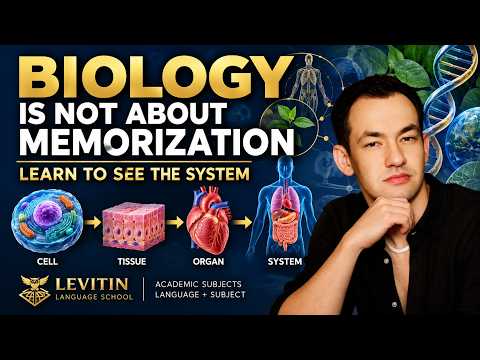
Why does biology become difficult when students try to memorize everything? In this video lesson, Tymur Levitin shows how understanding systems, relationships, functions, causes, and consequences can make biological knowledge more meaningful — and how the same kind of thinking can also support language development.
Biology can feel overwhelming when it is approached as a collection of isolated terms: cells, tissues, organs, species, processes, and definitions.
But remembering the names of biological elements is not the same as understanding how a living system works.
In this video lesson, we take a different approach.
A cell performs a function within a tissue. Tissues form organs. Organs interact within larger systems. Biological processes become meaningful when we understand the relationships between their parts.
The learning sequence is simple:
See the system.
Understand the relationships.
Name the elements.
Explain what happens.
This changes the role of terminology. Instead of memorizing scientific words first and trying to connect them later, students can build an understanding of the system and then attach precise terminology to something that already makes sense.
The lesson also explores an important connection between biology and language.
When students explain biological processes, they describe change, compare structures, identify causes and consequences, express relationships, and predict outcomes.
These are scientific thinking skills — but they are also communicative skills.
When a student explains a biological system in another language, language becomes more than vocabulary to memorize. It becomes a tool for thinking about a real subject.
Biology is not simply a collection of facts.
Language is not simply a collection of words.
Both become more meaningful when we understand how their elements relate to one another.
Related Article
Biology Is More Than Facts: How Systems Turn Information Into Understanding
The article develops the idea further by examining how relationships, functions, systems, scientific terminology, and explanation transform biological information into structured knowledge.
Continue Learning
Explore more lessons and educational materials from Levitin Language School, where languages, academic subjects, and Language + Subject learning form one interconnected educational system.
Author
Tymur Levitin
Founder & Director, Levitin Language School / Language Learnings
© Tymur Levitin