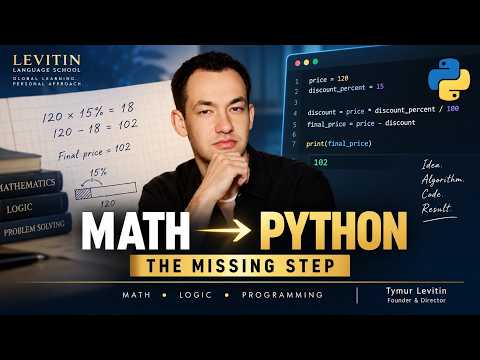
English Video Lesson | Intermediate | Math, Logic & Programming
Why can a student solve a math problem correctly on paper but struggle to write the same solution in Python?
The difficulty is often neither mathematics nor Python syntax.
The missing step is algorithmic thinking: the ability to take a mathematical idea that feels obvious in your head and turn it into a sequence of explicit operations that a computer can follow.
In this video lesson, we use a simple percentage problem to explore the complete transition:
Problem → Mathematical Relationship → Algorithm → Code
A student may immediately understand that a 15% discount must be calculated and subtracted from the original price. But Python cannot work with an intuitive instruction such as “take 15% off.”
The idea has to be unpacked.
We first identify the known values. Then we express the mathematical relationship. Next, we transform that relationship into an algorithm. Only after that do we write the Python code.
This distinction is important because knowing mathematics is not automatically the same as being able to program mathematics.
And knowing Python syntax does not automatically solve the problem either.
Between mathematics and code lies another skill: translating one representation of thought into another.
In This Lesson
You will learn how to:
- identify the mathematical structure behind a problem;
- separate an intuitive solution into explicit steps;
- turn a mathematical relationship into an algorithm;
- translate an algorithm into Python code;
- distinguish mathematical difficulty from programming difficulty;
- understand why syntax is only the final layer of the solution.
Example
We begin with a simple problem:
A product costs $120 and receives a 15% discount. What is the final price?
On paper:
15% of 120 = 18
120 − 18 = 102
In Python, however, the reasoning must become explicit:
price = 120
discount_percent = 15

discount = price * discount_percent / 100
final_price = price - discount

print(final_price)
The result is 102.
But the important part of the lesson is not the result.
It is the structure that produced it:
Problem → Math → Algorithm → Code
The Key Question
When you understand the mathematics but cannot write the program, do not immediately ask:
“Which Python command do I need?”
Ask instead:
“What exactly should the computer do, step by step?”
That is where mathematical thinking begins to become programming.
Watch the Video Lesson
How to Turn a Math Problem into Python Code — YouTube
Read the Full Analysis
This video lesson develops one practical mechanism from our broader article:
Why Many Students Can Solve a Math Problem on Paper but Cannot Write It in Python
The article explores why the gap between mathematical understanding and programming appears, why additional syntax practice may not solve it, and how mathematics, logic and programming can be taught as connected forms of thinking.
Lesson Information
Language: English
Level: Intermediate
Educational Layer: Academic Subjects / Language + Subject
Subjects: Mathematics, Python, Programming, Logic
Focus: Algorithmic Thinking, Mathematical Reasoning, Problem Solving
Format: Video Lesson
Author: Tymur Levitin
Learn More
At Levitin Language School, languages, academic subjects and integrated Language + Subject learning form parts of one educational system. Students can work not only with formulas or programming syntax, but with the reasoning that connects mathematical problems, algorithms and code.
Tymur Levitin
Founder & Director
Levitin Language School / Language Learnings
Global Learning. Personal Approach.
© Tymur Levitin