Video Lesson #19
Language: Ukrainian
Ukrainian Level: Advanced
Topic: 3D Modeling, CAD Logic & Technical Thinking
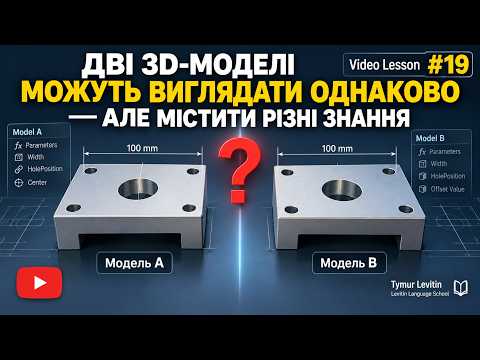
Two 3D models can look exactly the same.
The same shape. The same dimensions. The same holes.
But does that mean they contain the same technical knowledge?
In this short Ukrainian video lesson, Tymur Levitin compares two visually identical 3D models and changes just one parameter: the width of the part.
That simple experiment reveals something a static image cannot show.
In one model, the position of the hole is logically connected to the width of the part. When the width changes, the hole remains centered because the model contains that relationship.
In the other model, the hole position is stored as an independent value. The original geometry may look identical, but after the same parameter change, the model behaves differently.
The key distinction is:
Geometric similarity does not necessarily mean structural similarity.
A 3D model can store more than geometry. It can encode relationships, dependencies, constraints and rules about how an object is supposed to behave when something changes.
The lesson therefore asks one diagnostic question:
If I change one parameter, does my model know what else is supposed to change — and why?
This shifts attention from simply creating the correct shape to understanding the logic behind that shape.
Watch the Video Lesson
Watch Video Lesson #19: Two 3D Models Can Look Identical — but Contain Different Knowledge on YouTube.
The lesson is taught in Ukrainian and demonstrates how a single parameter change can reveal relationships and dependencies that are invisible in the finished geometry.
Watch Video Lesson #19 on YouTube
What This Video Explores
- why two visually identical 3D models may contain different knowledge;
- how parameter changes reveal hidden model structure;
- the difference between coordinates and relationships;
- why dependencies matter in parametric modeling;
- how model behavior can expose design logic;
- why a good 3D model preserves more than its current geometry.
Continue Exploring
For a deeper English-language analysis, read A Correct 3D Shape Is Not Necessarily a Correct 3D Model. It explores how expected future changes can reveal whether a CAD model contains the relationships it actually needs.
Because this video lesson is taught in Ukrainian, you can continue the same line of technical thinking in Ukrainian with Що 3D-модель вважає незмінним — і чому саме це показує її логіку. The article examines invariants: what a model should preserve when other properties change.
For the broader conceptual starting point of this research cycle, read Two 3D Models Can Look Identical and Still Contain Different Knowledge.
To explore CAD and 3D modeling through technical thinking rather than commands alone, visit Learn AutoCAD and 3D Modeling.
Tymur Levitin
Founder & Director, Levitin Language School / Language Learnings
Languages • Academic & Professional Subjects • Language + Subject
© 2026 Tymur Levitin. All rights reserved.



