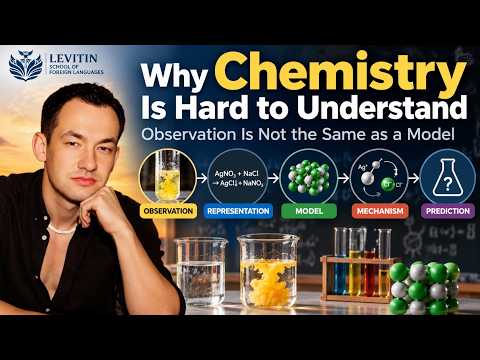
Chemistry becomes difficult when formulas, equations, observations, and models are treated as if they were the same thing.
In this short video lesson, Tymur Levitin explores a fundamental distinction in chemical thinking:
observation → representation → model → mechanism → prediction
A colour change, a precipitate, or the production of gas is something we can observe. A chemical equation represents the change. A particle model gives us another way to think about it. But none of these automatically explains the mechanism.
The central idea is simple:
a chemical equation is compressed knowledge — not the knowledge itself.
Real understanding begins when a learner can move between different levels of chemistry: observe a phenomenon, represent it symbolically, connect the representation to a model, reason about the underlying mechanism, and finally use that model to predict what should happen when conditions change.
This distinction helps explain why a student may successfully memorize formulas and reaction types yet struggle when a familiar problem appears in a new form. Chemistry is not primarily a collection of facts. It is a system for reasoning about matter.
The lesson also develops a broader educational principle: representation is not explanation. Understanding means being able to unpack the relationships compressed inside equations, diagrams, models, and other scientific representations.
Read the related article:
The article develops the same distinction in greater depth: chemistry requires movement between visible phenomena, symbolic notation and models of processes that cannot simply be observed directly. Вставлений текст
Continue exploring:
Learning Physics in English Online: How Language Shapes Scientific Thinking — a connected Language + Subject article exploring how scientific concepts, representations and language interact in learning. LANGUAGE SCHOOL by TYMUR LEVITIN
Why Is Economics So Hard to Understand? Because Definitions Are Not the Same as Economic Thinking — a parallel exploration from another academic subject: knowing definitions and representations does not necessarily mean being able to reason with the underlying model. LANGUAGE SCHOOL by TYMUR LEVITIN
Author
Tymur Levitin
Founder & Director, Levitin Language School
Author and methodology curator
Educational architecture:
Languages → Academic Subjects → Language + Subject
© 2026 Tymur Levitin. All rights reserved.