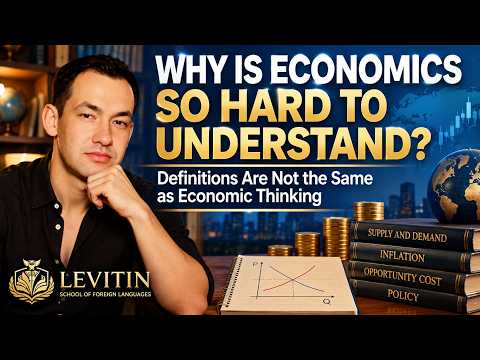
Why can a student define inflation, explain supply and demand, or describe opportunity cost — and still struggle to understand what happens when an economic situation changes?
In this video lesson, Tymur Levitin shows why economics is not simply a collection of definitions, formulas and graphs. Economic thinking begins when we follow relationships: scarcity → constraints → incentives → choices → trade-offs → interactions → consequences → feedback. Вставлений текст(20261008-23091… Вставлений текст(20261008-23091…
The central question is not only “What does this term mean?” but “What changes when conditions change — and what happens next?” This approach turns economics from a vocabulary test into a way of reasoning about human choices, systems and consequences. Вставлений текст(20261008-23091…
Read the full article:
Why Is Economics So Hard to Understand? Because Definitions Are Not the Same as Economic Thinking
Continue learning Economics:
Online Economics Lessons — understand systems, choices and consequences
Economics + English:
Learning Economics in English Online: Understanding How the World Really Works
Economics + German:
Economics in German — Understand How the World Works Through Fachsprache
Related Articles
Why Is History So Hard to Study? Because Memorizing Dates Is Not the Same as Understanding History — a connected exploration of causality, conditions, actors, decisions, consequences and evidence. The Economics article itself establishes this connection between historical and economic reasoning.
I Understand Math When Someone Explains It, but I Can’t Solve Problems Alone — Why? — connected through the distinction between recognizing an explained solution and independently generating an analysis.