Mathematics · Problem Solving · Critical Thinking
Video Lesson №24 | Levitin Language School
By Tymur Levitin
Can Every Math Problem Have One Correct Answer?
A student reads a familiar school question:
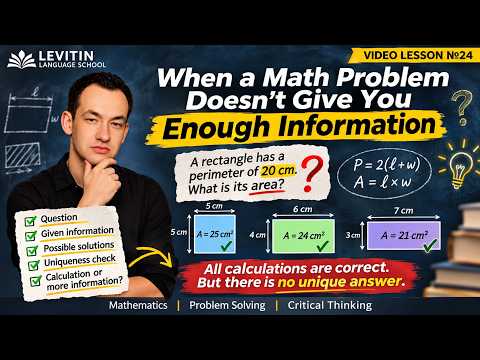
“A rectangle has a perimeter of 20 cm. What is its area?”
The formulas are simple. The arithmetic is familiar. But there is a problem: the information does not determine one unique area.
This video lesson explores an important distinction in mathematics: knowing how to calculate is not the same as knowing whether a calculation is justified.
Sometimes the most important step in solving a problem is recognising what the given information does—and does not—allow us to determine.
Watch Video Lesson №24
When a Math Problem Doesn’t Give You Enough Information
The YouTube video will be embedded here after publication.
In this short English-language lesson, we examine why several mathematically correct calculations can lead to different answers without contradicting the original conditions.
The Rectangle Problem: What Do We Actually Know?
The question gives us a perimeter of 20 centimetres.
For a rectangle:
Perimeter = 2 × (length + width)
Therefore:
2 × (length + width) = 20
Length + width = 10 cm
We know the sum of the two side lengths. But we do not know their individual values.
Now consider three possibilities:
| Length | Width | Perimeter | Area |
|---|---|---|---|
| 5 cm | 5 cm | 20 cm | 25 cm² |
| 6 cm | 4 cm | 20 cm | 24 cm² |
| 7 cm | 3 cm | 20 cm | 21 cm² |
All three shapes satisfy the given perimeter condition.
All three area calculations are correct.
But the areas are different.
The perimeter alone does not determine one unique area.
The first example is a square, which is also a rectangle. The other examples demonstrate that different side-length combinations can satisfy exactly the same perimeter condition.
Why a Correct Calculation May Not Be a Complete Answer
The area formula is:
Area = length × width
The formula is correct. But it does not supply missing side lengths.
If a student chooses 5 cm and 5 cm without justification, the resulting area of 25 cm² is mathematically valid for that particular shape. It is not necessarily the area of the rectangle described by the question.
This distinction separates three different ideas:
- A calculation can be arithmetically correct.
- A possible answer can satisfy the given conditions.
- A unique answer must be determined by those conditions.
These statements are not interchangeable.
How Can We Prove That Information Is Insufficient?
We do not need to test every possible rectangle.
It is enough to construct two examples that satisfy the same given conditions but produce different areas.
For example:
5 × 5 = 25 cm²
6 × 4 = 24 cm²
Both rectangles have a perimeter of 20 cm.
Because the requested area differs, the available information cannot determine a single unique answer.
This is a mathematical justification—not a refusal to solve the problem.
What Additional Information Would Help?
Suppose the question also tells us that the rectangle is 6 cm long.
Since the two side lengths must add up to 10 cm:
Width = 10 − 6 = 4 cm
Now the area can be uniquely determined:
Area = 6 × 4 = 24 cm²
Alternatively, if the problem explicitly states that the rectangle is a square, both sides must measure 5 cm, giving an area of 25 cm².
Different additional conditions may produce different answers.
The essential question is whether the conditions are sufficient for the conclusion being requested.
Five Steps Before Calculating
A useful problem-solving process is:
1. Identify the question. What exactly are we being asked to determine?
2. Examine the given information. Which facts and restrictions are explicitly stated?
3. Consider possible solutions. Could different situations satisfy the same conditions?
4. Check uniqueness. Do those situations necessarily produce the same requested result?
5. Calculate or request more information. Choose the next step based on what the conditions actually establish.
This approach is valuable in mathematics, science, data interpretation and everyday decision-making.
Is a Problem With Missing Information Always Wrong?
No.
Some mathematical questions deliberately provide insufficient information.
Their purpose may be to teach students how to identify missing conditions, construct counterexamples, recognise multiple solutions or explain why a conclusion cannot be justified.
In other tasks, students are expected to make reasonable assumptions and build estimates.
The important distinction is between an assumption that is openly stated and one that is silently treated as a given fact.
Recognising insufficient information is useful only when the student can explain why the information is insufficient.
Learning Mathematics Through Understanding
At Levitin Language School, individual online mathematics support focuses on more than memorising formulas or reproducing calculation procedures.
Students may need help understanding mathematical relationships, interpreting word problems, identifying relevant information or explaining their reasoning.
We also support learning academic subjects through different instructional languages, including English and German, depending on the student’s needs and teacher availability.
The goal is to connect mathematical knowledge with the ability to use it appropriately.
Before asking how to calculate the answer, ask whether the information allows you to determine one.
— Tymur Levitin
Continue Exploring
Read the full article:
The article examines insufficient conditions, multiple solutions, hidden assumptions and the difference between a calculation and a justified conclusion in greater depth.
Individual Online Learning at Levitin Language School
We provide individual online learning for children, teenagers and adults, including mathematics, academic subjects and language-supported subject learning.
Before lessons begin, we clarify the student’s learning goals, subject, preferred instructional language, schedule, teacher arrangements and pricing through written communication.
Explore: Levitin Language School | Language Learnings
Contact:
Telegram: @START_SCHOOL_TYMUR_LEVITIN
WhatsApp / Viber: +380932913429
Email: notification@levitintymur.com
Author: Tymur Levitin
Founder and Director, Levitin Language School
© Tymur Levitin. All rights reserved.