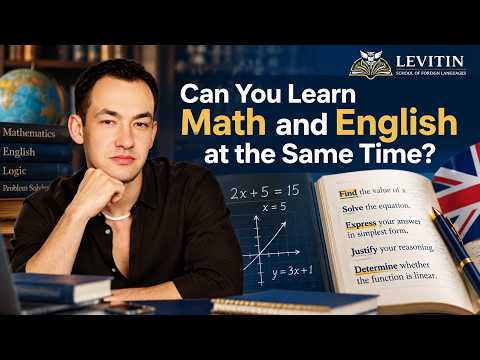
Video Lesson | Mathematics + English | Intermediate (B1–B2)
A student can understand mathematics — and still struggle with the same mathematics when the problem is presented in English.
That does not necessarily mean that the mathematics is too difficult. And it does not automatically mean that the student’s English is weak.
Sometimes the real difficulty lies somewhere between the two: the student has the mathematical knowledge but cannot yet access that knowledge efficiently through English.
This video lesson explores that difference and shows why learning mathematics through another language is much more than memorizing mathematical vocabulary.
Watch the Video Lesson
Can You Learn Math and English at the Same Time?
Language: English
English level: Intermediate (B1–B2)
Subject: Mathematics
Educational model: Language + Subject
Duration: approximately 3 minutes
Format: explanatory video lesson
Core idea:
Knowing mathematics ≠ being able to access mathematics through English.
One Problem Can Contain Two Different Problems
Consider a student who can solve an equation immediately when it is presented in their first language.
Now present a mathematically equivalent task in English.
The student hesitates.
What changed?
Not necessarily the mathematics.
The learner is now doing two things simultaneously:
understanding the mathematical structure
and
accessing that structure through English.
These processes interact, but they are not identical.
This distinction becomes especially important for students studying mathematics, physics, programming, economics, engineering or other academic subjects in a language that is not their first language.
A Small Language Difference Can Change the Mathematics
Compare these two instructions:
Increase the number by 20.
and:
Increase the number to 20.
Suppose the starting number is 50.
Increase by 20:
50 + 20 = 70
Increase to 20:
50 → 20
The vocabulary is almost identical.
The mathematical operation is not.
This is why academic language cannot always be treated as terminology added on top of an already completed subject.
Language participates in the construction of the problem itself.
A Wrong Answer Is Not a Diagnosis
When a student produces the wrong answer, there may be several different causes.
The learner may not understand the English formulation.
Or the language may be completely clear while the mathematical concept is not.
The learner may understand both but not know the required procedure.
Or the procedure may be known, while the student fails to recognize that this particular problem requires it.
That gives us at least four different layers to examine:
Linguistic understanding — What does the sentence mean?
Conceptual understanding — What mathematical idea is involved?
Procedural knowledge — Can the learner perform the required mathematical operation?
Strategic recognition — Can the learner identify which method is appropriate here?
One incorrect answer can therefore represent several entirely different learning problems.
That is why effective Language + Subject teaching requires diagnosis rather than assumption.
Mathematical Vocabulary Is Not Enough
Learning words such as:
addition,
subtraction,
multiplication,
division,
fraction,
equation
can certainly be useful.
But knowing those terms does not mean that a student can study mathematics through English.
There is a substantial difference between knowing that fraction is an English mathematical word and being able to understand an explanation involving fractions, ask a question about them, solve a problem and justify the solution in English.
The first is vocabulary.
The second is access to knowledge through another language.
This distinction is developed in greater depth in our expert article Can You Learn Math and English at the Same Time? Why Language + Subject Learning Works.
When English Becomes Part of Mathematical Reasoning
Imagine that a student is working with a linear function.
The learner observes a graph and says:
As x increases by one unit, y increases by three units.
Then:
The rate of change is constant.
And finally:
Therefore, the relationship is linear.
Something important has happened.
The learner has moved between:
graph → mathematical relationship → English sentence → mathematical conclusion.
English is no longer simply being studied next to mathematics.
It is carrying the mathematical reasoning.
That is the point at which integrated learning becomes educationally interesting.
Why This Is Language + Subject Learning
At Levitin Language School, we distinguish three connected educational layers:
Languages
Academic Subjects
Language + Subject
The third layer is not simply an English lesson followed by a mathematics lesson.
The learner must coordinate subject knowledge with linguistic access.
In mathematics, that can mean moving between symbols, diagrams, graphs, instructions, explanations and arguments while using another language as the working environment.
Students interested specifically in this interdisciplinary route can also explore Learn English Through Math and Science and the broader Learn Languages Through School Subjects direction.
For mathematics itself, our ecosystem also includes Online Mathematics Tutoring for School, University, and International Education.
Who Is This Video Lesson For?
This lesson is designed primarily for learners with Intermediate English (B1–B2).
At this level, students can already work with connected English explanations, but academic formulations may still slow down access to knowledge. That makes the B1–B2 range particularly useful for demonstrating the difference between knowing English conversationally and using English as an intellectual working language.
The lesson is especially relevant for students who:
- already understand mathematics in their first language but need to study it in English;
- are moving between national or international education systems;
- study mathematics, science, technology, economics or related subjects in English;
- understand mathematical procedures but struggle with English word problems;
- want to develop academic English through meaningful subject content rather than isolated exercises.
For learners who need broader English development alongside this work, see English lessons at Levitin Language School. The current English page covers individual learning across different levels and goals. LANGUAGE SCHOOL by TYMUR LEVITIN
For the U.S. ecosystem, Language Learnings also includes English among its language-learning directions. languagelearnings.com
What You Learn in This Lesson
By the end of the video, the learner should be able to understand an important distinction:
a difficulty with mathematics in English is not automatically a difficulty with mathematics itself.
The learner also encounters practical academic English connected with mathematical reasoning, including:
increase by / increase to
rate of change
constant
relationship
linear
solve
compare
explain
justify
But these expressions are not presented as a vocabulary list.
They appear because the mathematics requires them.
That difference is fundamental.
The Deeper Learning Goal
The long-term objective is not:
English → first language → mathematics → answer
every time a learner encounters a mathematical problem.
As proficiency develops, another pathway becomes increasingly possible:
English → mathematical meaning → reasoning → answer
Translation can still be useful.
The goal is not to prohibit it.
The goal is to make it less necessary when the learner already possesses the underlying mathematical knowledge.
This is where learning another language becomes more than acquiring words.
It becomes the development of another route into knowledge.
Key Takeaway
Vocabulary gives you terms. Language gives you access.
Learning mathematics and English at the same time works when neither side of the combination is reduced to decoration.
The mathematics must remain mathematically real.
The English must remain functionally necessary.
When both conditions are present, the learner is not merely studying English vocabulary connected with mathematics.
The learner is developing the ability to access, use, explain and construct mathematical knowledge through English.
That is the difference between learning words in another language and learning to think through another language.
Continue Learning
Read the full expert analysis:
Can You Learn Math and English at the Same Time? Why Language + Subject Learning Works
Develop your English:
Learn English with Levitin Language School LANGUAGE SCHOOL by TYMUR LEVITIN
Explore the interdisciplinary route:
Learn English Through Math and Science
Explore the complete Language + Subject model:
Learn Languages Through School Subjects
Explore mathematics as an academic subject:
Online Mathematics Tutoring for School, University, and International Education
Explore the U.S. language-learning direction:
Language Learnings languagelearnings.com
About the Author
Tymur Levitin
Founder & Director of Levitin Language School and Language Learnings
Language educator, certified translator and author
His educational work connects language learning, academic subjects and interdisciplinary Language + Subject learning, with particular attention to how learners understand, transfer and use knowledge rather than simply reproduce terminology.
© Tymur Levitin. All rights reserved.