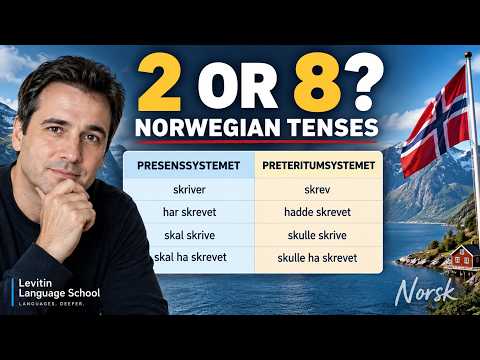
Does Norwegian have two tenses, eight tenses — or something else entirely?
This Russian-language video lesson shows why apparently contradictory answers can both make sense.
The key is not to begin with a number.
The key is to ask:
What exactly are we counting?
Language studied: Norwegian
Explanation language: Russian
For: Russian-speaking learners and learners who use Russian as a study language
Level: A2–B1+
Topic: Norwegian tense system, verb forms, perfect and future constructions
Format: Video lesson
Teacher: Tymur Levitin
Why can Norwegian have “2” and “8” tenses?
Consider the basic contrast:
skriver — skrev
Here the lexical verb itself shows a fundamental opposition between:
presens — present
and:
preteritum — preterite
If we are counting the basic tense distinction morphologically expressed on the finite verb, a two-way system is meaningful.
But Norwegian can build more complex temporal relationships:
har skrevet — hadde skrevet
skal skrive — skulle skrive
skal ha skrevet — skulle ha skrevet
Now we are no longer counting only two simple forms of skrive.
We are looking at larger grammatical constructions.
The system behind the number 8
One useful way of organising these constructions is through two parallel systems:
PRESENSSYSTEMET
- skriver
- har skrevet
- skal skrive
- skal ha skrevet
PRETERITUMSYSTEMET
- skrev
- hadde skrevet
- skulle skrive
- skulle ha skrevet
This gives us an eight-cell architecture:
presens ↔ preteritum
presens perfektum ↔ preteritum perfektum
presens futurum ↔ preteritum futurum
presens futurum perfektum ↔ preteritum futurum perfektum
The important point is that 2 and 8 are not necessarily competing answers.
They can result from counting different grammatical units.
Time is not the same thing as tense
Now consider:
Jeg reiser i morgen.
The event is in the future.
But reiser is morphologically present.
So:
FORM: present
TIME REFERENCE: future
This small sentence exposes a much larger principle:
grammatical tense ≠ time of the event
A language does not need a unique inflection on the lexical verb for every temporal meaning it can express. Norwegian can refer to future events through the present, constructions with skal, vil, kommer til å, and context.
So how many tenses does Norwegian really have?
Before choosing a number, define the unit.
Are we counting:
morphological tense forms?
or:
finite temporal verb-phrase categories?
or simply:
ways of referring to time?
Those are different questions.
And that is why learning a longer list of tense names does not necessarily give us a better model of Norwegian.
Sometimes the solution is not more rules.
It is higher resolution.
Watch the Video Lesson
The video explanation is in Russian:
Watch: How Many Tenses Does Norwegian Have — 2 or 8?
Continue with the Full Analysis
The video introduces the central model. For a much deeper treatment of Norwegian tense, time reference, perfect constructions, future meaning and the question of what exactly we are counting, continue with the full analysis.
If you watched the video in Russian, continue in Russian:
Or read the independent English analysis:
How Many Tenses Does Norwegian Really Have? The Question Is Harder Than the Number
Another Norwegian Video Lesson
A different problem reveals the same larger principle: translation can preserve the general meaning while hiding how Norwegian itself structures that meaning.
På telefon vs i telefonen — Explained in Russian
Learn Norwegian
Learn Norwegian — Levitin Language School
Norwegian Articles and Explanations
About Levitin Language School
At Levitin Language School, we do not treat grammar as a collection of isolated labels to memorise.
We examine how linguistic systems work: what a form encodes, what context contributes, which categories interact, and why two apparently contradictory explanations may simply be describing different levels of the same system.
Tymur Levitin
Founder & Lead Language Expert
Levitin Language School
Levitin Language School
Language Learnings
© 2026 Tymur Levitin. Levitin Language School. All rights reserved.