
You’ve probably heard the rule:
“Use ß after a long vowel, and ss after a short one.”
Sounds clear. Sounds logical.
But here’s the real question:
Can you actually hear the difference?
In this article, we’ll break down what the rule says, how it works in theory, what happens in real speech, and — most importantly — what students really need to know.
The Official Rule (Post-1996 Reform)
| Before… | You write… | Example |
|---|---|---|
| Long vowel or diphthong | ß | Straße, heißen |
| Short vowel | ss | müssen, dass |
That’s it. This is the rule that replaced the older spelling system, where ß was used almost everywhere.
After the reform, muß became muss, and daß became dass.
So far, so good.
What About the Old Spelling?
Before 1996, especially in Germany and Austria:
- ß was used even after short vowels
- You would see: daß, muß, Fluß
After 1996 (and fully enforced by 2006), these forms were officially considered outdated or even incorrect in formal German.
But here’s where it gets more complicated…
Switzerland: No ß at All
In Switzerland and Liechtenstein, ß is not used at all.
| Country | Usage |
|---|---|
| Germany | Yes (new rule) |
| Austria | Yes (less strict) |
| Switzerland | ❌ Always uses ss |
So in Zürich, Straße becomes Strasse, and no one sees that as a mistake.
But… Can You Hear the Difference?
No.
You cannot hear the difference between:
- muss and muß
- dass and daß
- Fluss and Fluß
In all cases, the sound is [s].
And since German doesn’t have a strong contrast between voiced and voiceless s, or between long and short vowels in natural speech — the spelling is mostly visual.
Why This Confuses Learners
Because students try to match writing and speaking.
They think:
“If it’s spelled differently, it must sound different.”
But with ß and ss, that’s not true.
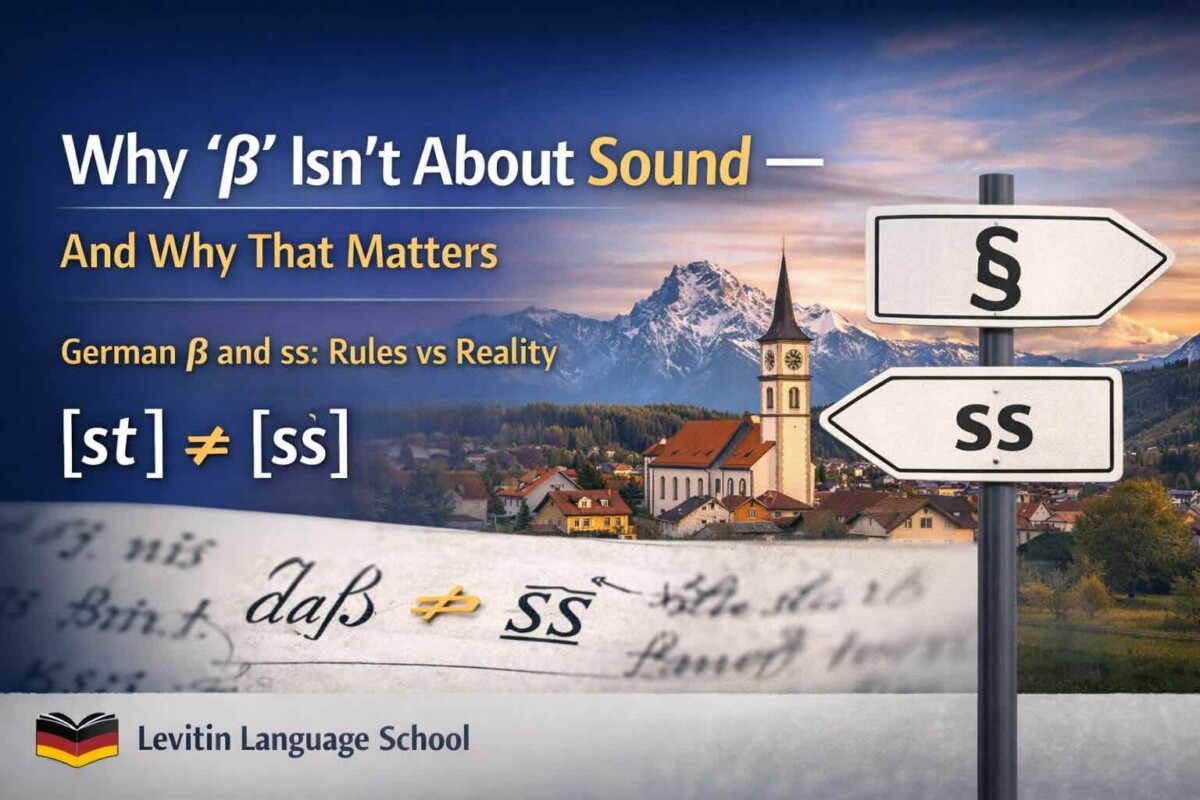
You won’t hear the rule. You can only see it.
How I Explain It to My Students
I say this:
“This rule is not for your ears.
It’s for your eyes — and your writing.
When you speak, just pronounce [s].
But when you write, think:– If the vowel is long or stretched → write ß
– If the vowel is short and closed → write ssYou don’t need to count milliseconds. Just feel it.
If you say it cleanly and firmly, it’s probably long.
If you say it quickly and lightly, it’s probably short.”
This way, students learn not to stress about rules — but to use them intuitively.
Table: Writing vs Sound
| Word | Sound | Spelling (Germany) | Spelling (Switzerland) |
|---|---|---|---|
| Straße | [ˈʃtraːsə] | ß | ss → Strasse |
| müssen | [ˈmʏsən] | ss | ss |
| heißen | [ˈhaɪsən] | ß | ss → heissen |
| dass | [das] | ss | ss |
| daß | [das] | ❌ outdated | ❌ not used |
Final Thought
So, is ß important?
- ❗ Yes — if you’re writing German in Germany or Austria.
- ❗ Yes — in official texts, emails, resumes, or exams.
- ❌ No — in conversation, audio, speaking, or listening.
German isn’t always logic on paper.
Sometimes it’s rhythm, feeling, and flow.
And that’s where real language begins.
Author: Tymur Levitin — founder, director and lead teacher at Levitin Language School / Start Language School by Tymur Levitin
© Tymur Levitin