
👉 Choose your language:
https://levitintymur.com/#languages
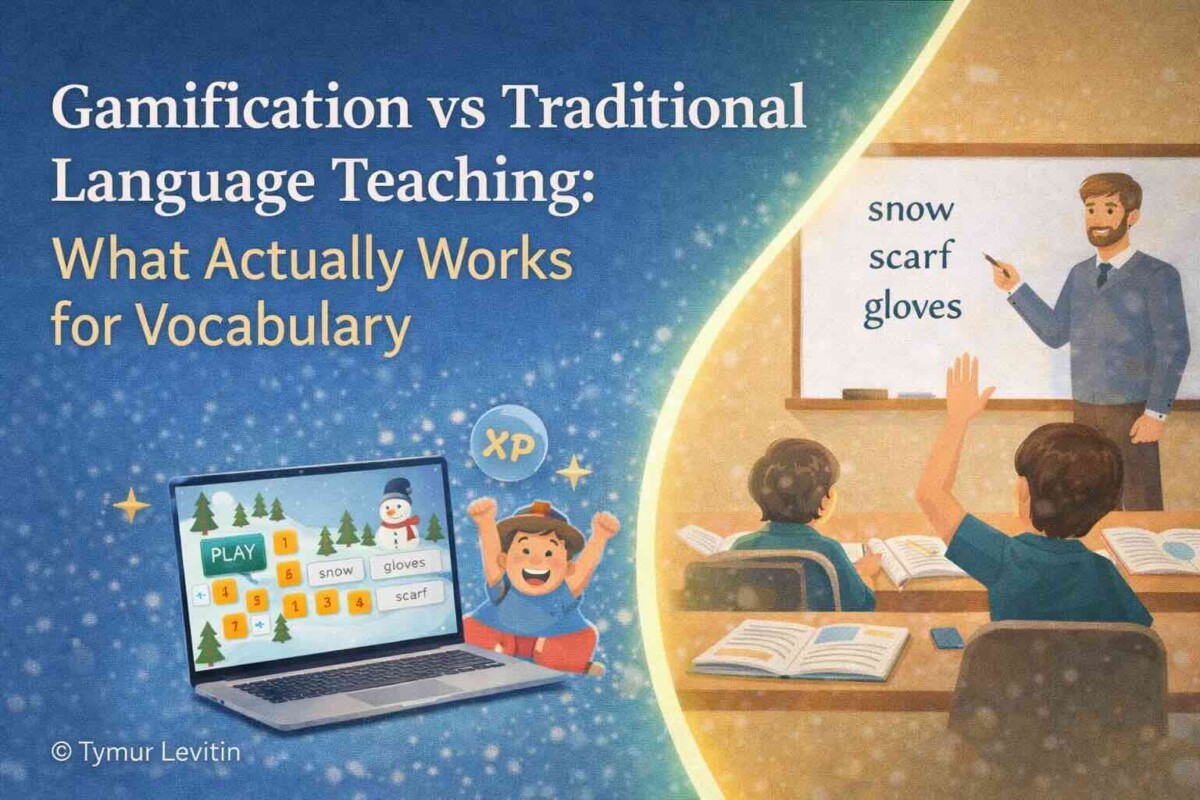
Two Approaches to Language Learning
For decades, language teaching relied on traditional classroom methods:
- memorizing vocabulary lists
- repeating words after the teacher
- completing written exercises
- translating sentences
These methods provide structure, but they often lack engagement.
Many students remember words only long enough to pass a test.
Gamification introduces a different approach.
Instead of passive memorization, learners interact with language through challenges, levels, and immediate feedback.
Why Traditional Memorization Often Fails
The human brain is not designed to store isolated information for long periods.
When students memorize lists such as:
snow
scarf
gloves
fireplace
the words remain disconnected.
Without context, the brain quickly discards them.
That is why many learners forget vocabulary shortly after studying it.
What Gamification Changes
Gamification transforms learning into an active experience.
Instead of memorizing, learners must:
- recognize vocabulary in context
- react quickly to prompts
- repeat actions across levels
- connect words to visual situations
This activates multiple cognitive pathways.
The result is deeper retention and faster recall.
Motivation and Progress
Another advantage of gamification is visible progress.
Traditional learning often feels endless.
Games introduce:
- levels
- achievements
- gradual difficulty
- immediate feedback
Each completed step reinforces motivation.
The Most Effective Approach: Combination
Gamification alone is not a full teaching system.
Traditional teaching alone is often too passive.
The strongest results appear when both approaches work together.
A teacher provides explanation and structure.
A game provides repetition and engagement.
How We Apply This at Levitin Language School
At Levitin Language School, we combine structured teaching with interactive learning tools.
Our Winter Vocabulary Game was designed to reinforce vocabulary through progressive levels and contextual learning.
👉 Try our Winter Vocabulary Game here:
https://levitintymur.com/games-to-learn-english/
Students move through 25 levels while encountering vocabulary repeatedly in meaningful situations.
This supports the transition from recognition to confident use.
The Future of Language Learning
Language education continues to evolve.
The most effective systems will not abandon traditional teaching — but they will enhance it through interactive learning experiences.
Gamification is not a replacement for teachers.
It is a powerful tool that makes vocabulary come alive.
© Tymur Levitin — founder, director, and lead teacher at Levitin Language School
Global Learning. Personal Approach.