
Introduction
When people speak about “medical English”, they often imagine conversations between doctors and patients.
In reality, modern healthcare operates through a far more complex communication system.
Hospitals, pharmaceutical companies, regulators, insurance systems and international research organizations must coordinate their work every day. This coordination requires a professional language that combines medicine, management, economics and logistics.
Healthcare therefore has its own professional vocabulary — a language used in boardrooms, international conferences, regulatory meetings and strategic planning sessions.
Understanding this language is essential not only for doctors but also for executives, managers, analysts and researchers working in global healthcare systems.
Healthcare Is One of the Most Complex Professional Environments
Few industries require such close cooperation between different professional domains.
A single medical innovation may involve:
- clinical researchers
- hospital administrators
- pharmaceutical companies
- regulatory agencies
- health insurers
- global logistics networks
Each of these groups uses specific terminology, but they must still communicate effectively.
For this reason, healthcare management has developed a vocabulary that combines:
- medicine
- business strategy
- law and regulation
- technology
- logistics
This hybrid language is the real working language of global healthcare.
The Language of Hospital Administration
Hospital management operates on principles similar to those used in large corporations.
However, the stakes are much higher because decisions directly affect patient care.
Common expressions used in hospital administration include:
healthcare system
The network of hospitals, clinics, insurance systems and public health institutions.
hospital administration
The management structure responsible for operating a hospital.
patient flow management
The process of organizing patient movement through departments.
capacity planning
Planning hospital resources to meet patient demand.
clinical governance
Systems that ensure medical quality and patient safety.
Example:
Effective patient flow management improves both efficiency and quality of care.
Communication Between Hospitals and Pharmaceutical Companies
Pharmaceutical companies work closely with healthcare providers.
Their discussions rarely focus only on medicines themselves. Instead, they include broader topics such as:
- treatment protocols
- hospital procurement
- reimbursement systems
- long-term patient outcomes
Typical expressions include:
treatment pathway
A structured plan describing how patients are treated.
hospital procurement
The process through which hospitals purchase medical products.
reimbursement policy
Rules determining how treatments are financially covered.
clinical outcomes
Measurable results of medical treatment.
Example:
The reimbursement policy determines whether hospitals can adopt the new therapy.
Technology and Digital Healthcare Vocabulary
Healthcare is increasingly shaped by digital technologies.
New terminology has emerged to describe these systems.
Important terms include:
electronic health records (EHR)
Digital systems storing patient information.
health data interoperability
The ability of different healthcare systems to exchange data.
telemedicine platform
Technology enabling remote medical consultations.
medical data analytics
The analysis of large healthcare datasets to improve treatment.
Example:
Health data interoperability allows hospitals to share patient records securely.
The Language of Healthcare Logistics
Modern medicine relies on global logistics networks.
Vaccines, medicines and medical devices must be transported safely and efficiently.
Important logistics terminology includes:
medical supply chain
The global system delivering medical products.
cold chain logistics
Temperature-controlled transportation used for vaccines and biological medicines.
inventory management
Monitoring hospital stock of medicines and equipment.
last-mile medical delivery
The final stage of delivering medical products to hospitals or patients.
Example:
Cold chain logistics is essential for transporting temperature-sensitive vaccines.
Why Professional Healthcare English Matters
Healthcare professionals often understand medical research in English, but international meetings require a broader vocabulary.
In global healthcare environments, professionals must discuss:
- regulatory decisions
- financial planning
- clinical research
- digital health technologies
- global logistics
Without familiarity with this professional vocabulary, communication becomes slow and inefficient.
Mastering the language of healthcare management therefore allows professionals to participate fully in international discussions and strategic decision-making.
Language as Infrastructure in Global Healthcare
Hospitals and pharmaceutical companies invest enormous resources into technology, research and logistics.
Yet communication remains the invisible infrastructure that connects all these systems.
Professional language allows experts from different countries and disciplines to collaborate effectively.
In this sense, mastering healthcare vocabulary is not simply about learning new words.
It is about understanding how modern medicine itself functions.
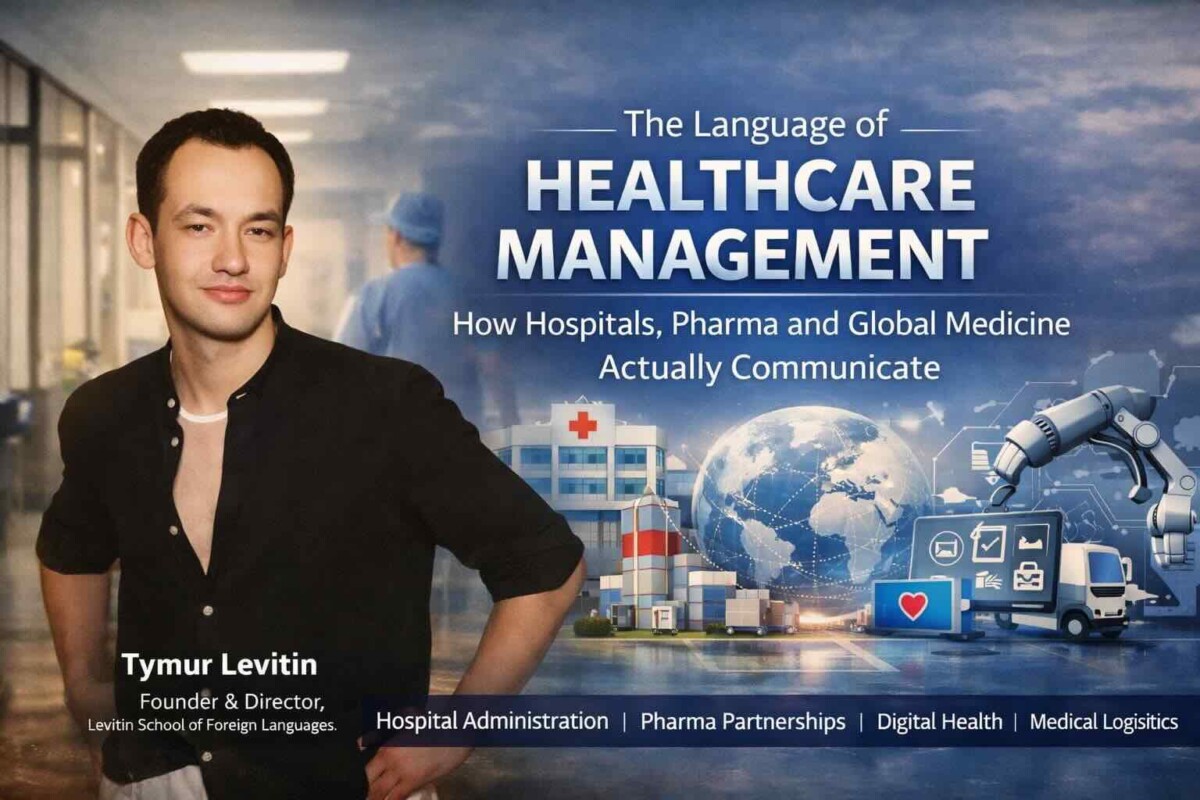
Author: Tymur Levitin
Founder & Director, Levitin Language School
© Tymur Levitin