
In education, people are often told that a school becomes “strong” only when it grows into a system that no longer depends on one person. On paper, that sounds rational. In reality, it often means something else: more layers, more distance, more bureaucracy, and less responsibility.
Levitin Language School was built differently.
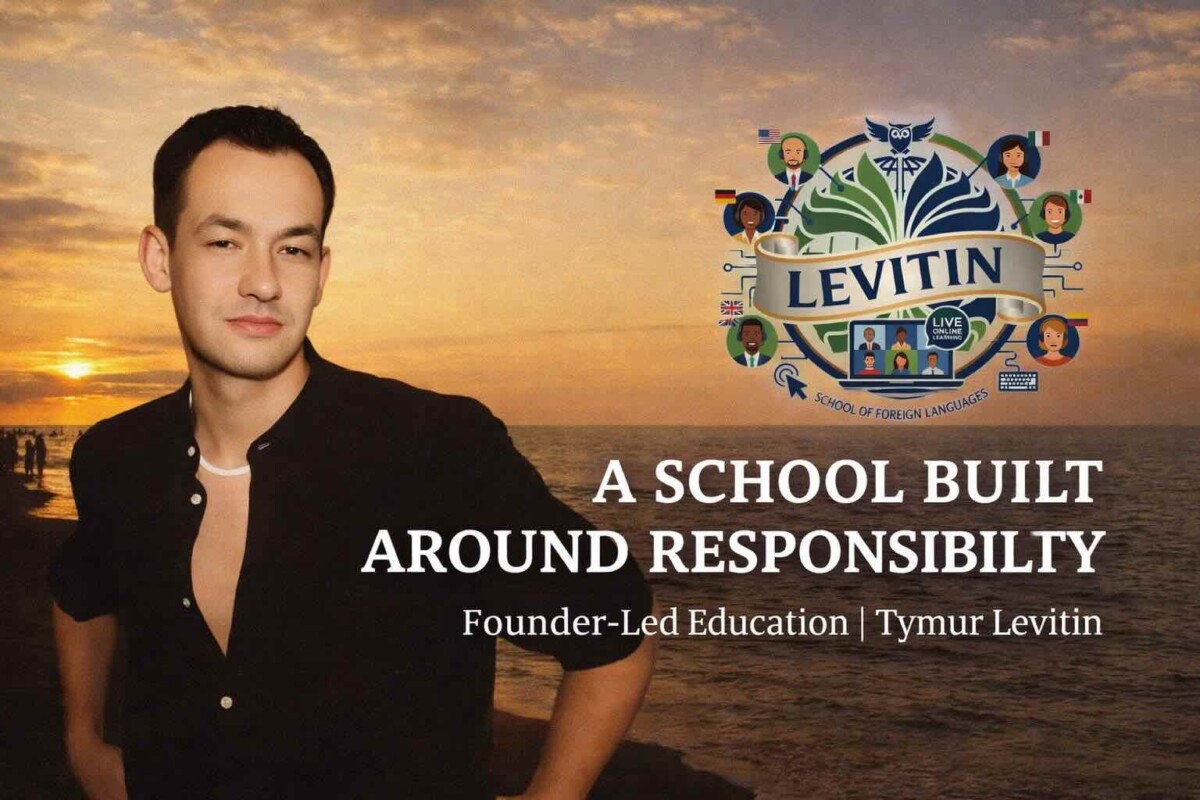
Yes, the school is built around me — Tymur Levitin. That is not an accident. That is not a temporary flaw. That is not a management failure. It is a conscious model.
I am the founder, director, senior teacher, strategist, and the person who carries the academic, organisational, and ethical responsibility of the school. I work directly with students, select teachers, supervise quality, solve difficult situations, structure the educational logic, build the content system, and shape the standards behind everything we publish and everything we teach.
This is exactly why the school remains coherent.
And this is exactly why I do not consider this structure a weakness.
Education Is Not a Factory
Many language schools today are not really schools in the deep sense of the word. They are education businesses built by people who know how to sell learning, package learning, automate learning, and scale learning — but not necessarily how to teach it well.
That difference matters.
When education is built primarily as a commercial mechanism, the centre of gravity shifts. The key question is no longer “What does this student actually need?” but “How do we process more people more quickly?” Once that happens, quality begins to erode quietly.
The website may look polished. The manager may sound confident. The branding may be modern. But underneath it, the system often depends on scripts, simplified promises, interchangeable staff, and delegated responsibility.
That is not how I work.
I did not build Levitin Language School as a language factory. I built it as a school where decisions still have a human source, where teaching still has intellectual integrity, and where responsibility still has a name.
One Person at the Centre Means One Standard at the Centre
There is a difference between dependence and authorship.
A weak system collapses because it has no structure. An author-led system holds together because it has one clear logic, one standard, and one accountable centre.
That is the model of Levitin Language School.
I do not stand outside the process as a distant owner. I am inside it every day.
I am involved in:
- communication with students;
- teacher selection and evaluation;
- academic positioning;
- quality control;
- strategic planning;
- difficult case resolution;
- payment logic and organisational clarity;
- content architecture across platforms;
- article strategy, educational texts, and methodological direction.
Even the website is filled and shaped through my logic. I do not personally code it, because development is handled by one specialist, but the educational meaning, structure, content direction, positioning, and practical purpose are defined by me. The same applies to our articles, video lessons, educational materials, and communication system. Their strength comes not from quantity, but from consistency.
That consistency exists because the school is not fragmented.
Why I Deliberately Keep Control
Some people see personal control and assume it means lack of scale. I see it differently.
In education, once too many hands touch the core of the system, the original meaning is usually lost. Standards become blurred. Tone changes. Responsibility gets diluted. Mistakes multiply. No one knows where a problem started, and no one truly owns the outcome.
That is one of the reasons I have chosen this model consciously.
I have seen too many cases where once control is spread thoughtlessly, quality disappears. Everything begins to look active, but less and less actually works. Someone answers part of one issue, someone else changes another piece, someone publishes something without understanding the full context, a third person interferes with communication, and eventually the entire system loses both clarity and trust.
Then the real damage begins: not only in organisation, but in reputation.
And reputation in education is not a decorative extra. It is the foundation.
A language school can survive an imperfect banner. It can survive a delayed post. It can survive a technical issue. But it cannot survive the loss of trust.
That is why I prefer a school where the chain of responsibility remains visible.
Personal Responsibility Is Slower — But Stronger
I will say something that may sound unpopular in a culture obsessed with scaling.
A school that is personally supervised by its founder is often slower than a corporate structure.
But slower does not mean weaker.
Slower can mean more careful. More honest. More precise. More responsible.
I do not promise what I cannot control. I do not build false “teams” around empty labels. I do not create layers of management just to imitate size. I do not hide behind assistants, scripts, or vague processes when a student needs a real answer.
If there is a problem, I deal with it.
If there is a mismatch, I address it.
If a teacher needs guidance, I give it.
If a student needs clarity, I provide it.
If the school makes a promise, I carry the burden of that promise personally.
That is not corporate efficiency. That is educational responsibility.
And I believe students feel that difference.
The Real Alternative to Bureaucratic Education
There is a sentence that reflects my position better than any corporate mission statement ever could:
Bureaucracy explains problems. Responsibility solves them.
This is not just a phrase. It is the operating principle behind the school.
In many organisations, when something goes wrong, the system produces explanations. There are policies, internal handovers, unclear chains of authority, or someone who was “not informed.” Everyone can describe the problem, but no one fully solves it.
I have no interest in building such a model.
At Levitin Language School, the goal is not to create an impressive structure around education. The goal is to protect the quality of education itself.
That means fewer empty layers and more real accountability.
That means less imitation of scale and more meaningful control.
That means a school where the founder is not a symbolic face, but the active source of standards.
Why This Matters for Students
From the outside, many schools can look similar. They all mention flexibility, professionalism, individual approach, and qualified teachers. Those phrases have become so common that they often mean very little on their own.
What matters is what stands behind them.
When a student comes to Levitin Language School, they are not entering a system where their case is passed from one disconnected role to another. They enter a school where the logic of teaching, selection, communication, and quality is tied together.
This gives students several practical advantages.
First, there is coherence. The person responsible for the school understands not only language teaching in general, but also the exact academic and methodological direction of the school.
Second, there is continuity. The educational logic does not change every time a new manager, coordinator, or content person appears.
Third, there is accountability. A real person stands behind the promise.
And fourth, there is intellectual integrity. The school is not built around selling a quick illusion. It is built around helping people learn in a real and lasting way.
That distinction is central to everything we do.
You can see that same logic in our broader educational philosophy on the main website at LevitinTymur.com, where the school is presented not as a mass product, but as a structured learning ecosystem built around real teaching.
Why I Did Not Build a “Bigger Team” Around the Core
This is another point worth stating honestly.
Could I add more people around the administrative and content core? Technically, yes.
But the real question is not whether something can be expanded. The real question is whether expansion would preserve quality or destroy it.
Too often, people assume that more participants automatically mean more strength. In reality, poorly controlled expansion often creates confusion, weakens standards, and produces exactly the kind of disorder that serious students do not need.
I would rather keep the centre strong than make it noisy.
That is why the school’s operational core remains concentrated.
The American side of the broader ecosystem develops separately in its own direction. The US website and its social media channels have their own rhythm. But the central body of the school’s work — content, communication, structure, educational logic, teacher coordination, student interaction, problem-solving, and strategic development — remains under my direct control.
This is not because I cannot delegate blindly.
It is because I understand the cost of careless delegation.
A School With a Human Face
There is also a deeper reason behind this model.
I believe people are tired of faceless systems.
They are tired of trying to study in places where no one truly sees them, no one fully understands their situation, and no one can make a final responsible decision.
A school should not feel like a support ticket system.
A school should feel like a place where somebody actually knows what they are doing, cares what happens next, and is prepared to stand behind the result.
That is what I want Levitin Language School to remain.
Not the biggest. Not the loudest. Not the most automated.
But real.
Clear.
Responsible.
Human.
This Model Is Demanding — and That Is the Price of Integrity
I am fully aware that this model is demanding.
It requires energy. It requires discipline. It requires constant attention. It is easier to build a structure where responsibility is diluted than one where responsibility is personal.
But I chose this path consciously.
I chose it because I do not want to build a school that looks efficient while losing its soul.
I chose it because I know that quality in education is fragile, and once you hand the core to people who do not think, teach, evaluate, and protect the process the same way, the damage begins quickly.
I chose it because order matters.
And I chose it because in education, especially online, trust is built not by volume, but by consistency.
We Do Not Offer a Corporate Illusion. We Offer a Responsible School.
Levitin Language School is not built to impress investors, imitate scale, or hide weakness behind departments.
It is built around a simpler and harder principle:
someone must truly be responsible.
In this school, that someone is me.
For some people, that may sound unusual. For me, it is the only honest way to build an educational system that preserves quality, logic, and trust.
The school is personal because responsibility is personal.
The school is coherent because its centre is coherent.
And the school works precisely because it is not run like a detached commercial machine.
If you want a factory, there are many options.
If you want a school where the founder still thinks, teaches, supervises, and stands behind what is being done, then you have understood what Levitin Language School is.
Related Reading
If this approach resonates with you, these articles will help you understand the broader philosophy behind the school:
- Why Choosing the Right Teacher Is Not About Endless Testing
- Why Too Many Rules Often Destroy Good Teaching
- Progress Without Pressure: How Adults Learn Languages Without Burnout
- The Main Website of Levitin Language School and Tymur Levitin
Final Thought
A school does not become strong when responsibility disappears into structure.
A school becomes strong when structure serves responsibility.
That is the difference.
And that is why this school is built the way it is.
Author: Tymur Levitin — Founder, Director and Senior Teacher, Levitin Language School
© Tymur Levitin