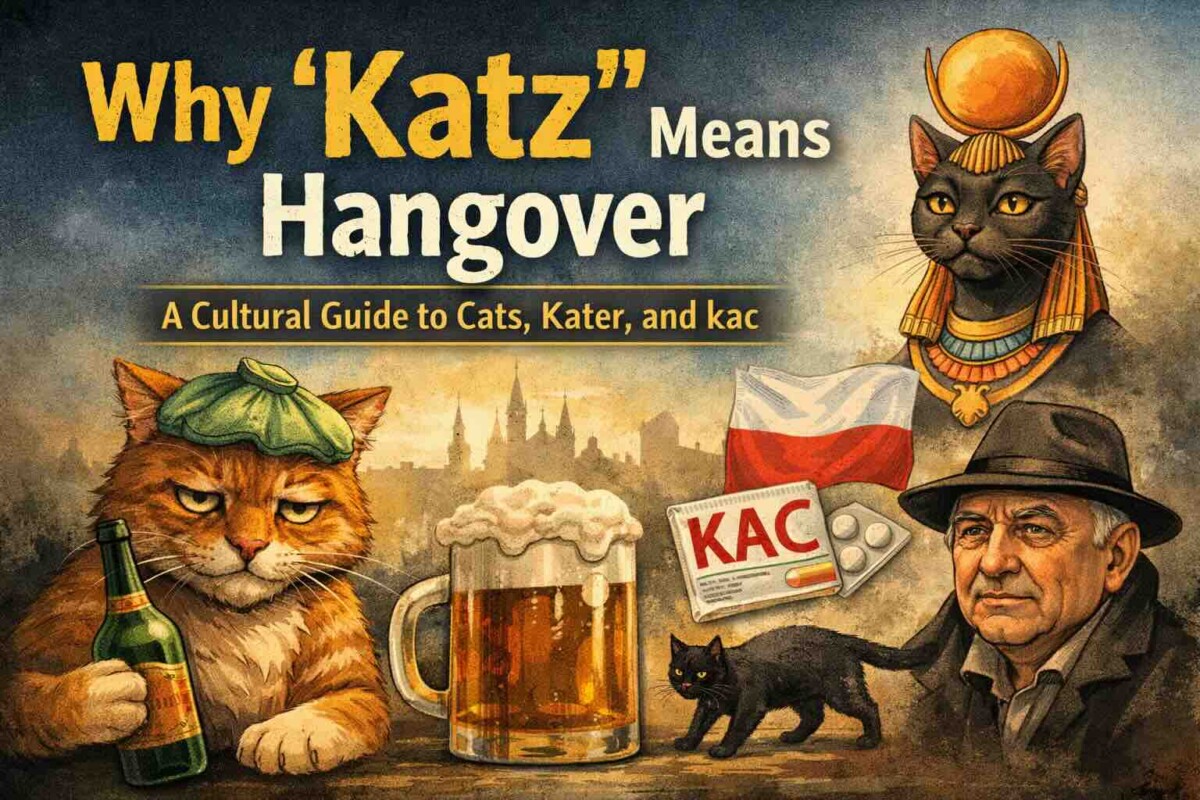

There are words that look simple.
And then there are words that open cultural trapdoors.
“Katz.”
In one language it sounds like a surname.
In another — like a cat.
In yet another — like the morning after a very bad decision.
This is not just a linguistic coincidence. It is a cultural map.
And once you see it, you cannot unsee it.
A Cat, a Hangover, and a Confusion
In Polish, kac means hangover.
In German, der Kater means both a male cat and a hangover.
In English, we say hangover — no cats involved.
In Russian and Ukrainian:
похмелье / похмілля — completely different roots.
Same human experience. Different imagery.
But why does German connect a cat to a hangover?
Because language does not describe reality.
It interprets it.
A Kater after a party is heavy, slow, irritated, sensitive to light, unproductive.
Like a grumpy tomcat dragged into daylight.
The metaphor stuck.
And once a metaphor sticks, it becomes grammar.
Katze, Kater, Kätzchen — and the Emotional Scale
In German:
- die Katze — cat (neutral)
- der Kater — male cat (and hangover)
- das Kätzchen — kitten (affectionate diminutive)
In English:
- cat
- kitten
In Russian:
- кот
- кошка
- котёнок
In Ukrainian:
- кіт
- кішка
- кошеня
In Polish:
- kot
- kotek
The root feels ancient, Indo-European, stable.
But meaning is never stable.
A kitten is tenderness.
A tomcat is independence.
A hangover is weakness.
One root. Three emotional layers.
Language compresses psychology into sound.
When “Katz” Becomes a Cultural Character
Now let’s shift from linguistics to culture.
In Russian-speaking pop culture, the name Kац became iconic through the film На Дерибасовской хорошая погода, или На Брайтон-Бич опять идут дожди.
The character repeatedly says, with unforgettable intonation:
“Кац предлагает сдаться…”
“Katz suggests surrender…”
Again.
And again.
And again.
The name becomes more than a name.
It becomes a meme.
“Katz” begins to symbolize:
- hesitation
- surrender
- cautious survival instinct
- ironic pragmatism
Notice something interesting.
The German Kater after a party also “suggests surrender.”
It lies down.
It avoids action.
It negotiates with reality from a horizontal position.
Different origins.
Different languages.
But the psychological imagery overlaps.
This is how culture quietly connects things that etymology does not.
From Sacred Cats to Superstitions
In Ancient Egypt, the cat was sacred — the goddess Bastet symbolized protection and grace.
In Japan, the maneki-neko invites luck.
In parts of Europe, a black cat crossing your path means misfortune.
In the UK, it can mean good luck.
Same animal. Opposite interpretations.
Language reflects belief.
Belief shapes metaphor.
Metaphor becomes idiom.
And idioms become invisible.
Drunk as a Skunk — Why Animals Carry Our Weakness
English says:
- drunk as a skunk
- drunk as a pig
Russian says:
- пьяный как свинья
- пьяный как сапожник
Ukrainian:
- п’яний як чіп
- п’яний як смерть
Polish:
- mieć kaca — to “have a hangover”
German:
- einen Kater haben — to “have a tomcat”
Animals absorb human excess.
We project weakness onto them.
Then we borrow them back into speech.
Katz as a Surname — A Different Layer
In Jewish tradition, Katz is a surname derived from Kohen Tzedek — “righteous priest.”
Completely unrelated to cats.
Completely unrelated to hangovers.
But phonetically identical.
This is the final twist:
Language does not care about our desire for neat systems.
It layers meaning.
It overlaps sound.
It creates coincidences that are not coincidences in cultural perception.
Why This Matters for Language Learning
If you only memorize vocabulary, you will learn that:
- Kater = hangover
- kac = hangover
But if you think, you will see:
- metaphor
- psychology
- history
- cinema
- religion
- collective memory
Real language is never literal.
It is cultural sediment.
And when you understand that, you stop translating word by word.
You start reading meaning between layers.
That is where fluency begins.
If you want to explore how cultural logic shapes German and English beyond grammar tables, start with real examples and real conversations.
At Levitin Language School, we teach languages the way they live — not the way they are printed.
Global Learning. Personal Approach.
Author: Tymur Levitin
Founder, Director and Lead Teacher
Levitin Language School
© Tymur Levitin