
Why language structure, logic, and responsibility define real education
In today’s global education system, academic integrity is often reduced to plagiarism policies, citation formats, and formal declarations.
But academic integrity is not paperwork.
It is not a technical requirement.
It is not a university formality.
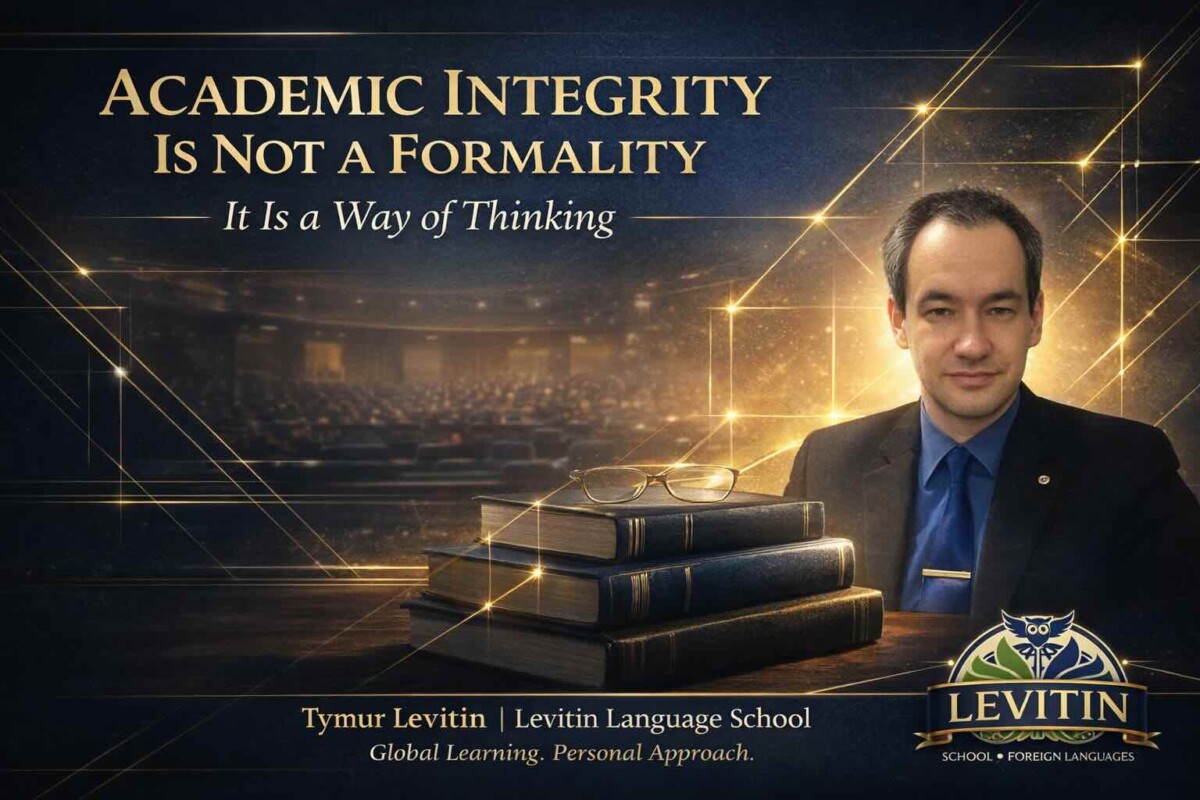
Academic integrity is a way of thinking.
And if a student does not understand how to structure thought through language, no policy will fix that.
At Levitin Language School, we approach academic learning differently. We do not separate language from logic. We do not separate communication from responsibility. We do not separate writing from thinking.
Because structured language builds structured minds.
What Academic Integrity Really Means
Most institutions define academic integrity as:
- avoiding plagiarism
- citing sources correctly
- submitting original work
- respecting academic standards
All of this is correct.
But these are consequences — not foundations.
The foundation is this:
Can a student express an idea clearly, logically, and independently?
If the answer is no, then copying becomes tempting.
Not because the student is dishonest —
but because the student does not yet know how to think in structure.
Language is not decoration.
Language is architecture.
Language as Structure: Why It Matters
When students study mathematics in Ukrainian, or professional communication in Ukrainian, something important happens:
They cannot hide behind memorized phrases.
They must:
- define terms precisely
- build arguments step by step
- distinguish assumption from fact
- justify conclusions
Mathematics enforces clarity.
Professional communication enforces responsibility.
Academic writing enforces logic.
And this is where integrity is born.
Not in rules —
but in structure.
Academic Writing Is Ethical Writing
Academic integrity also includes:
- acknowledging influence
- separating personal opinion from evidence
- understanding context
- avoiding manipulation
This is especially important in multilingual environments.
A student who studies in a second language often feels insecure.
Insecurity leads to simplification.
Simplification leads to distortion.
Structured academic language prevents distortion.
It teaches students to:
- slow down
- verify meaning
- question their own assumptions
- respect the reader
Integrity is not fear of punishment.
Integrity is intellectual discipline.
Why This Matters Internationally
In international education systems, many students move between languages:
English for global communication.
Ukrainian for academic or local context.
German for professional development.
If language training is isolated from academic responsibility, students struggle.
They may speak fluently —
but write poorly.
They may know vocabulary —
but fail to structure arguments.
They may pass tests —
but lack intellectual independence.
At Levitin Language School, we integrate:
- subject-based learning
- academic writing discipline
- structured communication
- multilingual awareness
Because education without structure produces noise.
Education with structure produces clarity.
The Role of Academic Ukrainian
For students studying or working in Ukraine, academic Ukrainian is not optional.
It is required for:
- university submissions
- professional documentation
- formal communication
- research and reporting
But academic Ukrainian is not about memorizing formal phrases.
It is about:
- precision
- hierarchy of ideas
- clear paragraph logic
- ethical citation and argumentation
And this is where structured instruction matters.
Not as a language course.
But as intellectual training.
Academic Integrity Is Personal
Policies do not create integrity.
Habits do.
If a student learns to:
- think before writing
- justify before concluding
- define before arguing
Then integrity becomes natural.
This is the level we work on.
Language as structure.
Structure as responsibility.
Responsibility as identity.
Because real education is not about passing.
It is about becoming capable.
Author: Tymur Levitin
Founder & Director, Levitin Language School
Global Learning. Personal Approach.
© Tymur Levitin