
The Language I Live — Author’s Column by Tymur Levitin
Language. Identity. Choice. Meaning.
One of the most persistent myths in language learning sounds deceptively simple:
“Don’t worry about accuracy. Just speak.”
It is often presented as a cure for fear, hesitation, and silence.
But in real life — and in real classrooms — this advice does more harm than good.
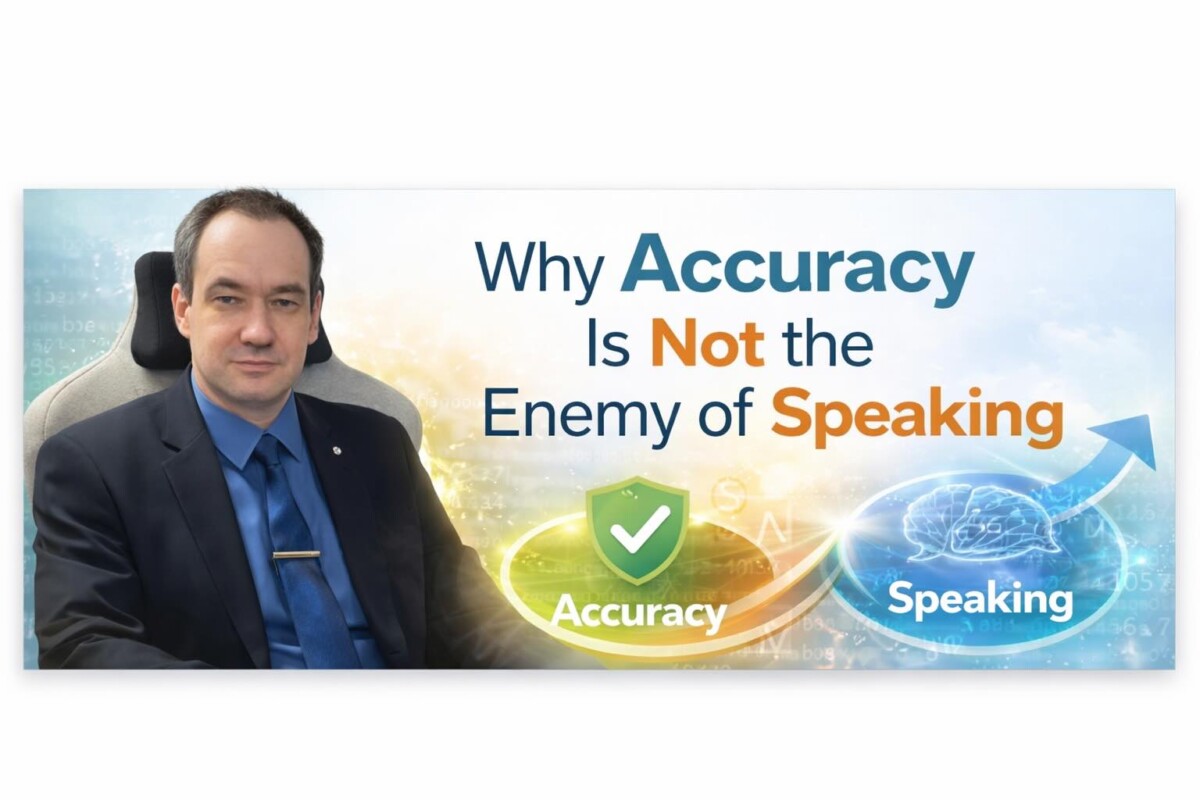
Because accuracy is not the enemy of speaking.
Misunderstanding what accuracy actually is — that’s the real problem.
The False Opposition: Fluency vs Accuracy
Many learners are taught to believe that they must choose:
- either fluency (speed, flow, confidence),
- or accuracy (correctness, structure, control).
As if these two were natural enemies.
They are not.
Fluency without accuracy is not freedom.
It is noise with confidence.
Accuracy without fluency is not mastery.
It is silence with knowledge.
Real language lives somewhere else.
What Accuracy Really Means (And What It Doesn’t)
Accuracy is often misunderstood as:
- perfection
- fear of mistakes
- constant self-correction
- academic obsession with rules
That is not accuracy.
Accuracy is orientation.
It is knowing where you are in the language.
When a speaker understands:
- what they are saying,
- why they are saying it this way,
- and what meaning their structure creates,
they stop being afraid of mistakes.
Because mistakes are no longer chaos —
they are signals.
Why “Just Speak” Often Backfires
I have seen this pattern hundreds of times.
A learner speaks a lot.
They speak confidently.
They speak incorrectly — consistently.
And after months or years, something strange happens:
They can no longer hear their own errors.
Why?
Because uncontrolled repetition does not create language thinking.
It creates automatisms.
And automatisms without awareness fossilize.
This is why many adult learners say:
“I’ve been speaking for years, but I feel stuck.”
They are not stuck because they care too much about accuracy.
They are stuck because they were taught not to care at all.
Accuracy as a Tool for Freedom
True accuracy does not slow speech down.
It does the opposite.
When you understand:
- tense logic,
- structural meaning,
- pragmatic boundaries,
- and cross-language differences,
your brain stops guessing.
It starts choosing.
And choice is the foundation of fluent speech.
Children, Adults, and the Dangerous Comparison
Children appear to speak freely without accuracy.
But children:
- receive constant correction,
- adapt subconsciously,
- and rebuild language systems daily.
Adults do not learn that way.
Adults already have:
- a completed linguistic system,
- conceptual categories,
- and thinking habits shaped by their native language.
Ignoring accuracy for adults is not “natural learning”.
It is methodological negligence.
Speaking Is Not Output. It Is Thinking Aloud.
This is the core misunderstanding.
Speaking is not just producing sounds.
It is real-time thinking through language.
And thinking requires structure.
Not rigidity.
Not perfection.
But orientation and meaning.
Accuracy gives the speaker a map.
Fluency is simply movement on that map.

When Accuracy Becomes the Enemy (And When It Doesn’t)
Accuracy becomes destructive only when:
- it is detached from meaning,
- imposed without explanation,
- or used to shame instead of guide.
But accuracy integrated into understanding:
- reduces fear,
- increases confidence,
- and accelerates speaking.
Not despite fluency —
but because of it.
The Quiet Paradox of Real Speech
The most fluent speakers I know are not reckless.
They pause when needed.
They adjust mid-sentence.
They reformulate naturally.
Not because they are afraid of mistakes —
but because they hear meaning.
That is accuracy in action.
Final Thought
You don’t become fluent by escaping accuracy.
You become fluent by making peace with it.
Accuracy is not a cage.
It is a compass.
And language without a compass does not lead to freedom —
it leads to circles.
Author: Tymur Levitin
Founder, Director, Senior Teacher
Levitin Language School / Start Language School by Tymur Levitin
© Tymur Levitin