
One of the biggest misconceptions in education is the belief that a good explanation should work immediately.
Many students assume that if they did not understand something the first time, the explanation must have been unclear.
Teachers sometimes feel the same pressure.
But real learning rarely works this way.
In language learning especially, understanding often appears only after the same idea is explained from a different angle.
Not because the first explanation was wrong.
But because the human brain does not process information in only one way.
Understanding Is Not a Switch
Many people imagine understanding as a simple switch.
Either you understand something or you do not.
In reality, understanding develops gradually.
At first a student hears an explanation and recognizes some elements.
Later the same idea appears in a different example.
Then another explanation connects it to something the student already knows.
At some point the pieces suddenly fit together.
What looked confusing before becomes obvious.
This moment rarely happens after a single explanation.
Different Minds Need Different Paths
Students do not think in identical patterns.
Some understand rules easily.
Others understand examples faster than definitions.
Some learners prefer structure and grammar logic.
Others understand language through context and communication.
Because of this, one explanation can work perfectly for one student and fail completely for another.
A second explanation does not contradict the first one.
It simply opens a different path to the same idea.
Why Repetition Alone Is Not Enough
A common mistake in teaching is repeating the same explanation again and again.
The teacher simply says the same words more slowly.
But repeating the same explanation rarely solves the problem.
The student has already heard it.
What the student needs is not repetition.
What the student needs is a different perspective.
For example:
A grammar rule can be explained as
- a structure
- a logical system
- a communication tool
- or a pattern found in real speech
Each explanation activates different cognitive processes.
Language Is a Network of Meanings
Language is not a list of isolated rules.
It is a network of connections.
Words connect to situations.
Grammar connects to meaning.
Pronunciation connects to emotion and rhythm.
Because of this complexity, a single explanation often captures only one side of the system.
Multiple explanations help the student see the structure from different directions.
This is how deep understanding forms.
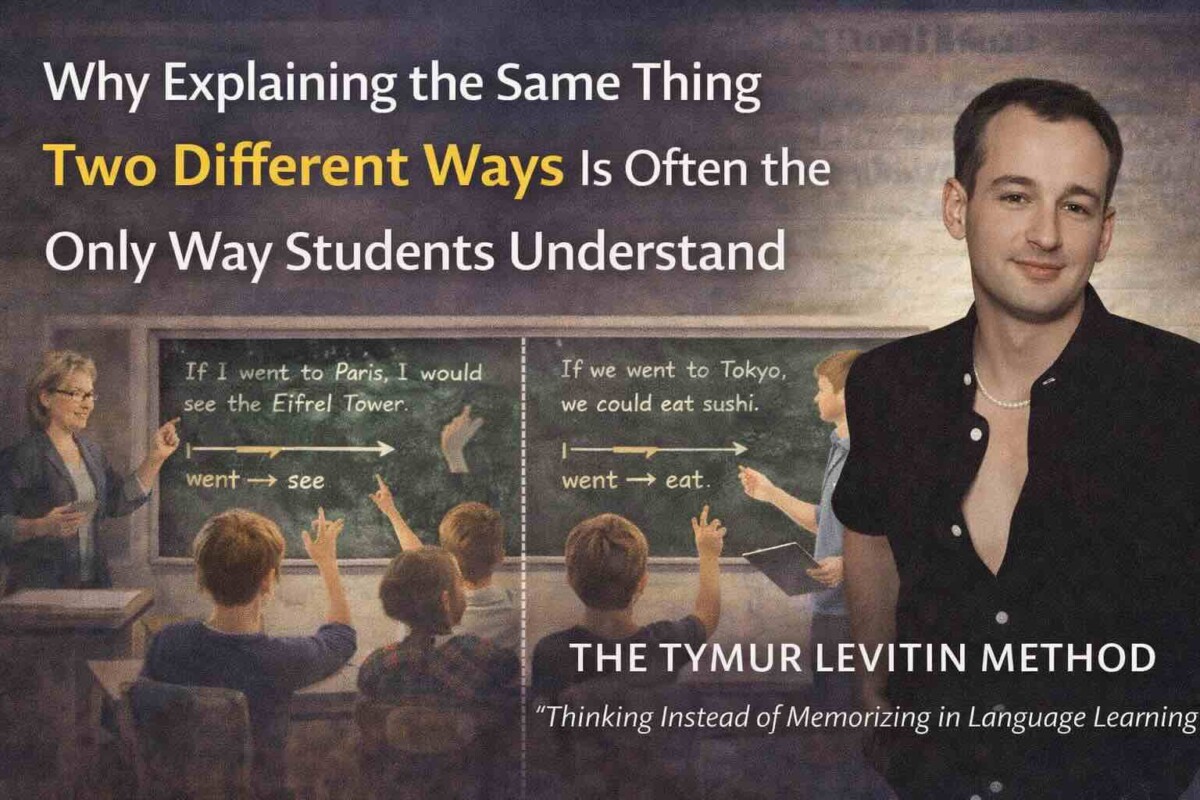
Good Teachers Translate Ideas
In a sense, good teachers constantly translate ideas.
Not between languages.
But between ways of thinking.
If a rule does not work for the student, the teacher reformulates it.
If a definition sounds abstract, the teacher gives a concrete example.
If an example is confusing, the teacher builds a visual image.
This process is not improvisation.
It is intellectual work.
The Moment Understanding Appears
When the right explanation finally appears, students often say something interesting.
They say:
“Ah… now I understand.”
The explanation may even look simpler than the first one.
But the real difference is not simplicity.
The difference is alignment with how the student thinks.
Once that alignment appears, the idea becomes clear.
Why This Matters in Language Learning
Language learning requires thousands of small moments of understanding.
Vocabulary, grammar, pronunciation, meaning, and context all interact.
If a teacher insists on only one explanation style, many students will remain confused.
But when teachers allow themselves to explain the same idea in different ways, something powerful happens.
Understanding becomes accessible.
Teaching Is the Art of Finding the Second Explanation
Some teachers believe that the first explanation should always be perfect.
Experienced teachers know something different.
The first explanation is only the beginning.
The real skill of teaching often appears in the second explanation.
Or the third.
Or the moment when the teacher finds the exact angle that makes the idea suddenly visible.
This is where real teaching begins.
Author: Tymur Levitin
Founder & Director, Levitin Language School
© Tymur Levitin