Level: Advanced
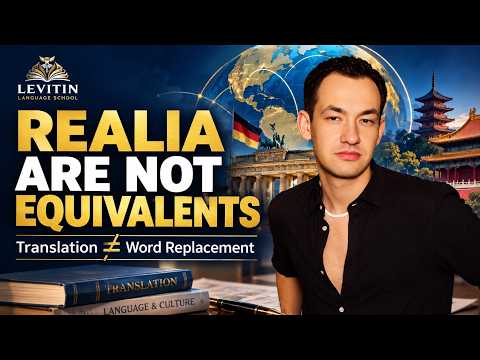
A clear video lesson on why cultural realia cannot be translated through word-for-word equivalence alone — and why professional translation begins with cultural interpretation.
Translation is often imagined as a simple movement from one word to its equivalent in another language.
But cultural realia show why this model is incomplete.
A word may refer to an institution, tradition, social role, object, practice, or concept that belongs to a particular cultural system. Even when another language offers a familiar-looking equivalent, the cultural meaning behind it may be different.
In this video lesson, Tymur Levitin explains a more precise model:
word → referent → cultural knowledge → function → interpretation → translation decision
Using the German Abitur as an example, the lesson shows why identifying a referent is only the beginning. A translator must also understand what source-culture readers already know about it, what function it performs in the text, and what the target reader actually needs to understand.
Instead of asking:
“What is the equivalent of this word?”
we ask:
“What must the reader understand here?”
That distinction explains why different contexts may require different solutions: retaining the original term, describing it, adding limited explanation, or choosing a functional rendering.
It also reveals a less obvious danger: a familiar equivalent can sometimes be more misleading than an unfamiliar foreign term because it may make two different cultural systems appear identical.
Realia therefore demonstrate that professional translation is not simply lexical substitution.
It is interpretation and decision-making between systems of meaning.
Foreign ≠ incomprehensible.
Familiar ≠ equivalent.
The translator’s task is not merely to replace words, but to reconstruct the conditions under which meaning can be understood.
Continue Reading
Realia Are Not Translated: Why Interpretation Matters More Than Equivalence
© Tymur Levitin / Levitin Language School. All rights reserved.