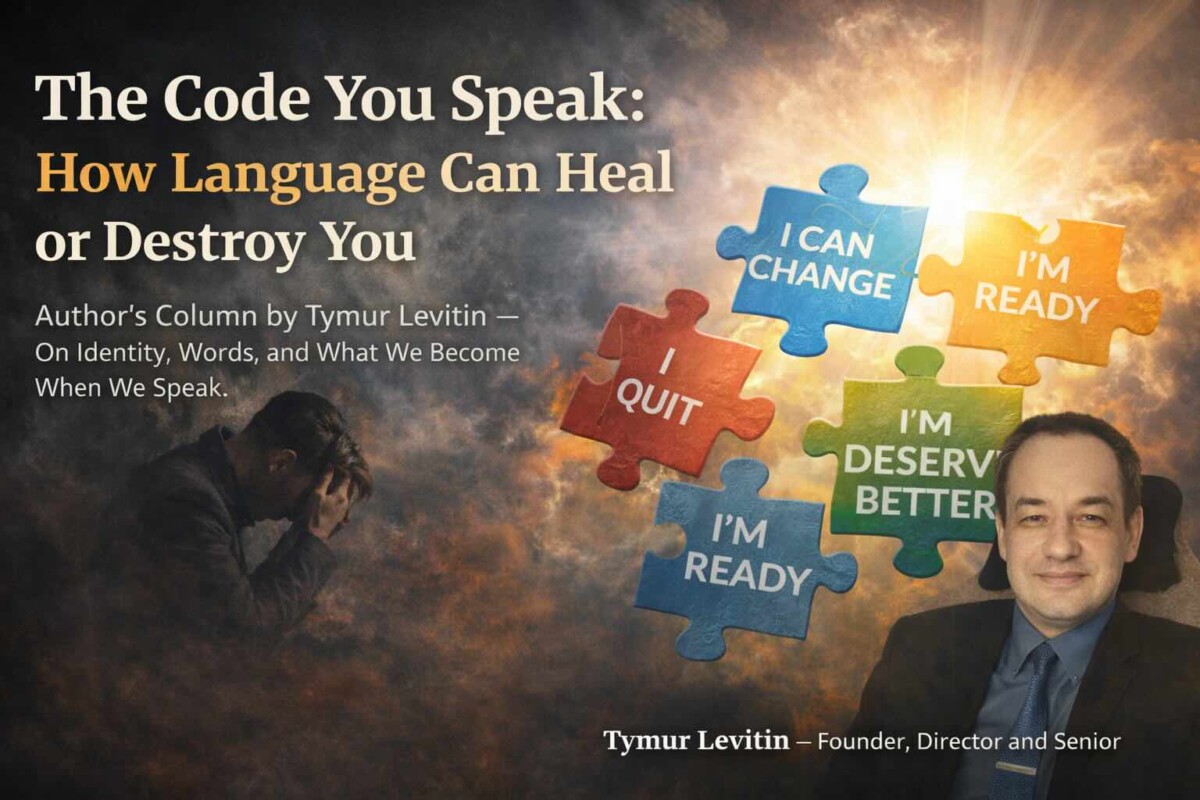

Author’s Column by Tymur Levitin — On Identity, Words, and What We Become When We Speak
All the world’s a stage.
And every stage has a script.
We don’t just speak to communicate.
We speak to play roles — son, father, partner, boss, teacher, stranger.
Every sentence we say is shaped by who we are, or who we think we need to be.
But what if that role isn’t ours?
What if we’re trapped inside someone else’s script — without knowing it?
For over two decades, I’ve taught languages to people from more than 30 countries.
And if there’s one thing I’ve learned, it’s this:
Language doesn’t just express identity — it writes it.
Words Don’t Describe You — They Build You
A man says “I’m fine” when he’s not.
A woman says “I’m sorry” when she’s not guilty.
A student says “I’ll try” when he’s afraid of failing.
These aren’t just habits.
They are verbal blueprints — codes that shape how we feel, think, and behave.
When you repeat certain phrases long enough, your brain doesn’t just hear them.
It starts to believe them.
Every Code You Speak Has a Cost
I’ve seen men destroy themselves with two words: “I can’t.”
I’ve seen women break under “It’s nothing.”
I’ve seen students stuck in self-doubt simply because their native language taught them that humility equals silence.
But I’ve also seen healing.
I’ve seen what happens when a student learns to say:
- “I deserve this.”
- “I can change.”
- “I see things differently now.”
These aren’t translations.
They’re transformations.
The Language You Use Can Rewire You
I once had a student from Spain.
In Spanish, he was loud, emotional, open.
In English, he became quiet, careful, hesitant.
He said to me:
“When I speak English, I feel like someone else.”
And he was right.
Because language isn’t neutral.
Each language carries its own emotional DNA — its own rhythm, mindset, history, pain.
When you switch languages, you’re not just switching words.
You’re switching identity masks.
Sometimes for survival.
Sometimes for freedom.
Sometimes to hide from yourself.
Shakespeare Was Right. So Was Eric Berne.
We play roles. Constantly.
And language is the costume we wear for each scene.
At work, we speak in reports and plans — “I’ll get back to you.”
At home, we soften, or pretend — “It’s nothing, don’t worry.”
In bed, we become someone else entirely — vulnerable, performative, silent, or loud.
But here’s the truth no one teaches in grammar books:
Every sentence is a decision. Every sentence is a mirror. Every sentence is a choice: to build or to break.
The Words You Use Choose the Life You Live
You may think you’re just saying a phrase.
But the phrase is saying you.
- “Whatever.” — resignation
- “I guess.” — uncertainty
- “I always mess up.” — identity
- “I’m not a language person.” — permission to give up
Now change the code:
- “Let me try that again.”
- “I’m learning.”
- “That’s not who I am anymore.”
And suddenly, you’re living in a different story.

I’m Not Teaching You Language. I’m Giving You Back the Script
I’m 41.
I’ve played enough roles to know which ones were lies.
And I’ve heard enough words to know which ones break people slowly, from the inside out.
You’re not learning English.
You’re learning how to tell your story differently.
You’re not learning German.
You’re learning how to feel structured, anchored, clear.
You’re not learning Spanish.
You’re learning how to be emotional without apology.
That’s what I teach.
Not grammar.
Direction. Identity. Voice. Power.
Because the code you speak either enslaves you — or sets you free.
© Tymur Levitin — Founder, Director, and Senior Teacher
View my teacher profile
Choose your language:
English,
German,
Spanish
Explore our international platform: languagelearnings.com