Skip to content

language and identity

Own Does Not Mean Possession: Why “My Own” Is About Identity, Not Ownership
Own Does Not Mean Possession: Why “My Own” Is About Identity, Not Ownership | LEVITIN SCHOOL
Comparative Linguistics

Own Does Not Mean Possession: Why “My Own” Is About Identity, Not Ownership

Most students learn the word own very early. Usually, the explanation is simple: The translation seems straightforward. The lesson ends. Everyone moves on. But sooner or later English starts producing sentences that make that explanation feel incomplete. Consider: What exactly is being possessed here? A room? Perhaps. But what about ideas? Decisions? Opinions? The deeper […]

Tymur Levitin | LEVITIN SCHOOL Tymur Levitin
• 04.06.2026 • 3 min read
Read full article

language and identity

When Language Rewrites Reality: The Power of Saying “We Are Only Acquainted” | LEVITIN SCHOOL
26.03.2026

When Language Rewrites Reality: The Power of Saying “We Are Only Acquainted”

Interesting information

Language, Memory, and Emotional Reality Across Cultures There are moments in life when a single phrase changes the emotional reality between two people. Not gradually.Not through explanation.But instantly — through language. One such example appears in an old Russian romance whose central line reads: «Мы только знакомы. Как странно…»(Literally: “We are only acquainted. How strange…”) […]

Tymur Levitin | LEVITIN SCHOOL Tymur Levitin
Read more →
When Language Becomes Status: | LEVITIN SCHOOL
23.03.2026

When Language Becomes Status:

Online Language Learning

Why Some Students Stop Speaking Even When They Understand You In one of my multilingual classes I was teaching German to a Spanish-speaking group. I teach German in German.In difficult moments, I may switch to English. Spanish I do not speak. During the lesson a student asked a question in Spanish. I answered honestly: I […]

Tymur Levitin | LEVITIN SCHOOL Tymur Levitin
Read more →
When Words Become Pressure: “You Said It — Now Prove It” | LEVITIN SCHOOL
20.03.2026

When Words Become Pressure: “You Said It — Now Prove It”

Language, Culture & Communication

How Language Turns into Social Obligation Language does more than describe reality.Sometimes it creates it. In many social environments, certain phrases carry far more weight than they appear to. A simple sentence can suddenly transform into an expectation, a demand, or even a test of character. Phrases like these exist in many languages: “You said […]

Tymur Levitin | LEVITIN SCHOOL Tymur Levitin
Read more →
When “Beautiful” Isn’t the Same Thing: Why Languages Don’t See Beauty the Same Way
19.03.2026

When “Beautiful” Isn’t the Same Thing: Why Languages Don’t See Beauty the Same Way

Language, Culture, and Meaning

Category: Language, Culture, and Meaning The Illusion of Universal Words Many learners believe that some words are universal.“Beautiful.”“Nice.”“Wonderful.” At first glance, they seem simple and transparent. A student opens a dictionary, finds a translation, and assumes the meaning travels intact from one language to another. But languages rarely work that way. What looks like a […]

Tymur Levitin | LEVITIN SCHOOL Tymur Levitin
Read more →
I Don’t Do That | LEVITIN SCHOOL
04.03.2026

I Don’t Do That

Words That Reveal a Person

The Language of Personal Boundaries Author: Tymur Levitin — Founder & Director, Levitin Language School© Tymur Levitin Sometimes the strongest statements in language are the shortest ones. Not long explanations.Not emotional speeches. Just one simple sentence. “I don’t do that.” Four words. But behind them stands an entire philosophy of identity. The Difference Between “I […]

Tymur Levitin | LEVITIN SCHOOL Tymur Levitin
Read more →
One Song, Two Worlds: Ukrainian and Polish Meanings Behind the Same Words | LEVITIN SCHOOL
11.01.2026

One Song, Two Worlds: Ukrainian and Polish Meanings Behind the Same Words

Author’s Column | Tymur Levitin on Language, Meaning and Respect

What happens when a single word travels across languages and cultures? Does it keep its meaning? Or does it change its weight, its tone, its soul? I once heard a haunting song called “Dumka na dwa serca” — A Thought for Two Hearts. It exists in both Ukrainian and Polish, and at first glance, it […]

Tymur Levitin | LEVITIN SCHOOL Tymur Levitin
Read more →
The Language of Inner Order | LEVITIN SCHOOL
05.01.2026

The Language of Inner Order

Author’s Column | Tymur Levitin on Language, Meaning and Respect

Why Mature People Stop Explaining Their Choices There is a moment in life when explanations quietly lose their power. Not because a person becomes cold, distant, or indifferent —but because something inside finally settles. Mature people do not explain every choice they make.They do not justify every pause.They do not comment on every silence. This […]

Tymur Levitin | LEVITIN SCHOOL Tymur Levitin
Read more →
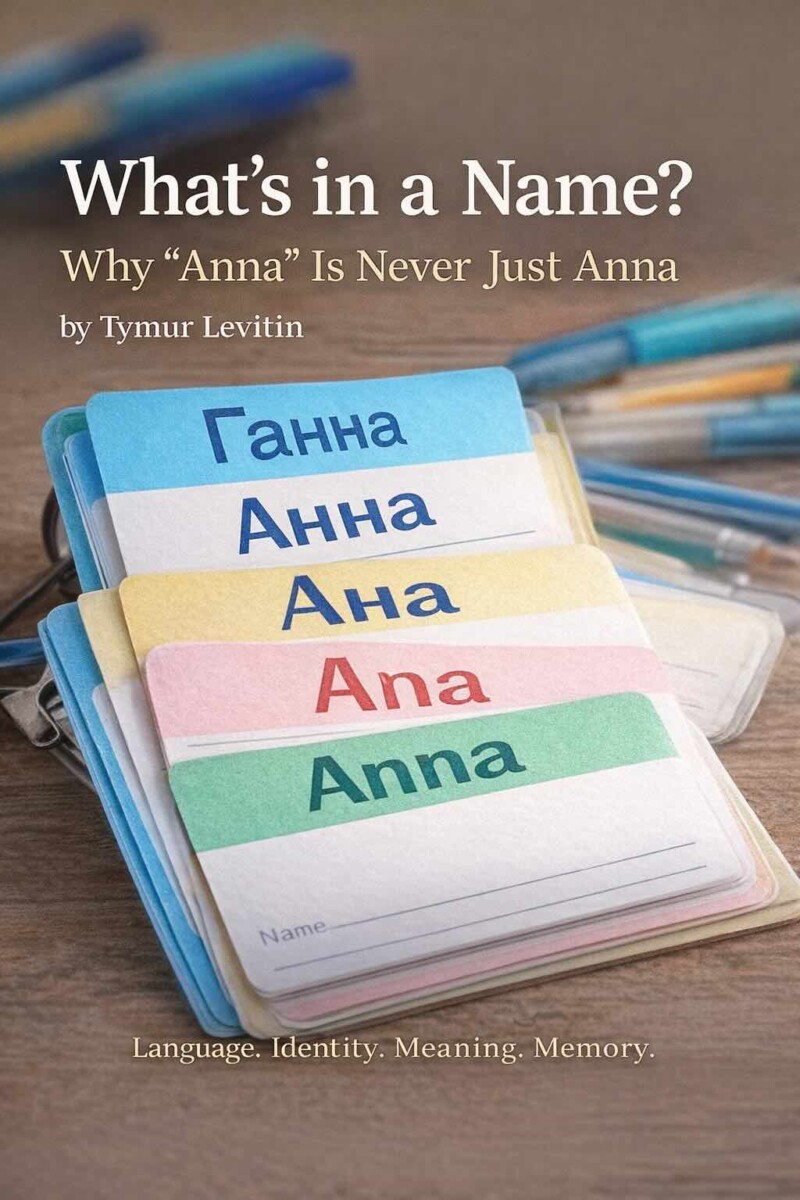
What’s in a Name? Why “Anna” Is Never Just Anna | LEVITIN SCHOOL
05.01.2026

What’s in a Name? Why “Anna” Is Never Just Anna

Author’s Column | Tymur Levitin on Language, Meaning and Respect

Language. Identity. Meaning. Memory.By Tymur Levitin — Founder, Director, Lead Teacher, Translator 👉 Choose your language Why Names Are Not Neutral — And Never Were It may look like a simple name. Four letters.But the difference between Anna, Ana, Анна, and Ганна isn’t cosmetic — it’s cultural, emotional, historical. Names are not just sounds.They are […]

Tymur Levitin | LEVITIN SCHOOL Tymur Levitin
Read more →
Why Adults Struggle More With Language Learning — And It’s Not About Age | LEVITIN SCHOOL
04.01.2026

Why Adults Struggle More With Language Learning — And It’s Not About Age

Author’s Column | Tymur Levitin on Language, Meaning and Respect

It’s often said that children learn languages more easily than adults. This explanation sounds convenient.And it’s mostly wrong. Age is not the main obstacle.Experience is. Adults Don’t Fear Language — They Fear Exposure Children make mistakes freely.They don’t protect an image.They don’t defend competence. Adults do. An adult doesn’t just speak —they represent themselves. Every […]

Tymur Levitin | LEVITIN SCHOOL Tymur Levitin
Read more →