Language. Identity. Meaning. Memory.
By Tymur Levitin — Founder, Director, Lead Teacher, Translator
Why Names Are Not Neutral — And Never Were
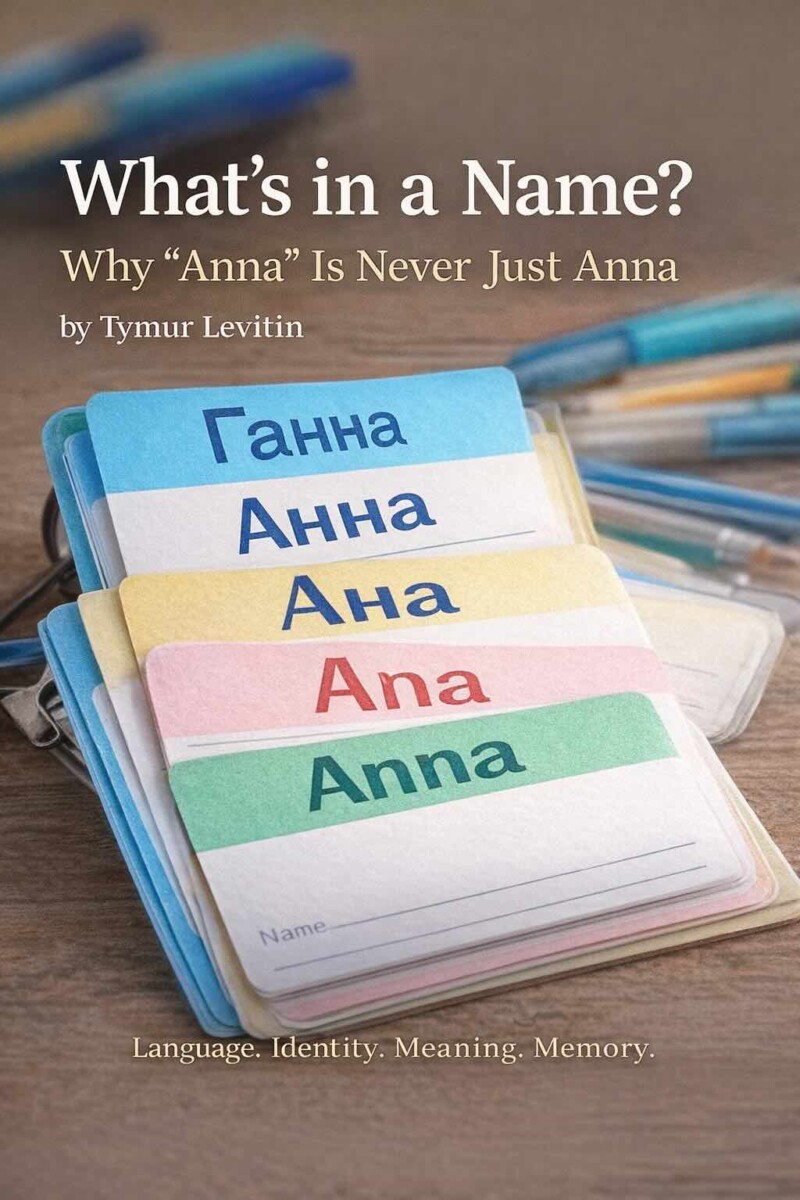
It may look like a simple name. Four letters.
But the difference between Anna, Ana, Анна, and Ганна isn’t cosmetic — it’s cultural, emotional, historical.
Names are not just sounds.
They are identity markers.
They hold the accents of your country, the rhythm of your grandmother’s voice, the rules of your grammar, the weight of your past.
That’s why every language touches names differently — and why transliteration is never just “spelling.”
“Ana” vs “Anna”: Same Name, Different Soul?
Let’s start with one you’ve probably seen:
Ana (without double n) is common in Romanian, Portuguese, Spanish, Serbian, and Hungarian (though pronounced differently).
On paper, it looks like a shortcut.
But in speech, Ana is softer, lighter, faster.
In Portuguese, it flows: “Ah-na”, almost musical.
In Romanian, it’s clipped and direct.
In Spanish, it’s often part of a compound name: Ana María, Ana Sofía — with a melodic lilt.
Now say Anna.
In German, Russian, Polish, or English, it’s heavier. Fuller. The double n pulls the voice down into the center of the mouth.
There’s gravity. Tradition. Sometimes even melancholy.
Ana smiles.
Anna reflects.
It’s the same person on a passport.
But not in a poem. Not in a lullaby. Not in your head.
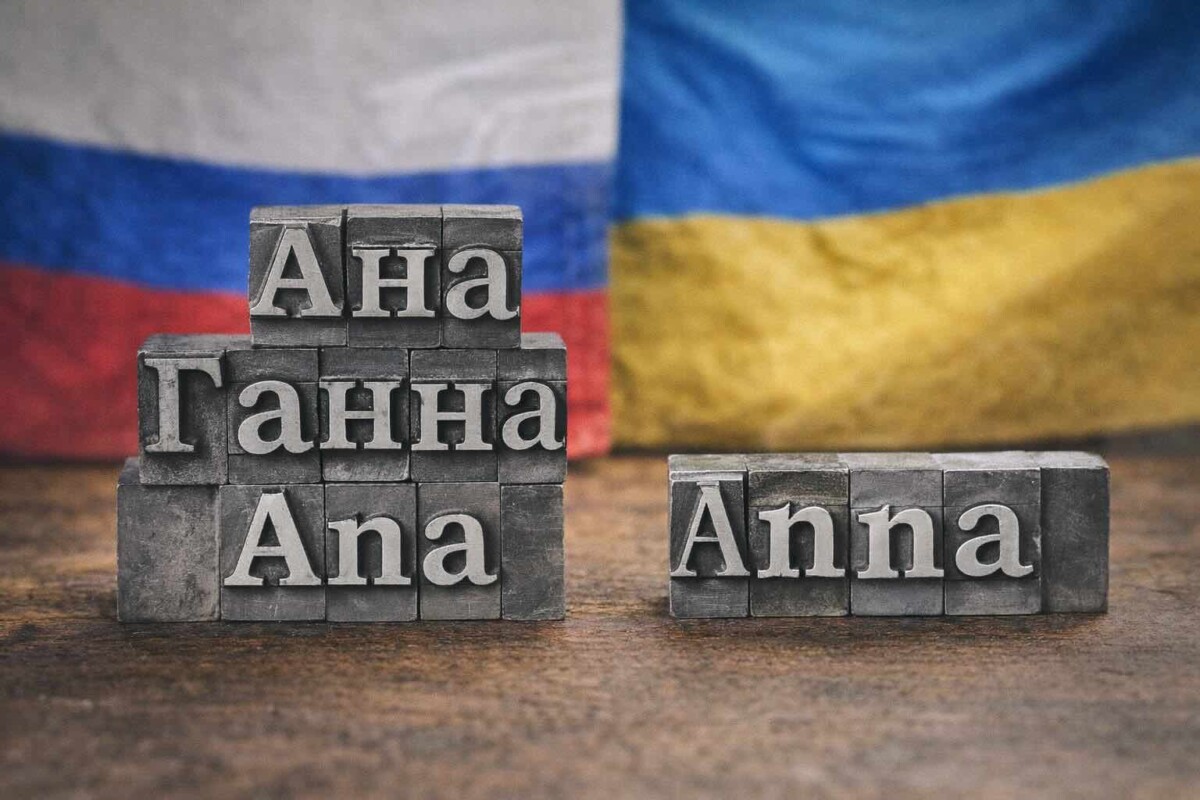
Анна or Ганна: A Slavic Puzzle of Sound and History
Here’s where it gets even more complex.
In Russian, Анна is classic. Regal. Canonical.
Think of Tolstoy. Think of Romanov queens. It carries weight — even when shortened to Аня, Анюта, Аннушка.
But move across the border into Ukrainian, and the same name transforms into Ганна.
Why?
Because Ukrainian preserved the older Greek and Old Church Slavonic pronunciation, where the initial G sound (gamma) remained.
So while Russian evolved toward a smoother A sound, Ukrainian kept the friction of G, giving us Ганна — more rustic, authentic, biblical.
It’s not a mistranslation. It’s a different timeline of sound.
To a Ukrainian speaker, Ганна sounds natural, even sacred.
To a Russian speaker, it might feel harsh or strange — as if something broke.
To a foreign learner, it’s just one letter — but that letter holds centuries of divergent identity.
Transliteration ≠ Translation
When students say, “How do I write my name in English?” — the real question is:
“How do I keep being myself… in another language?”
Because once you cross alphabets, you cross assumptions.
Let’s say your name is Ганна.
Transliterate it as Hanna, and it becomes a Nordic-sounding name in English or German — totally different from Anna or Ana.
Write Ganna, and it may look strange or even incorrect.
Write Anna, and you erase the unique phonetics of your native tongue — replacing it with a foreign archetype.
So what’s the answer?
Sometimes, there isn’t one.
But the question deserves to be asked — not ignored.
A Name Is a Mirror. Don’t Let It Get Frosted.
In school systems, job applications, and classrooms, names are often forced into forms.
They’re shaved, translated, “adjusted.”
Some of my students — from Ukraine, Hungary, India, or Brazil — have used 3 or 4 versions of their name depending on the country, the language, or the form.
But in doing so, something breaks.
The voice changes.
The perception changes.
And eventually… the person adapts to the name, not the other way around.
A name is a negotiation between how you say yourself and how others say you.
That’s why I always ask my students:
“How do you want to be addressed?”
“How does your mother say your name when she’s happy?”
“When you dream, what name do you hear?”
Because that’s the version I want to use.
Don’t Translate the Person Out of the Name
Translators: never assume.
Teachers: never flatten.
And students — keep your name alive, even when the spelling bends.
Correct your teachers if they change it.
Defend your sound.
It is yours.
Related Articles
- 📘 Understanding Realia in Translation
- 📘 Learning English Through Identity
- 📘 Language, Memory, and Mistakes
© Tymur Levitin
Founder, Director, Lead Teacher, Translator
Levitin Language School / Start Language School by Tymur Levitin
“Global Learning. Personal Approach.”
“Speak free. Learn smart.”
Stay Connected
🌐 Websites:
📱 Telegram:
- @start_school_tymur
- @START_SCHOOL_TYMUR_LEVITIN
📞 WhatsApp / Viber: +380 93 291 34 29
📞 Europe: +48 507 831 337
📸 Instagram:
- instagram.com/tymurlevitin
- instagram.com/tymur.levitin
- instagram.com/tymur_levitin_
- instagram.com/startschool.by.tymur.levitin
- instagram.com/startschool.eu
🧭 Facebook:
- facebook.com/levitinstartschool
- facebook.com/profile.php?id=61560395143684
- facebook.com/englishdeutschtimurlevitin
- facebook.com/startschool.eu
🐦 Twitter (X):
- x.com/timurlevitin
- x.com/levitintimur
- x.com/tymurlevitin
🔗 Threads:
- threads.net/@timurlevitin


