
Many learners expect reported questions to behave like normal questions.
You simply repeat the question structure.
But English does something surprising.
It removes the question structure completely.
And that is the key idea.
The First Big Change
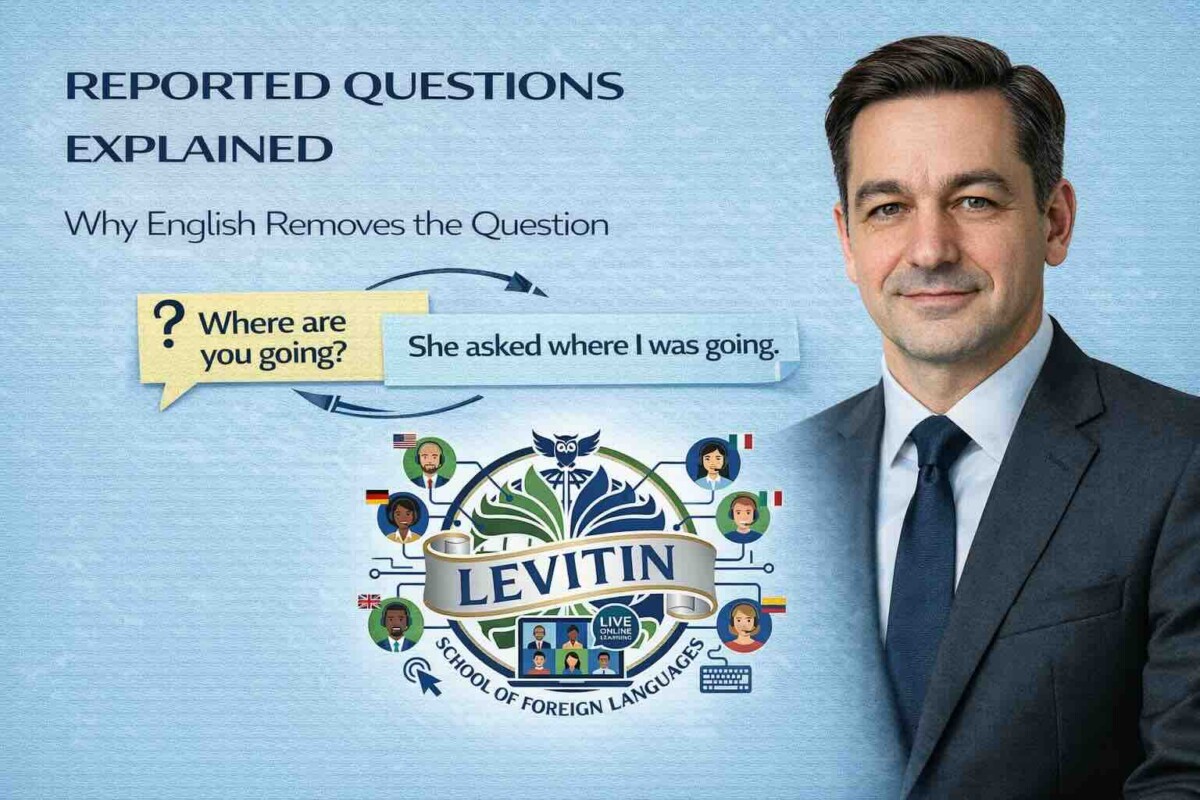
Direct question:
Where are you going?
Reported question:
She asked where I was going.
Notice what disappeared.
There is no auxiliary verb before the subject.
The sentence becomes a statement structure.
Because in reported speech, the sentence is no longer a real question.
It is information about a question.
Why the Structure Changes
Direct questions are used to ask someone directly.
Reported questions describe the question.
That difference changes the grammar.
Direct speech:
“Where are you going?”
Reported speech:
She asked where I was going.
English restores normal word order because the speaker is no longer asking.
They are reporting.
Yes / No Questions
Yes–no questions change differently.
Direct:
“Are you ready?”
Reported:
He asked if I was ready.
He asked whether I was ready.
The auxiliary disappears.
And if / whether introduces the clause.
Why English Avoids Question Order
Question word order exists only in real questions.
Reported questions are not questions anymore.
They are subordinate clauses.
And subordinate clauses follow statement order.
Subject comes before verb.
The Tense Alignment
Reported questions follow the same logic as reported statements.
Direct:
“Where do you live?”
Reported:
She asked where I lived.
The tense aligns with the reporting moment.
Again, this is not a mechanical rule.
It reflects perspective.
Time Expressions Also Shift
Direct:
“Are you coming tomorrow?”
Reported:
He asked if I was coming the next day.
The timeline moves with the reporting moment.
Just like in reported statements.
What Learners Often Do Wrong
A common mistake is keeping question order.
❌ She asked where was I going.
Correct structure:
✔ She asked where I was going.
Once the sentence becomes reported speech,
it must follow statement order.
Why This Structure Matters
Reported questions appear everywhere:
- interviews
- conversations
- journalism
- storytelling
- academic writing
They allow language to carry questions across time.
Without repeating them directly.
Final Insight
Reported questions do not keep the grammar of questions.
They become information structures.
English removes inversion
because the speaker is no longer asking.
They are narrating.
And once you understand that shift,
reported questions become simple.
Because the grammar reflects perspective.
Author: Tymur Levitin
Founder & Director, Levitin Language School
Global Learning. Personal Approach.
© Tymur Levitin