
When learners study reported speech, they quickly notice a familiar transformation:
can → could
Example:
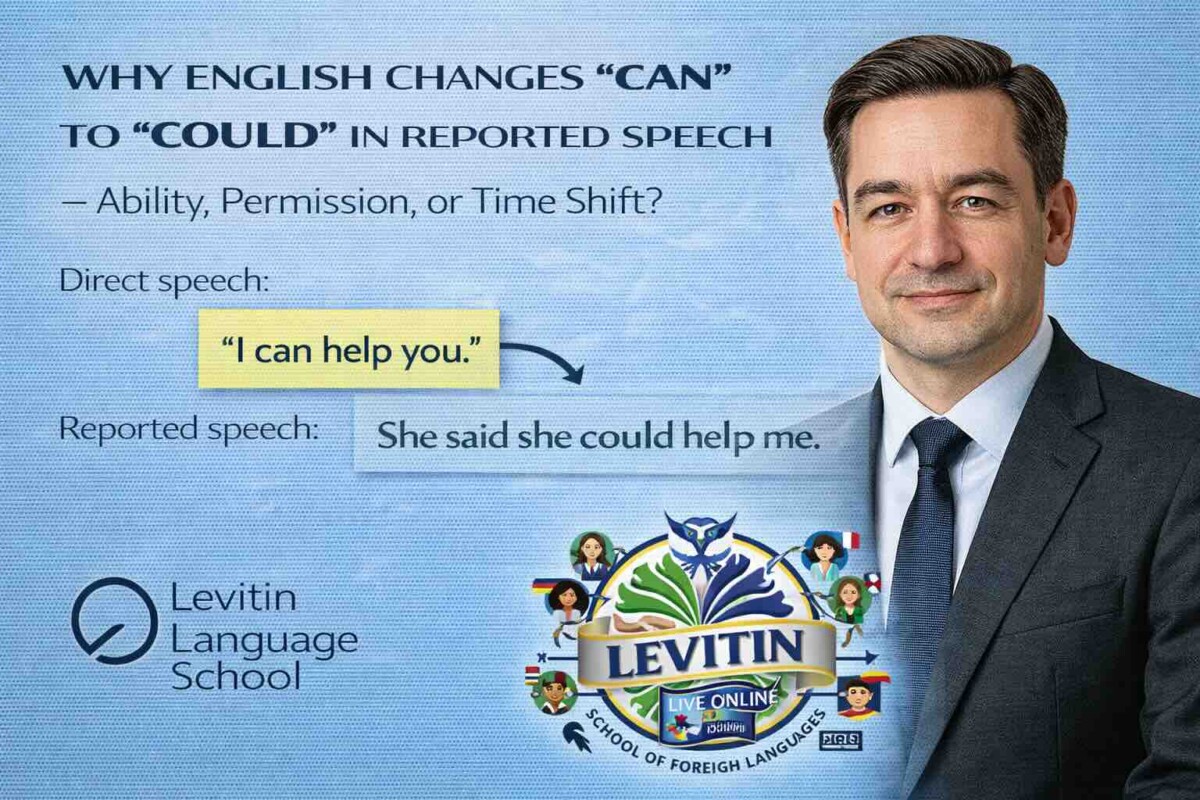
Direct speech:
She said:
“I can help you.”
Reported speech:
She said she could help me.
At first glance, this looks like another mechanical grammar rule.
But the change from can to could is not simply about tense.
In fact, it reflects something deeper in the way English expresses ability, permission, and time perspective.
Understanding this difference helps learners avoid many common mistakes in reported speech.
The Basic Transformation
In traditional grammar explanations, the rule looks simple.
Present modal → Past modal
Direct speech:
“I can finish the work today.”
Reported speech:
He said he could finish the work that day.
Just like will becomes would, the modal can moves into the past form could.
But the meaning of could is more complex than a simple past tense.
“Could” Does Not Always Mean Past Ability
Many students think could always describes ability in the past.
Example:
When I was younger, I could run very fast.
But in reported speech, could often does something different.
Example:
She said she could help me.
This does not necessarily mean the ability existed only in the past.
Instead, the modal shows distance from the original moment of speaking.
The sentence describes what was possible from the speaker’s perspective at that time.
Ability vs Possibility
The modal can often expresses ability.
Example:
“I can solve this problem.”
Reported speech:
He said he could solve the problem.
But English also uses can for possibility.
Example:
“This can happen again.”
Reported speech:
She said it could happen again.
In both cases, the shift to could reflects the change in time perspective, not necessarily the disappearance of the ability or possibility.
Permission in Reported Speech
Another common meaning of can is permission.
Example:
“You can leave early today.”
Reported speech:
The manager said we could leave early that day.
Again, the modal changes because the statement is now being described from a later moment.
The permission existed at that earlier time.
English marks this shift with could.
When “Can” Does Not Change
Just like other backshift rules, this transformation is not absolute.
If the situation is still true, English may keep can.
Example:
She said I can contact her anytime.
This sentence suggests that the permission or possibility still exists now.
In other words, the speaker is not distancing the statement from the present moment.
Reported Speech and Distance
A useful way to understand reported speech is to think about distance.
English often creates distance from the original statement.
Present → Past
Will → Would
Can → Could
This distance can represent:
- time
- perspective
- politeness
- uncertainty
In reported speech, it usually represents a shift in narrative viewpoint.
The Logic Behind the Change
Reported speech is not simply repeating someone’s words.
It reorganizes the sentence so that it fits the speaker’s timeline.
When the reporting verb moves into the past, English adjusts other elements of the sentence to match that perspective.
This is why can often becomes could.
The grammar aligns the entire sentence with the new point of reference.
Grammar Reflects Meaning
Understanding this system is much more useful than memorizing tables.
The change from can to could is not just grammar.
It reflects how English speakers structure information in time.
Instead of repeating the exact words someone said, the language adjusts them so the listener can clearly understand when and how the statement was originally true.
Once learners see this pattern, reported speech becomes much easier to use naturally.
© Tymur Levitin
Founder & Director
Levitin Language School
All rights reserved.