
🌍 Choose your language: https://levitintymur.com/#languages
History is not only a story of the past — it is the language through which we understand human experience. Learning it in German teaches you how to describe that experience with structure, clarity, and academic precision.
At Levitin Language School, History is more than dates and facts.
It is a system of cause and effect, interpretation, sources, and context — and German is a language perfectly suited for explaining these relationships.
German Fachsprache makes historical thinking clearer, sharper, and more logical.
Students learn not just what happened, but why, how, and what it means.
Why Study History in German
German-speaking countries played a central role in European and world history.
Studying History in German helps students develop:
- 📘 Academic Fachsprache vocabulary
(Mittelalter, Neuzeit, Quellenanalyse, Historischer Kontext, Kaiserreich, Industrialisierung) - 🧠 Analytical and interpretive thinking
- 📚 Strong preparation for German-medium schools, Gymnasium programs, and Goethe/Swiss exams
- 🌍 A deeper understanding of European perspectives
- 📝 Skills for source interpretation (Quellenarbeit)
German is a language of structure. History is a subject of structure.
Together they form an ideal academic foundation.
Core Concepts of “Geschichte” in German Schools
1. Historical Periods (Epochen)
- Antike
- Mittelalter
- Frühe Neuzeit
- Moderne
- Zeitgeschichte
Understanding transitions between these eras helps students see how societies evolve.
2. Source Analysis (Quellenanalyse)
Students learn to interpret:
- primary sources (Primärquellen)
- secondary sources (Sekundärquellen)
- author intention (Autorabsicht)
- reliability (Zuverlässigkeit)
3. Historical Context (Historischer Kontext)
Events make sense only when connected to:
- politics
- economy
- culture
- social change
4. Cause and Effect (Ursache und Wirkung)
German terminology forces students to build clear logical structures:
- Ursache (cause)
- Auslöser (trigger)
- Folge (consequence)
- Auswirkung (impact)
This strengthens both language and thinking.
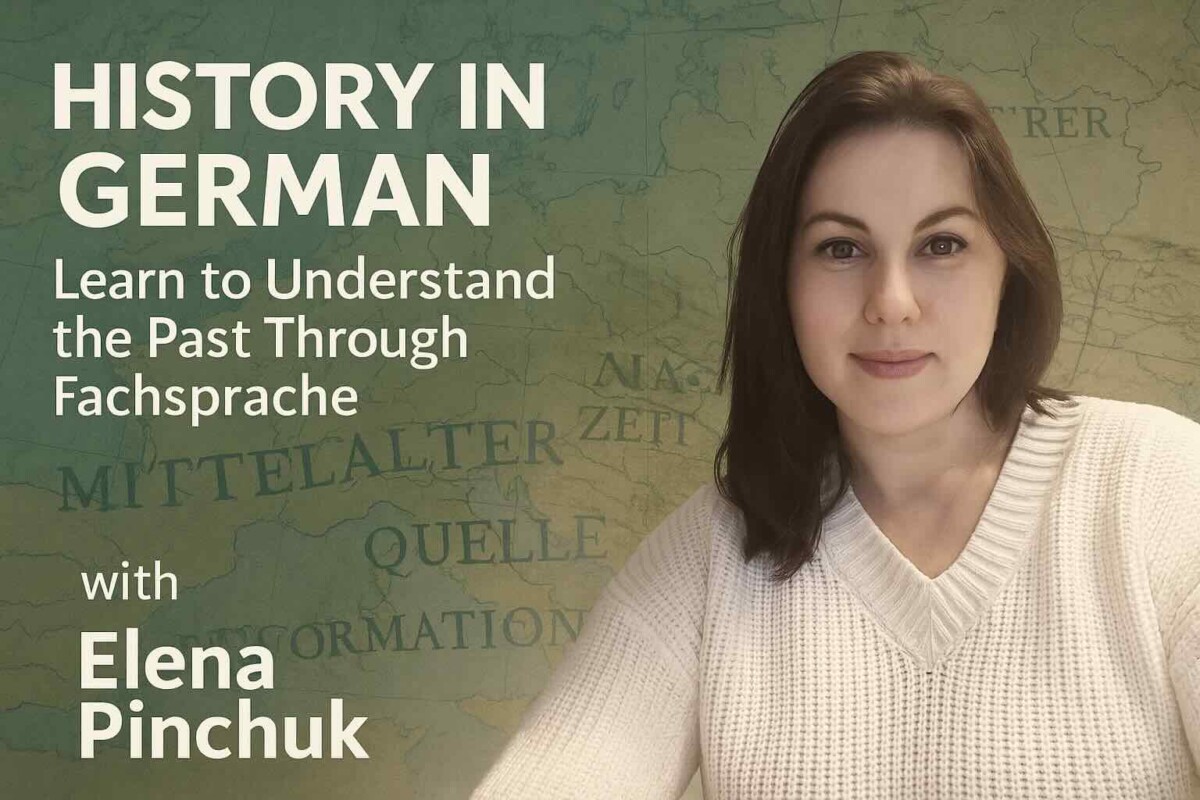
Your Instructor — Elena Pinchuk
History in German at our school is taught by Elena Pinchuk, a teacher who combines linguistic expertise with a deep understanding of academic German.
Elena teaches:
- History (DE)
- Biology (DE)
- Geography (DE)
- German language (all ages)
- Goethe exam preparation
Her teaching style is:
- communicative
- structured
- modern
- academically precise
- supportive and motivating
She uses authentic materials from German publishers and teaches students to understand not just the language — but the thinking behind German academic culture.
📌 Teacher profile:
https://levitintymur.com/teachers/elena-pinchuk/
History + German = Understanding with Meaning
When students study History in German, they learn to interpret the past through structured language.
They gain:
- academic confidence
- analytical clarity
- cross-cultural understanding
- readiness for German-speaking education and examinations
This is the philosophy of Levitin Language School and Start Language School by Tymur Levitin:
Global Learning. Personal Approach.
Explore More Articles
- Economics in German
- Geography in German
- Biology in German
- Mathematics in English
- Physics in English
- Chemistry in English
Author: Tymur Levitin — Founder, Director, and Head Teacher
© Levitin Language School | Start Language School by Tymur Levitin