
When people first look at the linguistic map of Europe, they often feel surprised.
Compared to continents such as North America or Australia, Europe appears extremely fragmented linguistically. Countries located only a few hundred kilometers apart may use completely different languages.
But the real question is not just why Europe has many languages.
The deeper question is why so many languages exist in such a relatively small geographic space.
Geography That Divides People
One of the main reasons is geography.
Europe developed in regions separated by:
- mountains
- rivers
- valleys
- forests
Before modern transportation, these natural barriers significantly limited communication between communities.
Over centuries, speech patterns developed independently in these isolated areas.
This process gradually produced distinct dialects and eventually separate languages.
Political Borders That Reinforced Differences
Geography alone does not explain everything.
Political history also played a crucial role.
For more than a thousand years, Europe consisted of:
- kingdoms
- duchies
- city-states
- empires
Each political structure often promoted its own language or dialect.
Over time, these local varieties gained written traditions, administrative functions and educational systems.
When modern nation states formed, many of these speech forms became official national languages.
Luxembourg and Switzerland: Two Different Paths
Two fascinating examples illustrate how language develops differently even within the same region.
Luxembourg officially recognized Luxembourgish as a national language in the late twentieth century.
At the same time, Switzerland maintained Swiss German dialects for everyday speech while continuing to use Standard German for writing and education.
Both linguistic situations developed from similar historical roots.
Yet the outcomes are completely different.
The Role of Identity
Language is never only a technical system of grammar and vocabulary.
It is also a powerful symbol of identity.
Communities often choose to preserve or promote a particular language form because it represents:
- history
- culture
- independence
- belonging
This is why some dialects eventually become national languages while others remain regional forms.
Europe as a Linguistic Mosaic
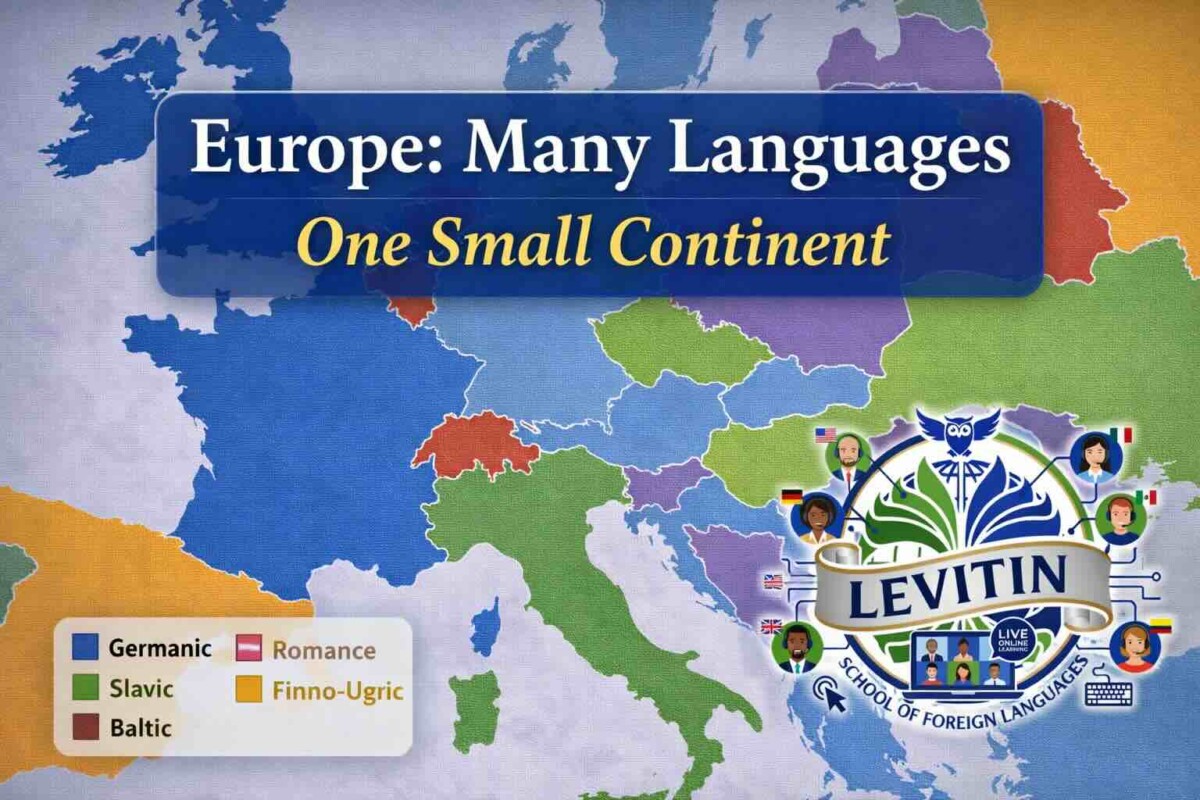
Today, Europe functions as a unique linguistic mosaic.
Within relatively short distances, one can encounter:
- Germanic languages
- Romance languages
- Slavic languages
- Finno-Ugric languages
- Baltic languages
Each group developed through centuries of migration, political change and cultural interaction.
This diversity is not a problem to solve.
It is one of the defining characteristics of the European continent.
What This Means for Language Learners
For language learners, Europe provides an important lesson.
Languages are not static systems that exist in isolation.
They evolve within societies shaped by geography, politics and culture.
Understanding these broader contexts helps learners approach language study not just as memorization of rules, but as exploration of human history and communication.
Author: Tymur Levitin
Founder & Director
Levitin Language School
Global Learning. Personal Approach.
© Tymur Levitin