
Many language learners complain about the same problem:
“I learn words… and then I forget them.”
At first glance, this sounds like a memory issue.
But in most cases, memory is not the problem at all.
The real problem is simpler — and more uncomfortable:
The word was never truly learned in the first place.
Recognition Is Not Knowledge
Many learners encounter words through lists, apps, or explanations.
They see the word.
They see the translation.
They recognize it later.
This creates the feeling that the word has been learned.
But recognition is not the same as ownership.
Recognizing a word means you can identify it.
Knowing a word means you can use it without hesitation.
These are two completely different mental processes.
Why Vocabulary Feels Familiar but Stays Passive
When learners study vocabulary, they often focus on:
- translation
- spelling
- definition
This builds familiarity.
But language does not operate through definitions.
Language operates through situations.
A word becomes real only when it is connected to:
- intention
- context
- decision
Without these elements, the word remains passive knowledge.
Passive Vocabulary vs Active Vocabulary
Most learners possess a large passive vocabulary.
They can understand many words when reading or listening.
But active vocabulary — the words used in speech — is much smaller.
This is normal.
The mistake is expecting passive knowledge to automatically become active.
Activation requires use, not exposure.
Why Words Disappear When You Try to Speak
When learners try to speak, they often say:
“I know the word, but I can’t remember it right now.”
The word is not missing.
The brain simply has no retrieval pathway for real-time use.
If a word has only been seen in lists or translations,
the brain has never practiced pulling it into speech.
So when the moment comes, the pathway doesn’t exist yet.
How Words Become Usable
Words become usable when they are linked to action.
This means using them in:
- real sentences
- spontaneous responses
- unpredictable contexts
Every time a word is used actively, the brain strengthens the connection between meaning and expression.
This is how vocabulary becomes part of speech instead of remaining theoretical knowledge.
Why Forgetting Is Part of Learning
Forgetting is often seen as failure.
In reality, it is a normal filtering process.
The brain keeps what is used repeatedly
and lets go of what remains unused.
Words that are used in communication survive.
Words that exist only in lists quietly disappear.
Final Thought
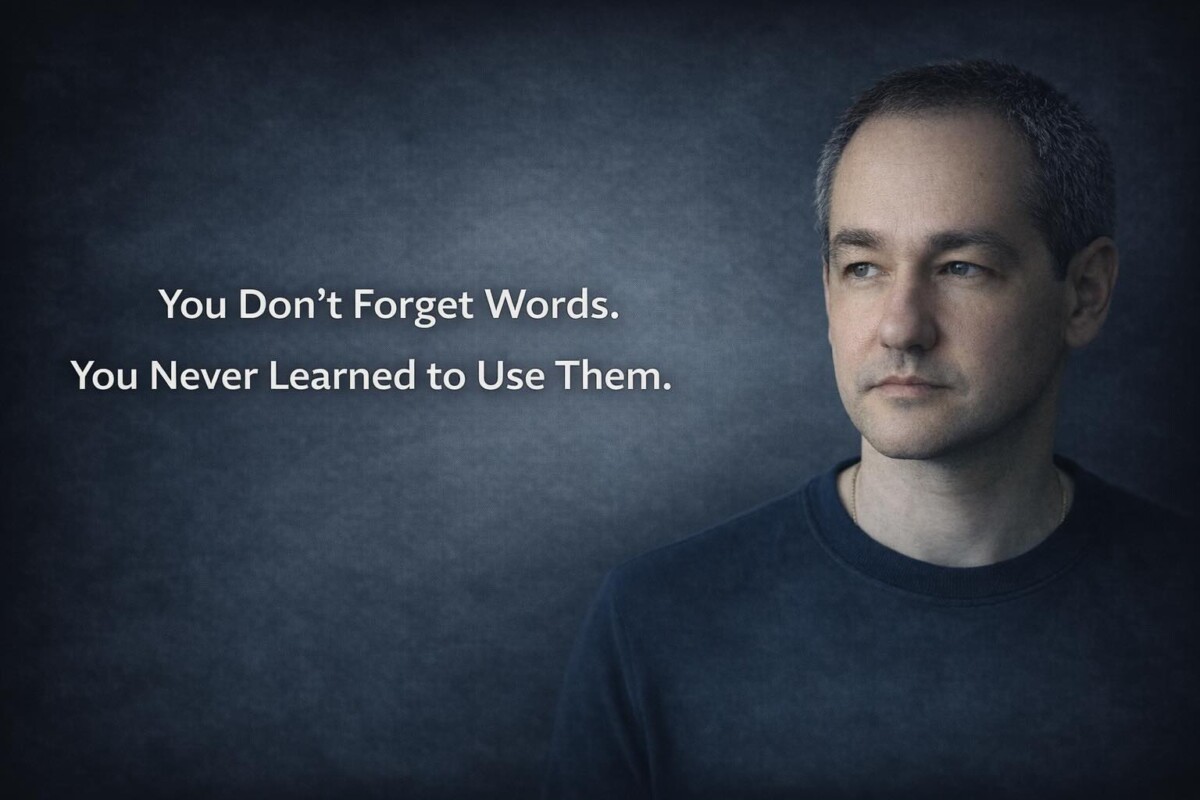
The problem is rarely forgetting.
The problem is believing that recognition equals learning.
Words become part of a language only when they participate in communication.
Until then, they remain visitors in memory —
present for a moment, but never truly settled.
Author: Tymur Levitin
Founder, Director & Senior Teacher
Levitin Language School / Start Language School by Tymur Levitin
© Tymur Levitin. All rights reserved.