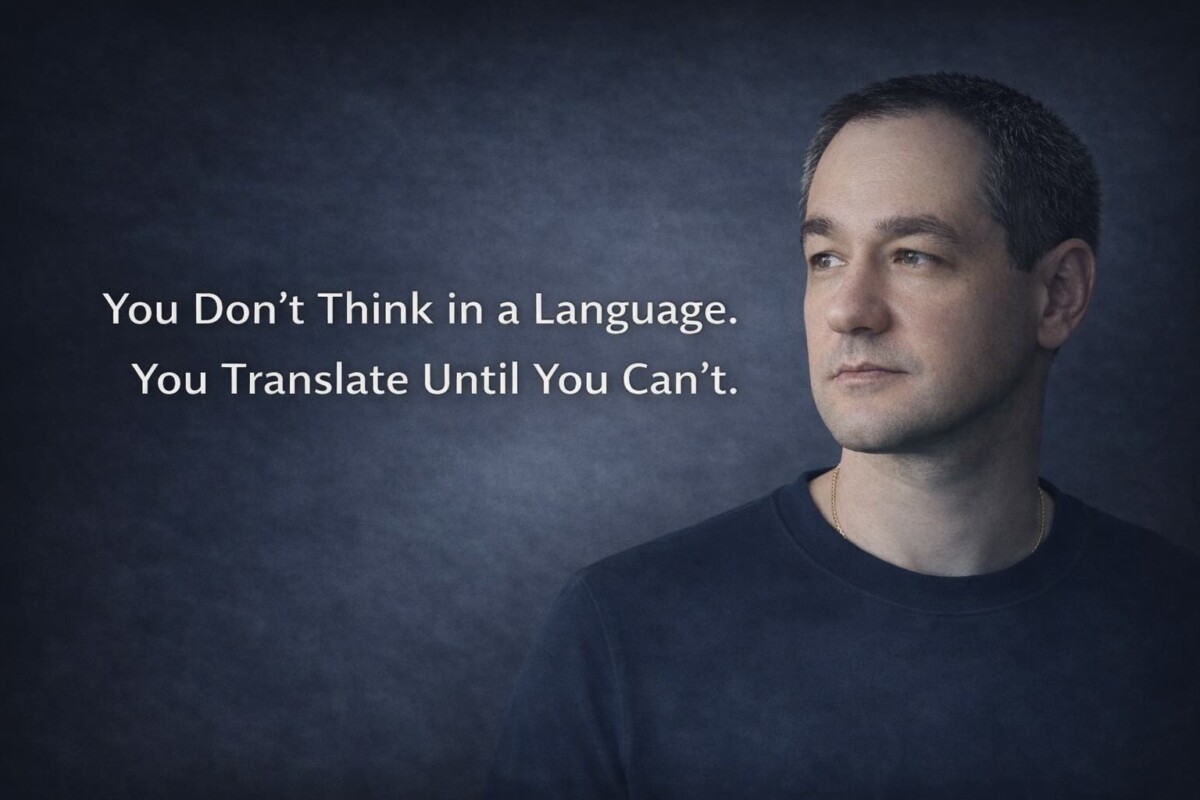

Many learners believe they need to “start thinking” in a foreign language.
They wait for a moment when translation disappears
and direct thinking appears naturally.
That moment rarely comes on its own.
Because what most learners call “thinking”
is actually translation under pressure.
What Really Happens in Your Head
When learners try to speak, they often:
- build a sentence in their native language
- search for equivalents
- translate word by word
- adjust grammar along the way
This feels like thinking.
It is not.
It is a delayed conversion process.
Why Translation Feels Necessary
Translation is a natural starting point.
It gives:
- control
- clarity
- a sense of correctness
Without it, learners feel lost.
So they rely on translation longer than they should.
The problem is not translation itself.
The problem is not moving beyond it.
The Moment Translation Breaks
Translation works — until it doesn’t.
It breaks when:
- structures don’t match
- meanings don’t align
- words don’t exist in the same way
- speed becomes necessary
At that point, learners feel stuck.
Not because they lack knowledge,
but because translation cannot keep up with real communication.
Why Direct Thinking Is Not Automatic
Many expect that with enough exposure,
the brain will “switch” to thinking in the new language.
But the brain does not switch modes by itself.
It follows habit.
If you always translate,
you train the brain to keep translating.
What Real Thinking in a Language Means
Thinking in a language is not:
- speaking perfectly
- using complex structures
- avoiding all mistakes
It is something simpler.
It is the ability to:
- choose words directly
- accept approximate meaning
- move forward without rebuilding everything in your native language
This ability must be trained.

How the Shift Actually Happens
The shift begins when you:
- stop completing sentences in your native language first
- allow incomplete thoughts in the target language
- accept faster, imperfect choices
- reduce internal translation time
At first, this feels uncomfortable.
You may feel less precise, less intelligent, less confident.
That is normal.
You are not losing ability.
You are changing the system.
Why Imperfect Thinking Is Necessary
Direct thinking is not clean at the beginning.
It includes:
- gaps
- simplifications
- rough structures
But it is alive.
And living language develops only in motion.
Final Thought
You don’t suddenly start thinking in a new language.
You gradually stop translating.
And the moment translation becomes too slow,
your brain is forced to find another way.
That way is not perfect.
But it is real.
Author: Tymur Levitin
Founder, Director & Senior Teacher
Levitin Language School
© Tymur Levitin. All rights reserved.