
Before choosing a teacher, first choose your learning direction:
https://levitintymur.com/#languages
Sooner or later almost every student or parent asks the same question:
“Should we take a native speaker?”
Very often the question appears at a specific moment — when progress slows down or when an exam approaches.
The logic seems obvious:
A native speaker speaks perfectly → therefore they must teach best.
In reality, the situation is more complicated.
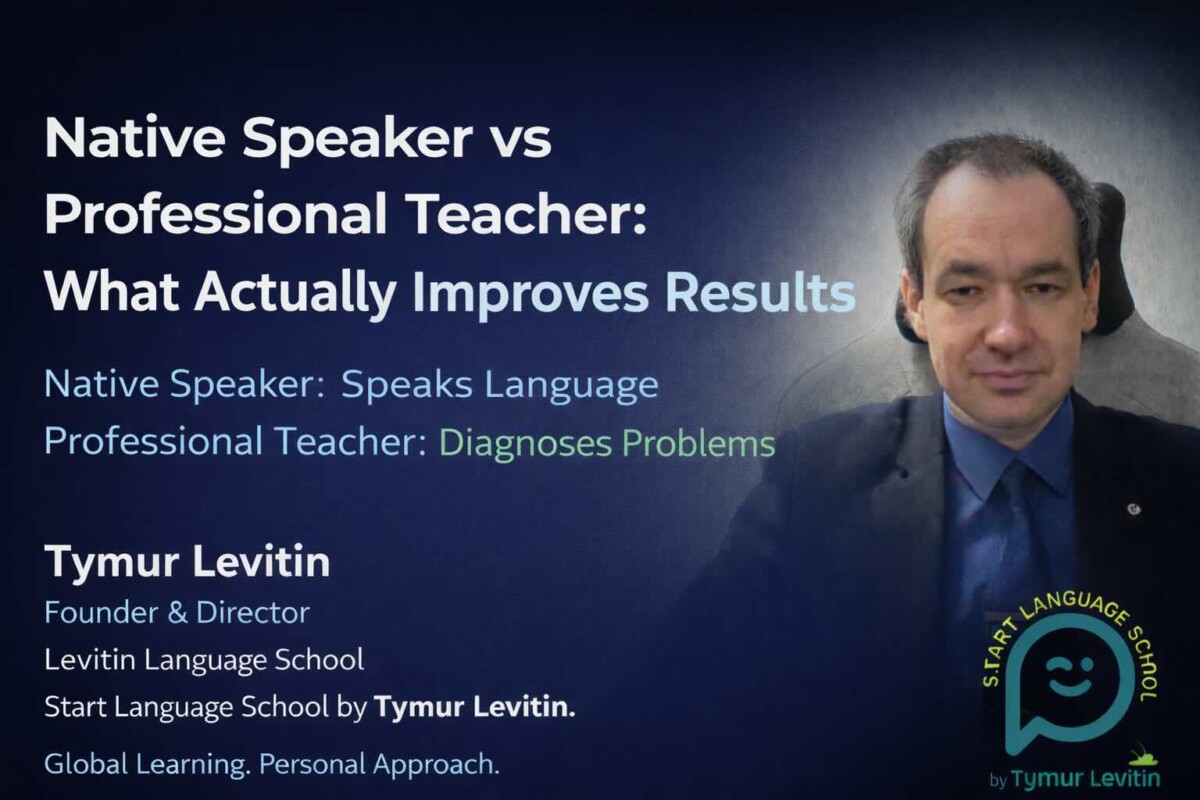
The problem is not that native speakers are bad teachers.
The problem is that teaching and speaking are different skills.
What a Native Speaker Really Gives
A native speaker provides something extremely valuable.
Natural reaction.
When students communicate with a native speaker, they experience:
- real conversational tempo
- natural pronunciation
- authentic vocabulary
- emotional language use
This is important because language is not only structure — it is behavior.
Students learn:
how fast people answer,
how short real sentences are,
how often grammar is simplified in real communication.
Confidence often grows quickly.
Fear decreases.
And this is exactly where native speakers are irreplaceable.
What a Native Speaker Usually Cannot Provide
However teaching requires a different competence.
A teacher must not only produce language.
A teacher must understand why the student cannot produce it.
A native speaker did not learn the language consciously.
They acquired it.
Therefore they often cannot see the learner’s mechanism of difficulty.
Typical situations:
A student says a sentence that sounds correct but unnatural.
The native speaker says:
“We just don’t say it like that.”
This is accurate — but not diagnostic.
The student now knows the sentence is wrong,
but does not know why.
Without diagnosis, correction becomes memorization.
Memorization works temporarily, but under pressure the old structure returns.
Why This Matters for Exams
Exams such as IELTS or similar tests measure not only communication.
They measure:
- structure control
- error patterns
- response organization
- time-pressure performance
A professional teacher analyzes:
- how the student forms ideas
- which native-language patterns interfere
- which mistakes are systematic
This allows targeted correction.
A native speaker may improve fluency.
But exams often require restructuring thinking.
That is a pedagogical process, not a conversational one.
The Key Difference
A native speaker operates inside the language.
A professional teacher operates between two languages.
This difference becomes critical at certain stages:
Beginner
The student needs explanation more than exposure.
Intermediate plateau
The student needs cognitive restructuring.
Exam preparation
The student needs error diagnosis and strategy.
Advanced conversation
Now native speakers become extremely useful.
So the real question is not:
“Who is better?”
The real question is:
“For which task?”
Why Many Students Feel Confused
Many learners study with a native speaker and feel improvement during lessons.
Conversation flows.
The atmosphere is comfortable.
But outside the lesson the same problems remain:
- hesitation
- translation
- unstable grammar
- exam scores not growing
Nothing is wrong with the teacher.
The teaching goal and the learning task simply do not match.
Practice without targeted correction stabilizes current ability instead of transforming it.
When a Native Speaker Is the Best Choice
A native speaker is ideal when the student already:
- understands comfortably
- reacts relatively quickly
- no longer translates most sentences
At this stage communication practice accelerates naturalness.
Especially useful for:
- relocation preparation
- confidence building
- accent adaptation
- real-life communication
When a Professional Teacher Is More Effective
A trained language teacher is more effective when the student:
- gets stuck at B1–B2
- prepares for IELTS or other exams
- understands but cannot speak
- repeats the same mistakes
Here the task is not exposure.
The task is rebuilding processing habits.
The teacher identifies patterns and removes them systematically.
This is not conversation training.
This is cognitive training.
The Most Effective Approach
In many cases the strongest result comes not from choosing one type of teacher forever, but from using the right specialist at the right stage.
Language learning is not a single process.
It is a sequence of different problems.
Different problems require different tools.
Understanding this often saves students years of frustration.
What You Should Do
If you are deciding between a native speaker and a professional teacher, first determine your goal:
Do you need communication comfort?
Or do you need measurable progress?
These are not always the same thing.
You may describe your situation to us even if you are not currently our student.
We will honestly tell you which type of teacher fits your specific stage and timeframe.
Author: Tymur Levitin
Founder & Director, Levitin Language School
© Tymur Levitin, Levitin Language School. All rights reserved.
Global Learning. Personal Approach.