
Before choosing a language, choose the way you think.
Explore all language directions here:
https://levitintymur.com/#languages
At Levitin Language School, we do not separate language from knowledge.
We integrate them.
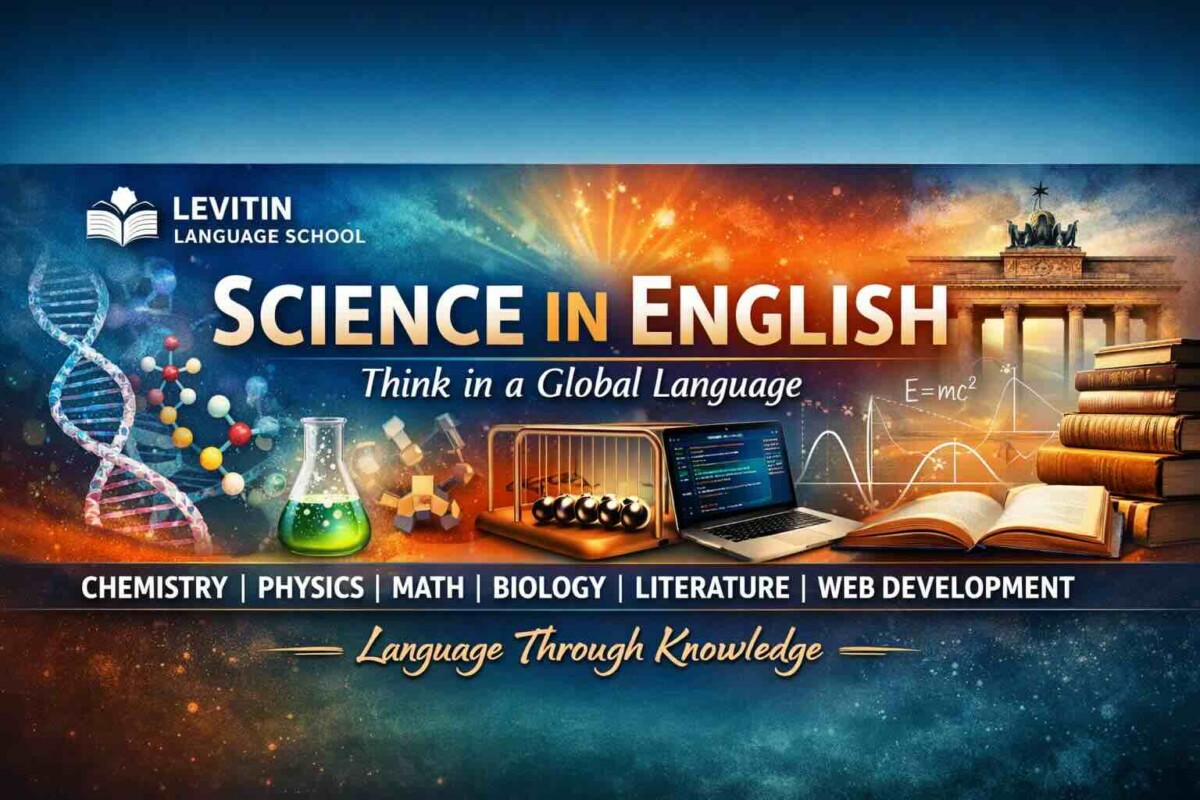
Chemistry in English.
Biochemistry in English.
Physics in German.
Mathematics in English.
Web Development in English.
Literature in English.
Sciences in English.
Not as translation exercises.
Not as vocabulary lists.
But as structured thinking.
Language Is Not a Subject. It Is an Operating System.
Most schools teach English as a set of rules.
But real English — especially academic English — is the language of structure, argument, precision, and logic.
When a student studies chemistry in English, something important happens:
- They stop translating.
- They begin categorizing.
- They learn how definitions work.
- They understand how cause and effect are expressed.
- They see how scientific reasoning is built grammatically.
Language becomes a cognitive framework.
And that is the difference between memorizing and thinking.
Chemistry in English: The Language of Transformation
Chemistry is built on transformation:
- react
- convert
- bond
- release
- synthesize
- decompose
These are not just scientific verbs.
They are abstract thinking verbs.
When students study chemistry in English, they learn:
- how passive voice structures responsibility
- how conditionals express experimental logic
- how nominalization creates academic tone
- how precision replaces emotional exaggeration
Scientific English trains restraint.
It trains clarity.
It trains structured explanation.
And that is real language mastery.
Biochemistry in English: Precision at the Molecular Level
Biochemistry is the intersection of language and life.
Words such as:
- enzyme
- catalyst
- substrate
- membrane
- regulation
- inhibition
require exact understanding.
One wrong preposition changes meaning.
One unclear subject breaks the logic.
In biochemistry lessons conducted in English, students develop:
- academic reading skills
- analytical listening
- structured argumentation
- terminology confidence
They do not just “learn words.”
They learn to operate in academic environments.
Physics in German: Logic, Order, and Structural Thinking
German is uniquely suited for physics.
Why?
Because German grammar forces structural anticipation.
In physics lessons in German, students learn:
- sentence framing before conclusion
- hierarchical clause construction
- logical sequencing
- precise terminology placement
German builds discipline in thought.
It teaches students that meaning is constructed step by step — not emotionally, but structurally.
This is why physics in German is not just content learning.
It is mental training.
Mathematics in English: The Universal Language of Abstraction
Mathematics in English is not about numbers.
It is about:
- argumentation
- symbolic reasoning
- conceptual explanation
- academic clarity
Students must explain:
- why a function behaves a certain way
- how a proof is constructed
- what assumptions underlie a solution
This develops:
- explanatory confidence
- structured speaking
- academic writing fluency
Mathematics becomes language training.
Language becomes mathematical reasoning.
Web Development in English: Global Communication in Action
Programming languages are built in English.
To study web development in English means:
- understanding documentation
- reading technical specifications
- communicating in international teams
- explaining logic to clients
This is not theoretical English.
This is applied global English.
Students who learn web development in English automatically develop:
- professional vocabulary
- clarity in instruction
- structured task description
- problem-solving communication
They learn to speak as professionals.
Literature in English: Depth, Nuance, Interpretation
While sciences train logic, literature trains perception.
In literature lessons in English, students learn:
- metaphor interpretation
- tonal nuance
- cultural context
- emotional precision
They discover how language shapes identity.
And they learn to express complex ideas without oversimplifying them.
Why This Approach Matters
The world does not need more students who “know grammar.”
It needs thinkers.
Studying sciences in English or German:
- prepares students for international universities
- develops academic fluency
- builds confidence in professional environments
- removes translation dependency
- integrates language with real knowledge
At Levitin Language School, we do not teach subjects separately from language.
We teach students how to think through language.
Who Is This For?
- International students preparing for IB or European universities
- Teenagers planning to study abroad
- Adults entering global academic or professional fields
- Parents seeking serious academic development for their children
If you want language to become a real tool — not a decorative skill — this path is for you.
Language.
Science.
Logic.
Structure.
Global Learning. Personal Approach.
Author’s Concept by Tymur Levitin
Founder & Director, Levitin Language School
© Tymur Levitin