
Before choosing a language, first choose your direction:
https://levitintymur.com/#languages
There is a moment almost every language learner eventually reaches.
At first everything moves quickly.
You learn basic grammar.
You begin to understand simple texts.
You can introduce yourself.
You recognize words in movies.
Progress is visible and encouraging.
Then you reach intermediate level.
And something strange happens.
You continue studying — but improvement almost stops.
Months pass.
Sometimes years.
You still study.
You still attend lessons.
You still do exercises.
But your level does not really change.
Many students think this means they are not talented for languages.
In reality, this is the most predictable stage of language learning.
Why Early Progress Feels Fast
Beginner learning is based on accumulation.
Every new word produces immediate effect.
Every grammar structure expands understanding.
At this stage, language is additive.
You add vocabulary → comprehension grows.
You add grammar → sentences appear.
The brain easily measures success.
This creates motivation because improvement is clearly visible.
But this stage is temporary.
What Actually Changes at Intermediate Level
When a student reaches approximately B1, the nature of learning changes.
The task is no longer to learn new information.
The task becomes to reorganize thinking.
And this is where most students unknowingly continue using beginner strategies for an advanced problem.
The brain already understands the language.
But it still processes it through the native language.
Up to B1 this works.
After B1 this becomes the main obstacle.
The Hidden Translation System
Intermediate learners still operate a mental mechanism:
foreign language → native language → meaning → response → translation back
The student understands slowly but correctly.
However conversation requires immediate reaction.
The brain now faces a conflict:
- understanding requires translation
- speaking requires speed
The student is not lacking vocabulary.
The student is running two languages simultaneously.
Cognitive load becomes too high.
This is the plateau.
Why Vocabulary Starts “Disappearing”
Many learners report a frightening experience:
“I knew this word yesterday. Today I forgot it.”
They did not forget it.
They never stored it in a speech system.
They stored it in a recognition system.
Recognition memory is passive.
Speech memory is active.
A student can understand 5000 words and still be unable to use 1500 of them spontaneously.
At intermediate level the brain refuses to convert passive knowledge into active behavior automatically.
This is not memory failure.
This is processing architecture.
Why Speaking Sometimes Gets Worse
A particularly confusing moment occurs.
A student improves understanding — but speaking deteriorates.
Parents often worry at this point.
In reality, this is often progress.
The brain is beginning to bypass translation.
During this transition, control temporarily weakens.
The student no longer carefully constructs sentences.
They attempt direct expression.
Accuracy falls.
Fluency is being built.
This stage is psychologically uncomfortable but cognitively necessary.
Why Native Speakers Often Do Not Solve the Problem
Many families react logically:
“If the problem is speaking, a native speaker will fix it.”
Sometimes yes.
Often no.
Native speakers communicate naturally but rarely analyze processing mechanisms.
They can model language, but they cannot always diagnose cognitive interference.
At plateau level, the student needs not only exposure, but guided restructuring of how meaning is formed.
Otherwise practice reinforces hesitation patterns.
More conversation does not always create faster speech.
It can stabilize slow speech.
The Real Skill Missing at Intermediate Level
At beginner level, the skill is memorization.
At advanced level, the skill is nuance.
At intermediate level, the missing skill is automatic response formation.
The learner must stop building sentences and start reacting with meaning.
This cannot be achieved by more grammar alone.
It requires specific types of tasks:
- reformulation
- immediate response drills
- perception training
- controlled pressure speaking
These retrain the brain to attach thought directly to the foreign language.
Why Students Change Teachers at This Stage
It is very common for a student to study successfully for years with one teacher and then suddenly need a different approach.
This does not mean the previous teacher was ineffective.
The learning task changed.
One teacher helped accumulate knowledge.
Another may be needed to reorganize cognitive habits.
Both roles are valid.
But they are not identical.
Understanding this prevents unnecessary frustration for families and students.
What the Plateau Actually Means
The plateau is not stagnation.
It is a neurological transition.
The learner moves from:
learning a language
to
operating in a language.
This transition cannot be forced by intensity alone.
It requires a change in how learning is structured.
Once the shift occurs, progress accelerates again — but differently.
Not in rules learned.
In reaction speed, confidence, and natural speech.
What You Should Do If You Are at This Stage
If you or your child feels stuck after years of learning:
Do not immediately increase homework volume.
Do not only change textbooks.
Do not assume ability limits.
First determine whether the issue is knowledge or processing.
Very often the student knows enough.
They simply have not yet switched from translation to thinking.
You may describe your situation to us even if you are not currently our student.
We will honestly explain what stage you are at and what realistically can be improved within your timeframe.
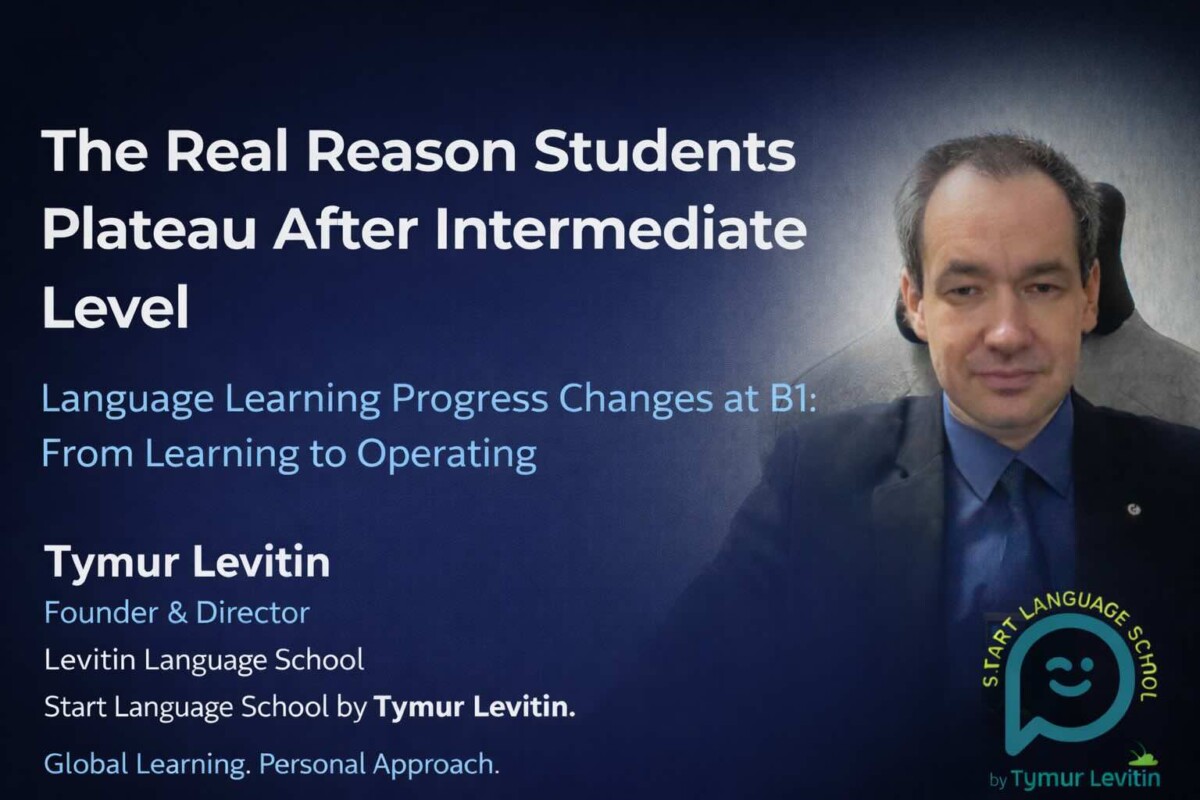
Author: Tymur Levitin
Founder & Director, Levitin Language School
© Tymur Levitin, Levitin Language School. All rights reserved.
Global Learning. Personal Approach.