
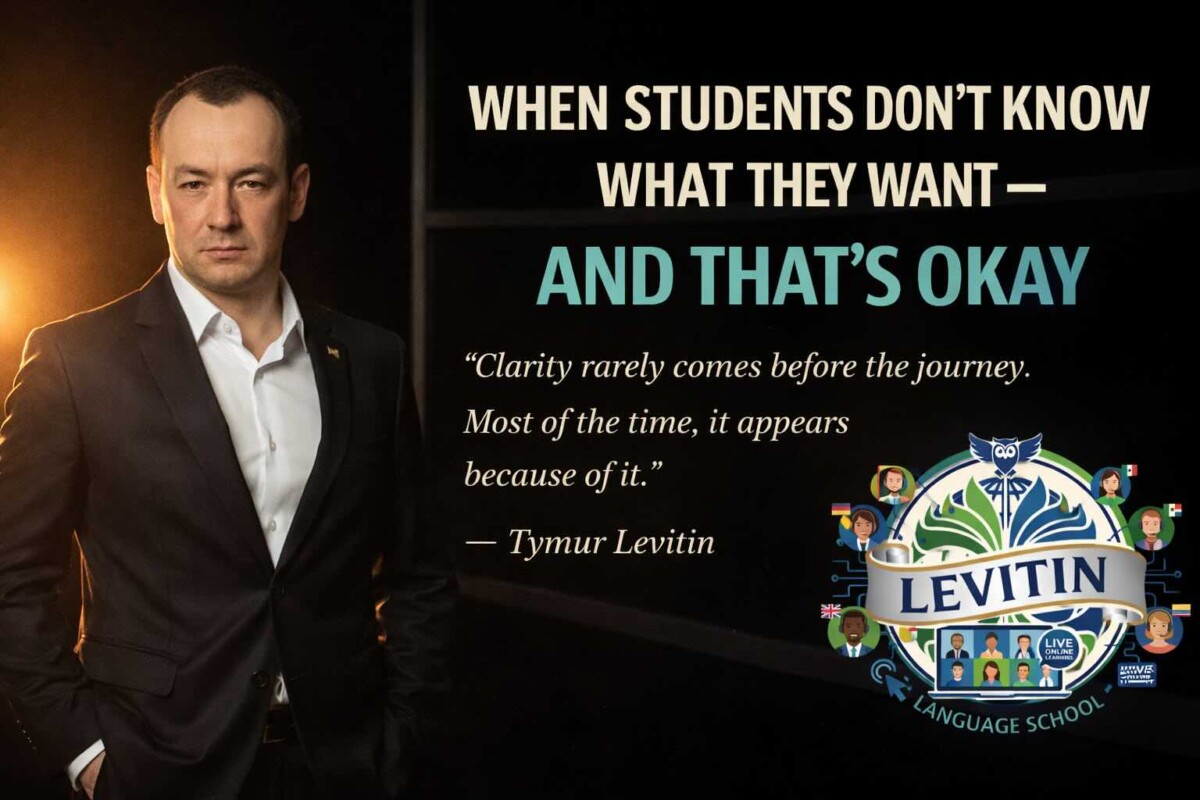
“Clarity rarely comes before the journey.
Most of the time, it appears because of it.”
— Tymur Levitin
Many people believe that learning a language must begin with a perfectly clear goal.
“Why do you want to learn?”
“How long do you plan to study?”
“What exact result do you expect?”
These questions sound reasonable. But in real life, the answers are often uncertain.
And that’s completely normal.
The Myth of the Perfect Goal
In many systems, students are expected to arrive with a fully formed plan.
They should know which language they need, why they need it, and how far they want to go.
But people rarely live like that.
Someone writes that they want to learn German.
Later they realize they actually need English for work.
Another student believes conversation is the priority.
Then grammar suddenly becomes the missing piece.
Someone else simply says:
“I don’t know. I just feel I need a language.”
For many schools, that answer creates confusion.
For us, it creates a starting point.
Learning Begins With Exploration
At Levitin Language School, we don’t expect students to arrive with perfect clarity.
Our job is not to interrogate a person until they produce a goal.
Our job is to discover the direction together.
Sometimes the first lessons are not only about language.
They are about understanding the student:
- how they think
- what slows them down
- what motivates them
- what they actually need
And that understanding rarely appears in the first message or even the first lesson.
It develops gradually.
The Journey Reveals the Goal
Many students begin their studies believing they want one thing.
Months later, they discover something else entirely.
Someone starts with grammar but finds confidence in conversation.
Someone else begins with speaking but realizes structure is the real key.
Another student discovers that learning a language is not only about work — it is about identity, freedom, and possibility.
None of these discoveries are mistakes.
They are part of the process.
And a teacher who refuses to adjust to this process is not guiding the student — they are forcing the student into a rigid system.
Teaching Is Not Navigation With a Fixed Map
Traditional systems often treat education like a railway line:
one route, one direction, one schedule.
But real learning is closer to exploration.
Sometimes the path turns.
Sometimes the destination changes.
Sometimes the student realizes the journey itself is more important than the original plan.
A responsible teacher does not panic when this happens.
A responsible teacher adjusts the direction.
Uncertainty Is Not Weakness
When a student says, “I’m not sure what I want yet,”
they are not demonstrating confusion.
They are demonstrating honesty.
And honesty is the best possible foundation for learning.
Because when the pressure to pretend disappears,
real progress can begin.
At Levitin Language School, the Path Is Built Together
We believe that language education should not force people into predefined templates.
Instead, the learning process should grow naturally from the student’s needs, abilities, and discoveries.
That is why our approach remains flexible, attentive, and human.
We don’t demand certainty from the beginning.
We build clarity along the way.
And very often, by the time the student understands exactly where they want to go,
they have already traveled much further than they expected.
Written by Tymur Levitin
Founder and Director of Levitin Language School
Learn more:
https://levitintymur.com/
© Tymur Levitin