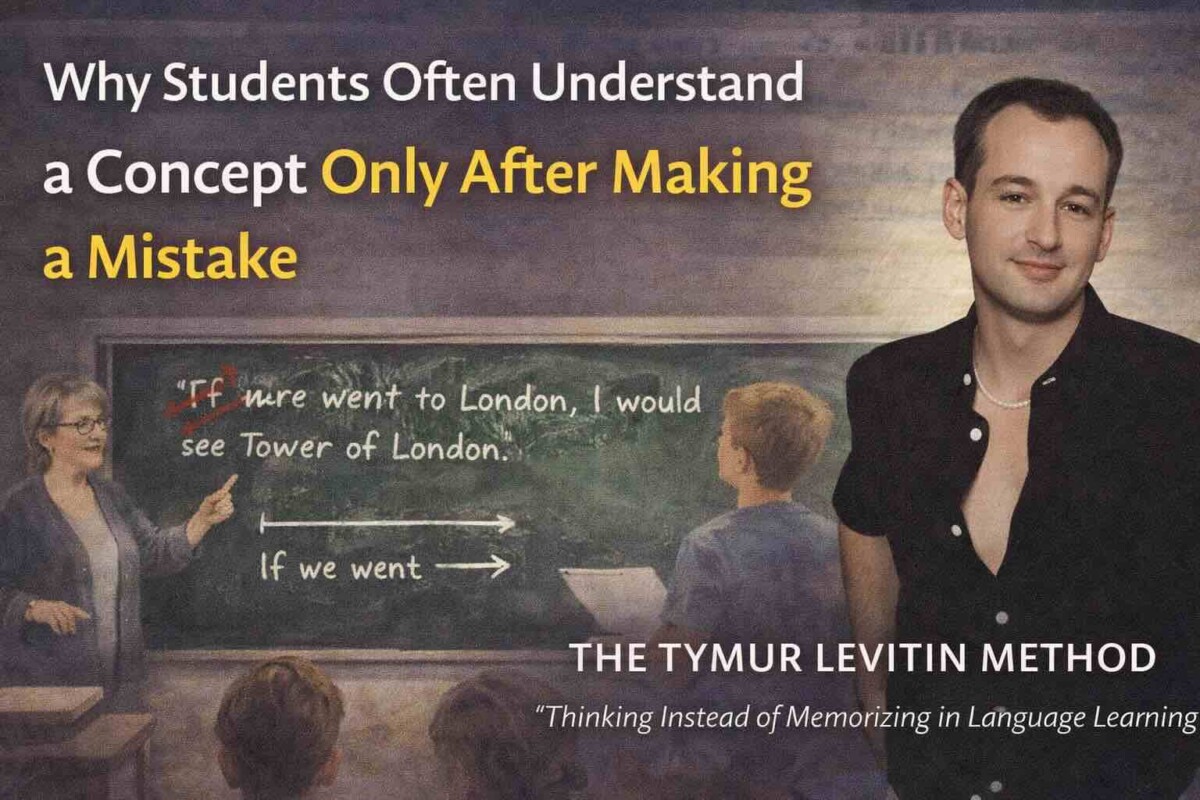

In many classrooms, mistakes are treated as something negative.
Students try to avoid them.
Teachers try to correct them immediately.
Educational systems often measure progress by counting how many mistakes students make.
But in real learning, something very different often happens.
Many students understand a concept only after making a mistake.
Not before.
Why the Brain Needs Contrast
Understanding does not appear only through correct answers.
It often appears through contrast.
When a student makes a mistake, the brain suddenly receives new information.
Something does not match expectations.
Something does not work.
That moment of mismatch forces the brain to re-examine the structure of the idea.
And this is exactly when real learning often begins.
The Illusion of Passive Understanding
Sometimes students think they understand a concept simply because it sounds logical.
They listen to the explanation.
They follow the teacher’s reasoning.
Everything seems clear.
But when they try to apply the idea themselves, the structure collapses.
A mistake appears.
This mistake is not a failure.
It is the first real test of understanding.
Why Mistakes Reveal Hidden Thinking
When a student answers incorrectly, the teacher receives valuable information.
The mistake reveals how the student is actually thinking.
For example, in language learning a student may apply a rule too broadly.
Or combine two correct rules incorrectly.
Or transfer logic from another language.
Each of these mistakes shows something important about the student’s internal model of the language.
Without mistakes, these hidden models often remain invisible.
Correct Answers Do Not Always Prove Understanding
A surprising fact in education is that correct answers can sometimes hide confusion.
Students may guess correctly.
They may repeat patterns from memory.
They may imitate examples.
Everything looks successful.
But the structure of understanding may still be fragile.
When a mistake finally appears, it exposes the weakness of the system.
And this gives the teacher an opportunity to rebuild the idea correctly.
Why Fear of Mistakes Slows Learning
Many educational environments unintentionally create fear.
Students become afraid of giving the wrong answer.
They hesitate to speak.
They avoid trying new structures.
But fear prevents experimentation.
And without experimentation, mistakes disappear.
At first this may look like progress.
In reality, it often means that learning has slowed down.
Productive Mistakes
Not all mistakes are equal.
Some mistakes appear randomly.
But many mistakes are highly productive.
They show that the student is actively trying to apply the system.
These mistakes are signs of intellectual work.
They indicate that the student is moving from passive listening to active thinking.
And that transition is essential for language learning.
What Good Teachers Do with Mistakes
Experienced teachers rarely treat mistakes as simple errors to be eliminated.
Instead, they treat them as diagnostic tools.
A mistake can show:
- where a rule was misunderstood
- where two rules conflict in the student’s mind
- where the explanation was incomplete
- where the student’s native language influences the structure
Each mistake becomes a clue.
And each clue helps refine the explanation.
Learning Through Correction
One of the most powerful moments in learning happens when a student sees exactly why a mistake occurred.
The incorrect structure becomes clear.
The correct structure replaces it.
The contrast between the two creates a strong memory.
Students often remember these moments much longer than perfect answers.
Because the brain remembers the correction of an error as a meaningful event.
The Role of Mistakes in Language Learning
Language is a complex system.
No student can master it without testing its limits.
Mistakes are part of this exploration.
They show that the student is moving beyond memorized phrases and beginning to build independent speech.
And this is where real language learning begins.
Not when students repeat correct sentences.
But when they experiment, fail, adjust, and understand.
The Paradox of Good Teaching
The goal of teaching is not to eliminate mistakes.
The goal is to transform mistakes into understanding.
A classroom without mistakes may look perfect.
But a classroom where mistakes are analyzed, understood, and corrected often produces much deeper learning.
Because that is where thinking replaces memorizing.
Author: Tymur Levitin
Founder & Director, Levitin Language School
© Tymur Levitin