
How Colours Reveal the Hidden Logic of Culture
We think colours are universal.
Red is red.
Green is green.
Blue is blue.
But the moment you step into another language, colour stops being visual — and becomes cultural.
And this is where misunderstandings begin.
Red Is Not Always Just Red
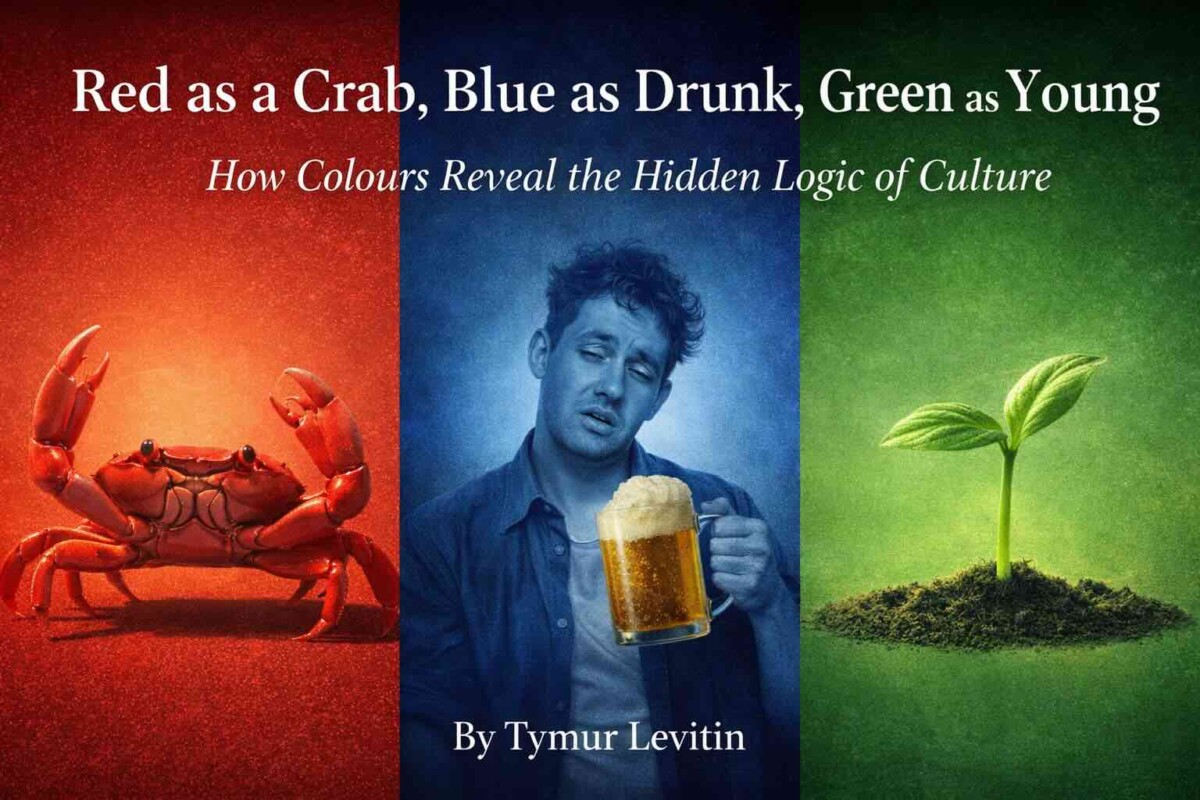
In English, someone embarrassed is “red as a lobster.”
In Ukrainian, the comparison is different.
«Червоний, як рак.»
Red as a crab.
In Russian, you hear the same structure:
«Красный, как рак.»
Why lobster in English? Why crab in Slavic languages?
Because metaphor grows from environment.
Britain and North America — coastal lobster culture.
Eastern Europe — river crab imagery.
The biology changes.
The embarrassment does not.
Now look deeper.
In English:
- to see red — to become angry
- in the red — financial loss
- red tape — bureaucracy
In German:
- rot sehen — to become furious
In Ukrainian:
- «почервоніти» — to blush
- «червона лінія» — a red line, a boundary
Same colour.
Different symbolic density.
Red can mean shame, rage, debt, warning, revolution, passion.
Language does not describe colour.
It encodes history.
Green Is Not Always Youth
In English, someone inexperienced is “green.”
In Ukrainian:
«Зелений» also means inexperienced.
In Russian:
«Зелёный» — same idea.
That seems simple.
But English also says:
- green with envy — jealous
- green light — permission
- go green — ecological consciousness
In German:
- grün hinter den Ohren sein — literally “to be green behind the ears” (inexperienced)
But German also says:
- blau sein — to be drunk.
Blue is not sadness here.
It is intoxication.
In English, blue often signals melancholy:
- feeling blue
In Ukrainian:
«Синій» in colloquial speech can also describe drunkenness.
Same colour.
Different emotional mapping.
Blue, Drunk, Sad — Why Does This Happen?
Because colour symbolism is not visual logic.
It is associative logic.
Climate influences metaphor.
Religion influences metaphor.
Politics influences metaphor.
Even alcohol culture influences metaphor.
German “blau sein” has historical roots in craft traditions and fermentation.
English “feeling blue” is linked to older maritime and cultural associations with sorrow.
These expressions were not invented by linguists.
They emerged organically.
And once embedded, they shape how people feel language.
The Illusion of Direct Translation
A student once asked me:
“If green means inexperienced in my language, can I always use it the same way in English?”
The grammatical answer is yes.
The cultural answer is no.
Because meaning is not a word.
Meaning is a network.
When you translate a colour expression literally, you risk transferring the wrong emotional charge.
And emotional charge is what people react to.
Not grammar.
Colour as Cultural Memory
Every metaphor is a fossil.
It preserves a worldview from another time.
Why does English associate envy with green?
Why does German associate drunkenness with blue?
Why does Slavic speech prefer river creatures over ocean creatures?
Because languages evolve inside environments.
And environments are never identical.
Why This Matters Beyond Vocabulary
When students memorise colour idioms as vocabulary lists, they believe they have learned something.
They have not.
They have learned surface equivalence.
Real mastery begins when you ask:
What does this culture associate with this colour?
What emotional temperature does this metaphor carry?
Would a native speaker feel this phrase as neutral, ironic, aggressive, poetic?
That is a different level of awareness.
That is thinking inside the language.
Languages Do Not Share a Palette
At school we were taught that colours are universal categories.
But languages do not divide the spectrum identically.
Some languages historically did not separate blue and green clearly.
Some distinguish shades that others group together.
So even before metaphor appears, perception is already filtered.
Add culture on top — and you have a completely different symbolic system.
Why I Insist on Depth
After more than two decades in education, I no longer believe that fluency is speed.
Fluency is sensitivity.
If you understand how colours operate metaphorically in a language, you are no longer translating mechanically.
You are interpreting intention.
And that is what protects you in real conversations — in interviews, in negotiations, in relationships.
Because when someone says they are “seeing red,”
they are not talking about colour.
They are telling you something about emotional intensity.
And if you misread it, the consequences are not linguistic.
They are human.
Author: Tymur Levitin
Founder and Director, Levitin Language School
Global Learning. Personal Approach.
© Tymur Levitin