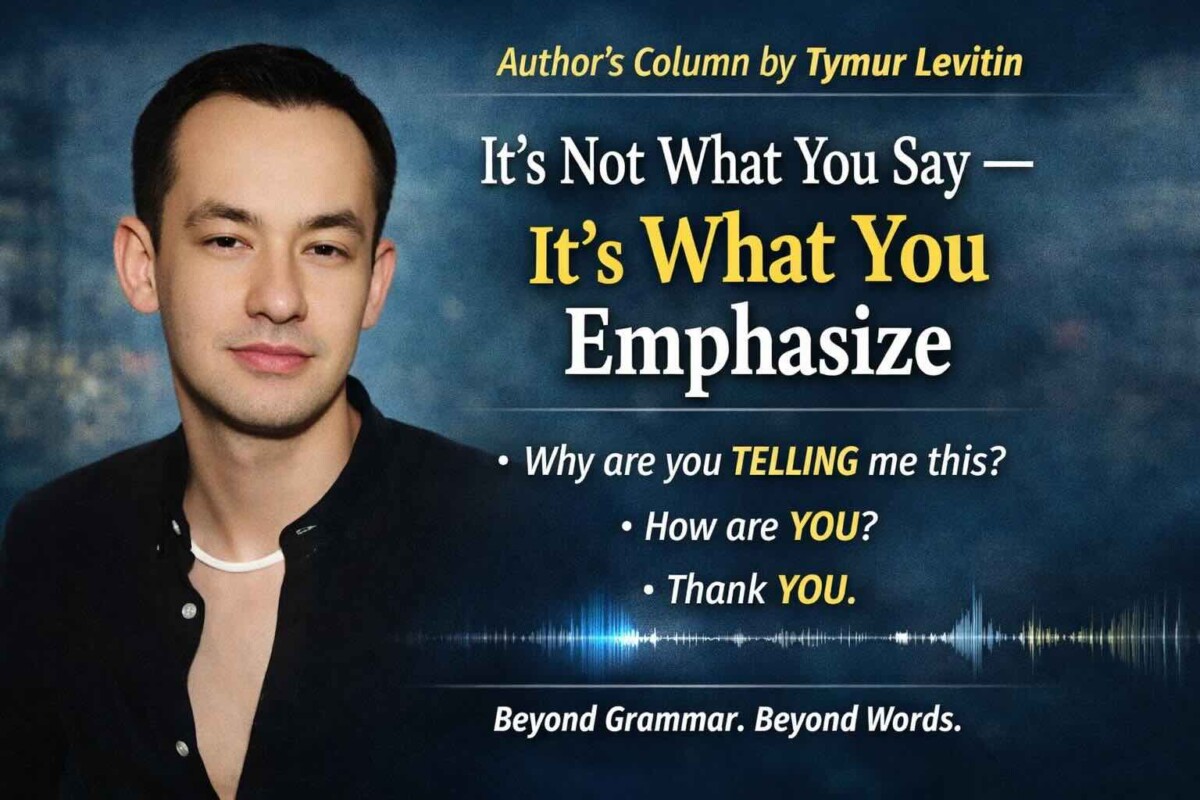

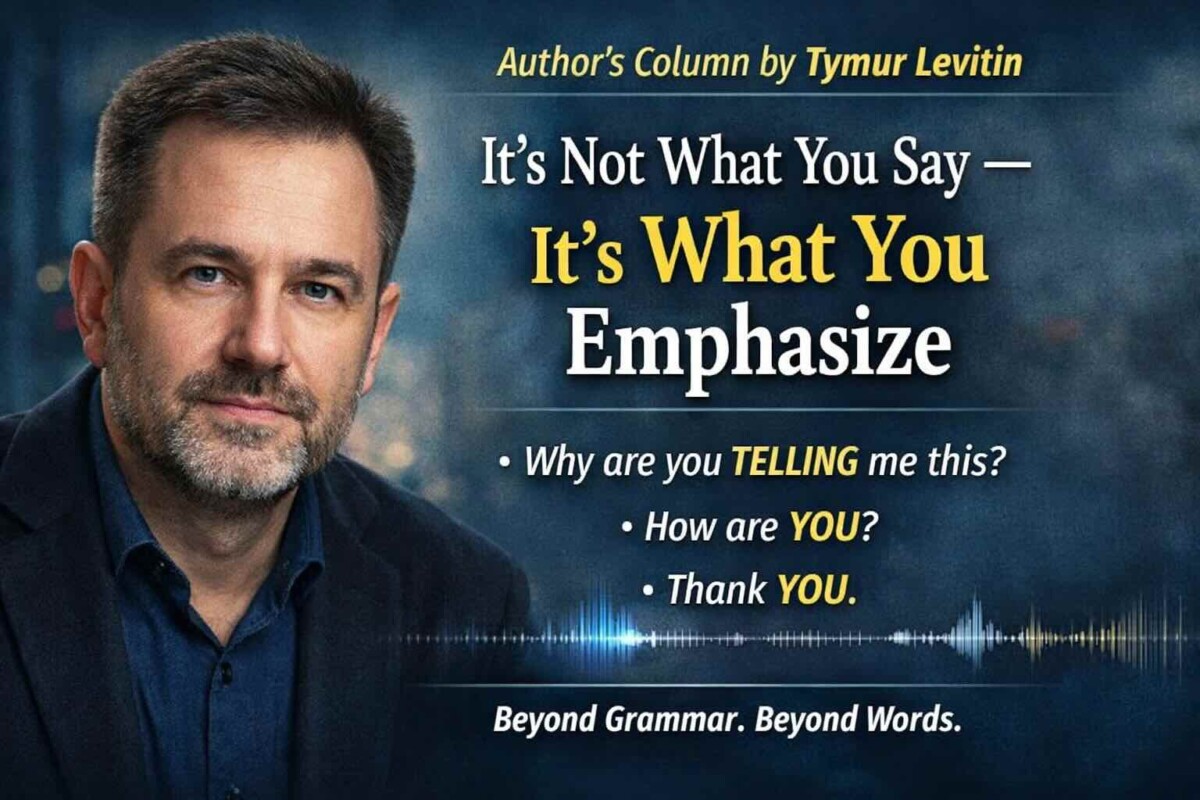
Author’s Column by Tymur Levitin
Language. Identity. Choice. Meaning.
There is a layer of language that grammar books almost never explain.
Not because it is unimportant.
But because it is difficult to formalize.
You can learn vocabulary.
You can memorize tenses.
You can master articles, prepositions, cases, and word order.
And still completely misunderstand — or be misunderstood.
Because meaning is not only in the words.
It is in what you emphasize.
The Same Sentence. Different Realities.
Let’s take a simple line:
Why are you telling me this?
Now listen carefully — not to the words, but to the stress.
- Why are you telling me this?
→ What is your reason? - Why are you telling me this?
→ Why are you informing me instead of doing something else? - Why are you telling me this?
→ Why me? Why not someone else? - Why are you telling me this?
→ Why this specific information?
The grammar hasn’t changed.
The vocabulary hasn’t changed.
But the meaning has.
This is not grammar.
This is pragmatics — the real mechanics of communication.
And this is where most learners get lost.
“How Are You?” — And What You Actually Mean
Many learners treat How are you? as a neutral, universal question.
But English is not neutral.
- How are you?
→ Polite routine. Social signal. Not always a real question. - How are you?
→ Personal shift. I am now focusing on you specifically. - How are you today?
→ Something has changed. I expect a different answer.
The structure is identical.
The intention is not.
Students who don’t understand this layer often sound either too flat — or too intense.
They answer sincerely when no sincerity was requested.
Or they sound emotionally cold when warmth was expected.
“Thank You” Is Not Always Gratitude
Consider:
- Thank you.
- Thanks.
- Thank you.
- Thank you very much.
These are not interchangeable.
“Thanks.” can be casual.
“Thank you.” can be neutral.
“Thank you very much.” can be genuine — or sarcastic.
“Thank YOU.” can express correction, gratitude, or confrontation — depending on tone.
Again: grammar does not explain this.
Only awareness does.
“I Suppose We Could…” — Five Possible Meanings
Let’s take another simple sentence:
I suppose we could.
Depending on intonation, it can mean:
- Mild agreement.
- Doubt.
- Polite refusal.
- Reluctant acceptance.
- Soft suggestion.
Flat tone:
I suppose we could.
→ Neutral agreement.
Lowered voice, pause:
I suppose… we could.
→ Doubt. Hesitation.
Slight emphasis on we:
I suppose we could.
→ Maybe others can’t. But we can.
Emphasis on could:
I suppose we could.
→ It’s possible, but not ideal.
Nothing changed in grammar.
Everything changed in meaning.
What Textbooks Don’t Teach
Most language education focuses on correctness.
Correct tense.
Correct form.
Correct preposition.
But real-life communication depends on:
- Logical stress
- Pauses
- Rhythm
- Emotional alignment
- Cultural expectations
A sentence can be grammatically perfect and socially wrong.
A phrase can be structurally accurate and pragmatically aggressive.
And learners rarely understand why.
Why This Matters
In real communication, stress placement can:
- Turn a question into an accusation
- Turn gratitude into irony
- Turn agreement into resistance
- Turn politeness into distance
You don’t just speak words.
You project intention.
And native speakers hear intention faster than grammar.
The Hidden Layer of Language
When students say to me:
“I know the words. I know the grammar. Why do I still sound wrong?”
The answer is usually here.
Not in vocabulary.
Not in tense.
But in emphasis.
Language is not a set of constructions.
It is a system of signals.
And emphasis is one of the most powerful signals we have.
What We Actually Teach
At Levitin Language School, we don’t only analyze structure.
We analyze intention.
We train students to hear:
- What is being said
- What is being implied
- What is being emphasized
- What is being avoided
Because fluency is not speed.
Fluency is control.
Control over meaning.
Control over tone.
Control over impact.
This article opens a new series dedicated to the invisible mechanics of speech — the layer that exists beyond grammar but determines real understanding.
Because in language, it is rarely about what you say.
It is about what you emphasize.
Author: Tymur Levitin
Founder & Director, Levitin Language School
Global Learning. Personal Approach.
© Tymur Levitin