
When students first encounter Future Perfect, they usually see this formula:
will have + past participle
And they are told:
“It describes an action that will be completed before a certain time in the future.”
Technically correct.
Structurally incomplete.
Because Future Perfect is not about “completion before.”
It is about looking back from a future point.
That shift in perspective is everything.
The Core Perspective Shift
Imagine you move forward in time.
You are now standing in the future.
From that position, you look backward.
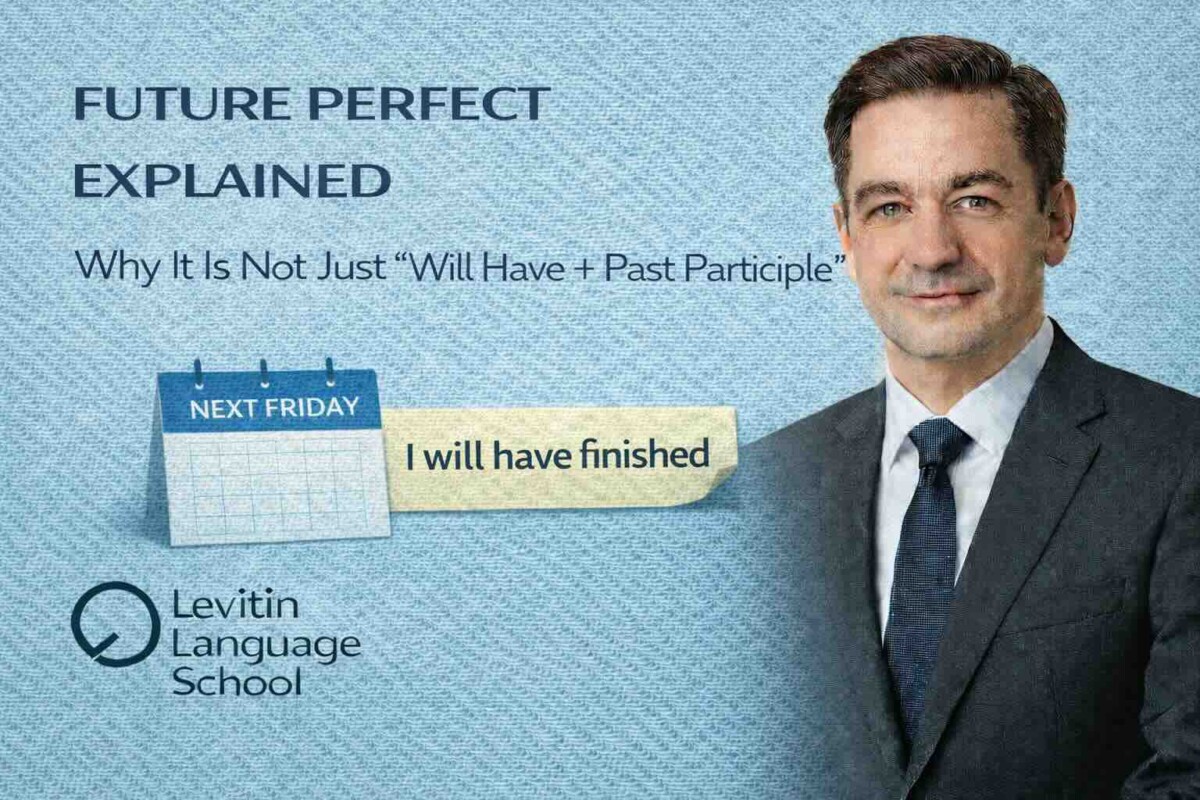
By next Friday,
I will have finished the project.
You are not speaking from today.
You are speaking from next Friday.
And from that future position,
the project is already complete.
That is the logic.
It Is Not About the Action — It Is About the Deadline
Future Simple says:
I will finish the project.
Future Perfect says:
By Friday, I will have finished the project.
The focus changes.
Future Simple = decision.
Future Perfect = state at a future deadline.
The action is secondary.
The reference point is primary.
The Structural Formula
will have + past participle
But the deeper formula is:
future reference point → completed state before it
Without a clear reference point, the tense feels artificial.
Future Perfect almost always needs:
- by + time
- before + time
- by the time + clause
Because it depends on structure.
Compare With Past Perfect
Past Perfect:
When I arrived, she had left.
Future Perfect:
By the time I arrive, she will have left.
They mirror each other.
Both create depth in time.
Both step inside a moment
and look backward.
The only difference is direction.
Why Learners Avoid It
Because it feels distant.
But in real English, it is extremely common:
By next year, she will have completed her degree.
In two months, we will have been married for ten years.
It expresses progress toward a target.
It sounds structured.
Professional.
Planned.
The Planning Effect
Future Perfect often appears in:
- business contexts
- project planning
- academic timelines
- long-term goals
Because it frames completion as a measurable result.
It is not emotional.
It is architectural.
The Psychological Dimension
Future Simple = I promise.
Going To = I intend.
Present Continuous = It’s arranged.
Future Continuous = It will be in progress.
Future Perfect = It will already be done by then.
That last phrase — by then — is the key.
When Not to Use It
If there is no future reference point,
Future Perfect becomes unnecessary.
❌ I will have finished the project. (without context)
✔ I will have finished the project by Friday.
The structure requires anchoring.
Final Insight
Future Perfect is not about grammar complexity.
It is about temporal architecture.
You move forward in time,
stand at a future moment,
and observe what is already complete.
That is not just a tense.
That is perspective control.
And once you see that,
the formula stops being mechanical.
It becomes visual.
Author: Tymur Levitin
Founder & Director, Levitin Language School
Global Learning. Personal Approach.
© Tymur Levitin