

Most learners are told something very simple:
“Use will to talk about the future.”
That explanation is convenient.
It is also misleading.
Because will is not primarily a time marker.
It is a marker of decision, intention, and speaker perspective.
Future Simple is not about time.
It is about commitment.
The Hidden Meaning of “Will”
The word will historically meant “to want.”
Even today, traces of that meaning remain.
When you say:
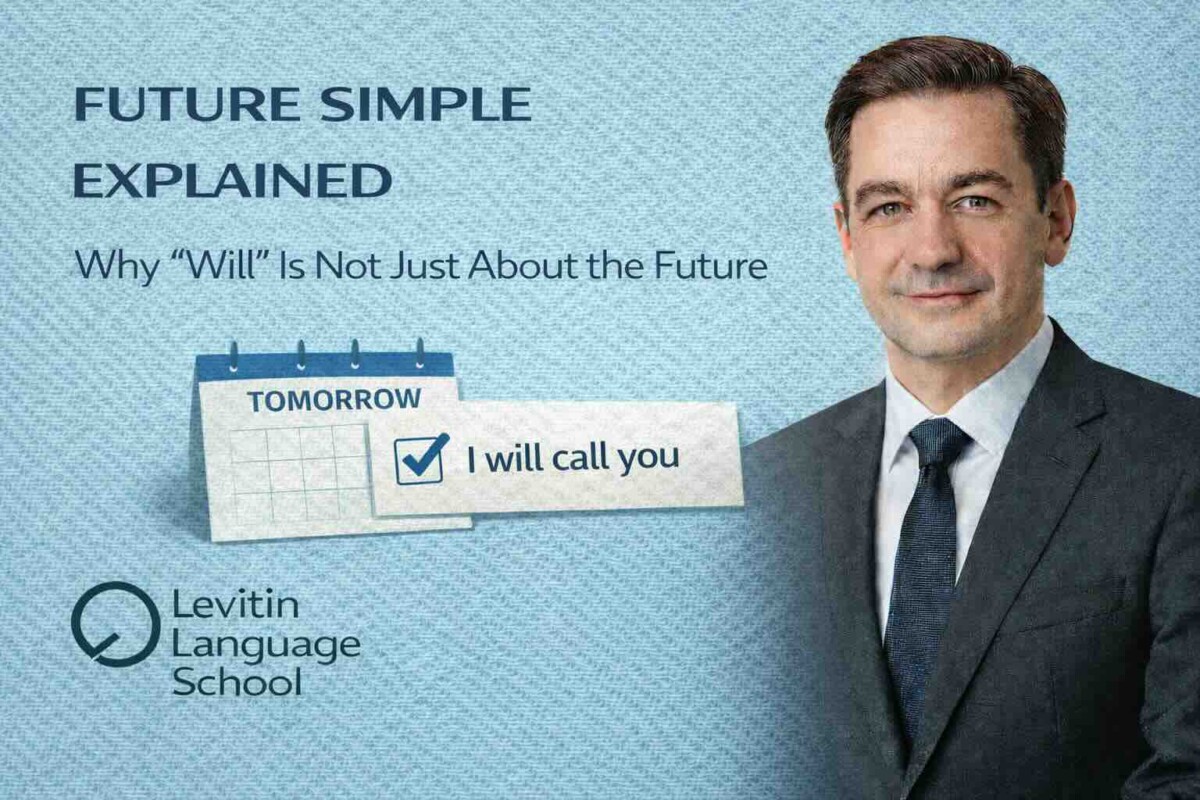
I will call you tomorrow.
You are not just describing tomorrow.
You are expressing a decision made now.
The tense connects the present mind
to a future action.
That connection is the key.
Future Simple Is About Decision at the Moment of Speaking
Compare:
1️⃣ Spontaneous decision
The phone is ringing.
I’ll answer it.
The decision is made now.
That is why we use will.
2️⃣ Prior plan
I’m going to visit London next week.
This decision was made earlier.
Different structure.
Different logic.
Future is not one tense.
It is a system of perspectives.
Promise, Offer, Threat
Future Simple often expresses:
- promises
- offers
- willingness
- threats
- determination
Examples:
I’ll help you.
I won’t forget this.
You’ll regret it.
These are not neutral time statements.
They are emotional commitments.
Why “Tomorrow” Does Not Automatically Mean “Will”
Students often think:
“Future time word → use will.”
Not always.
Compare:
The train leaves at 7 tomorrow.
I’m meeting her tomorrow.
I’ll call you tomorrow.
Three futures.
Three structures.
Because English does not organize future by time.
It organizes it by intention and structure.
The Real Function
Future Simple answers this question:
What am I deciding, promising, or predicting right now?
Even predictions carry personal stance:
I think it will rain.
She’ll probably arrive late.
It is not only about rain.
It is about how certain you feel.
Prediction vs Arrangement
Future Simple:
I’ll meet you at 5.
Spontaneous.
Present Continuous:
I’m meeting you at 5.
Arranged.
Subtle difference.
Huge impact on meaning.
One is commitment now.
The other is scheduled reality.
Why Learners Struggle
Because they try to map “future” as one block.
English does not treat the future as a fixed timeline.
It treats it as:
- decision
- intention
- plan
- arrangement
- prediction
Future Simple is just one piece.
But it is the most psychological one.
Stop Thinking About Time
Start thinking about stance.
When you say “will,”
you show personal involvement.
You are not reporting the future.
You are shaping it.
Structural Formula
will + base verb
But again — structure without logic is mechanical.
The deeper formula is:
present decision → future action
When that relationship is clear,
the tense becomes natural.
Final Insight
Future Simple is not about tomorrow.
It is about now.
It is about what you decide, promise, or predict at this moment.
Once you see that,
you stop asking:
“Is it future?”
You start asking:
“Is this my decision?”
And that is how English actually works.
Author: Tymur Levitin
Founder & Director, Levitin Language School
Global Learning. Personal Approach.
© Tymur Levitin