
Two very common verbs confuse English learners all the time: make and do.
Both are used constantly in everyday speech, and both can translate into the same verb in many languages.
But in English they follow a simple logic.
Once you see the pattern, the confusion disappears.
The Core Difference
The easiest way to remember:
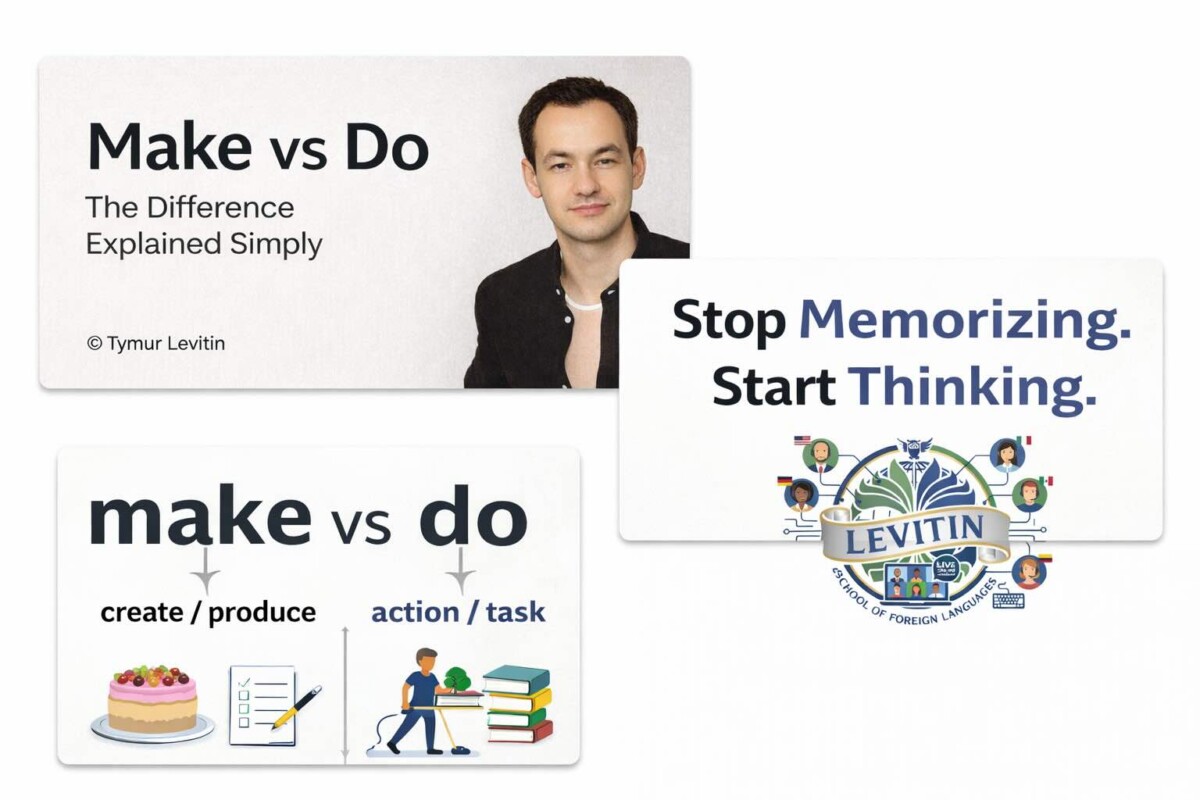
make = create / produce something
do = perform an action or task
In other words:
- make focuses on the result
- do focuses on the activity
Using MAKE
We use make when something new is created or produced.
Examples:
- She made a cake.
- He made a mistake.
- They made a plan.
In all these cases something appears as a result.
More examples:
- make a decision
- make a list
- make a promise
- make a phone call
Using DO
Do is used for actions, tasks, or work.
Examples:
- I did my homework.
- She does the cleaning.
- They did the work yesterday.
Here the focus is not the result but the activity itself.
Common expressions:
- do homework
- do the dishes
- do the work
- do business
The Most Common Mistakes
Mistake 1
❌ I did a mistake.
✔️ I made a mistake.
Mistake 2
❌ She made her homework.
✔️ She did her homework.
Mistake 3
❌ I did a decision.
✔️ I made a decision.
Fixed Expressions You Should Memorize
Unfortunately, some expressions must simply be learned.
Common MAKE expressions
- make a mistake
- make money
- make progress
- make a decision
- make a phone call
Common DO expressions
- do homework
- do the dishes
- do business
- do your best
- do work
A Simple Way to Remember
Ask yourself one question:
Is something being created?
If yes → make
If not, and it is just an action or task → do
Example:
- create a cake → make a cake
- complete homework → do homework
Related Articles
- https://levitintymur.com/english/since-vs-for-explained-simply/
- https://levitintymur.com/english/already-vs-yet-explained-simply/
- https://levitintymur.com/english/say-vs-tell-the-difference-explained-simply/
Learn English with Clear Structure
Grammar becomes much easier when it is explained step by step and practiced in real conversation.
Explore English learning options here:
© Tymur Levitin
Founder & Director
Levitin Language School