
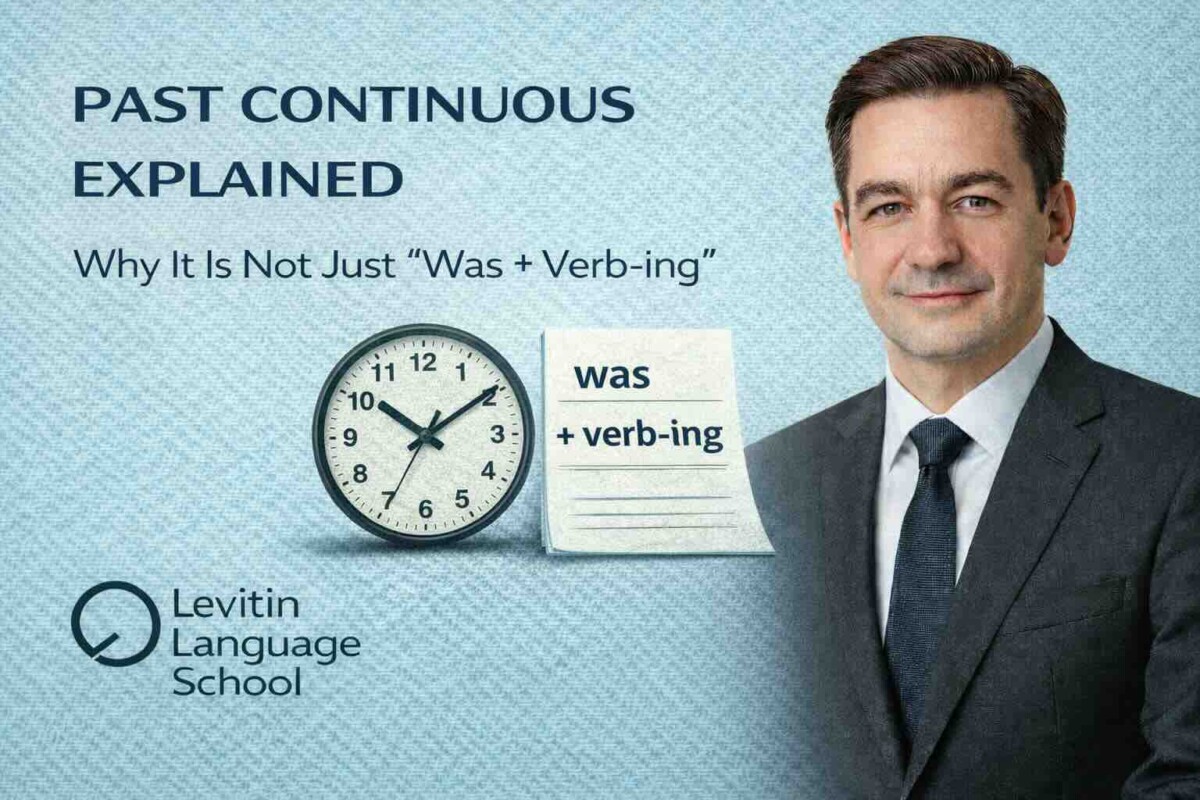
Many learners reduce Past Continuous to a formula:
was / were + verb-ing
Technically correct.
Conceptually incomplete.
Past Continuous is not about grammar structure.
It is about background perspective inside the past.
And if you misunderstand that, you will misuse it for years.
Past Continuous Is About Internal Time
Past Simple moves events forward:
She opened the door.
She entered the room.
She sat down.
Timeline. Movement. Sequence.
Past Continuous does something different.
She was opening the door.
She was entering the room.
Now we are inside the action, not observing it as a completed fact.
Past Continuous does not describe finished events.
It describes actions in progress at a past moment.
The Core Principle: Interrupted or Framed
Past Continuous usually appears in two major functions:
1️⃣ Interrupted Action
I was working when you called.
She was sleeping when the phone rang.
Past Continuous = background process
Past Simple = interruption
It creates depth in the timeline.
2️⃣ Parallel Background
While I was cooking, she was setting the table.
They were talking while we were driving.
Two processes unfolding at the same time.
Not sequence — simultaneity.
Why It Is Not Just “Long Action”
Students are often told:
“Use Past Continuous for longer actions.”
This is misleading.
Length is irrelevant.
It is about perspective at a specific past point.
At 8 PM, I was studying.
Not finished. Not evaluated.
Just ongoing at that moment.
Past Continuous answers:
What was happening at that past moment?
The Visual Difference
| Past Simple | Past Continuous |
|---|---|
| Dot on timeline | Segment on timeline |
| Event completed | Action unfolding |
| Moves story forward | Provides background |
| External view | Internal view |
Past Continuous zooms in.
Past Simple steps back.
Why It Sounds More Descriptive
In storytelling, Past Continuous creates atmosphere.
The wind was blowing.
People were shouting.
The city was sleeping.
It builds environment.
Past Simple builds action.
Good narrative uses both.
The Psychological Effect
Past Continuous often softens statements.
Compare:
You broke my phone.
Direct accusation.
You were using my phone.
Context before accusation.
It shifts focus from result to situation.
Why Learners Mix It With Present Continuous
Because the structure looks similar:
- I am working.
- I was working.
But the anchor is different.
Present Continuous → happening now
Past Continuous → happening then
The difference is not structure.
It is reference point.
The Deeper Structural Insight
Past Continuous does not compete with Past Simple.
It depends on it.
Past Continuous creates the frame.
Past Simple delivers the event.
Without Past Continuous, narrative is flat.
Without Past Simple, narrative does not move.
Final Insight
Past Continuous is not about duration.
It is about being inside the past moment instead of outside it.
When you understand that, tense choice becomes visual, not mechanical.
You stop memorizing formulas.
You start controlling perspective.
Grammar becomes cinematic.
Author’s original explanation and methodology by Tymur Levitin
Founder & Director
Levitin Language School
Global Learning. Personal Approach.
© Tymur Levitin