

Most grammar books define Past Perfect like this:
“Use Past Perfect for an action that happened before another past action.”
Technically correct.
Conceptually shallow.
Past Perfect is not about “earlier.”
It is about priority and background status inside the past.
And until you see that distinction, it will always feel mechanical.
Past Perfect Is About Past Perspective
Imagine you are already standing in the past.
You are not in the present anymore.
You are inside a finished time frame.
Now you look further back.
That backward step creates Past Perfect.
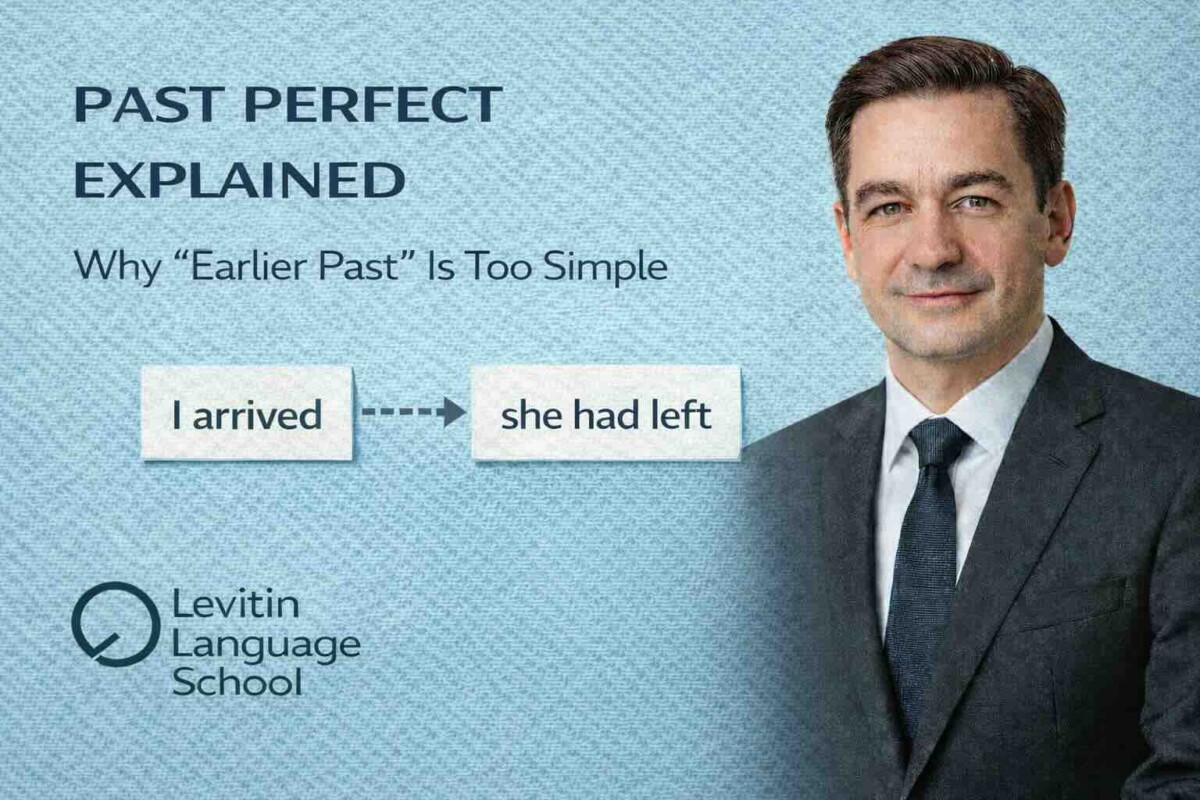
When I arrived, she had already left.
We are inside the past moment: I arrived.
From that point, we look further back: she had left.
Past Perfect creates depth inside the past.
The Structural Logic
Past Simple builds the main timeline:
I arrived at 8 PM.
Past Perfect builds what existed before that moment:
She had prepared everything before I arrived.
It answers:
What was already true at that past moment?
Not:
“When did it happen?”
But:
“What was the background reality then?”
Why “Earlier Past” Is Not Enough
If Past Perfect were only about earlier events, we would use it every time we mention something that happened first.
But we don’t.
She finished dinner and went to bed.
No Past Perfect needed.
Why?
Because sequence alone is not enough.
Past Perfect is used when the speaker wants to emphasize:
- cause
- prior condition
- completed background
- established state
It is about logical priority, not chronological order.
The Two Core Functions
1️⃣ Established Background
By the time the meeting started, I had already read the report.
At the meeting’s start, the reading was already complete.
It defines the situation at that moment.
2️⃣ Cause Before Effect
He was nervous because he had never spoken in public before.
Past Simple: he was nervous.
Past Perfect: the reason.
Without Past Perfect, the relationship weakens.
Why Learners Overuse It
Students often think:
“If two past actions exist, one must be Past Perfect.”
Not true.
If the order is clear and simple, Past Simple works.
Past Perfect appears when the speaker wants to:
- clarify background
- avoid ambiguity
- emphasize prior completion
It is about clarity of structure.
Visual Comparison
| Past Simple | Past Perfect |
|---|---|
| Main timeline | Timeline before timeline |
| Event | Prior condition |
| Sequence | Logical priority |
| Story movement | Story depth |
Past Perfect does not move the story forward.
It explains why the story unfolds the way it does.
Why It Feels Formal or Literary
Because it adds structural layering.
It often appears in:
- formal writing
- literature
- complex storytelling
- academic explanation
It allows precise control over temporal architecture.
The Deep Insight
Past Perfect is not about “long ago.”
It is about what was already completed relative to a past reference point.
It creates:
- hierarchy
- clarity
- cause-and-effect logic
Without it, complex narrative collapses into flat sequence.
With it, the past becomes three-dimensional.
Final Understanding
Past Perfect is a tool of perspective.
You are inside the past,
and you look further back
to explain what was already true.
Once you understand that,
you stop guessing when to use it.
You start structuring time with intention.
Grammar becomes layered.
Author’s original explanation and methodology by Tymur Levitin
Founder & Director
Levitin Language School
Global Learning. Personal Approach.
© Tymur Levitin