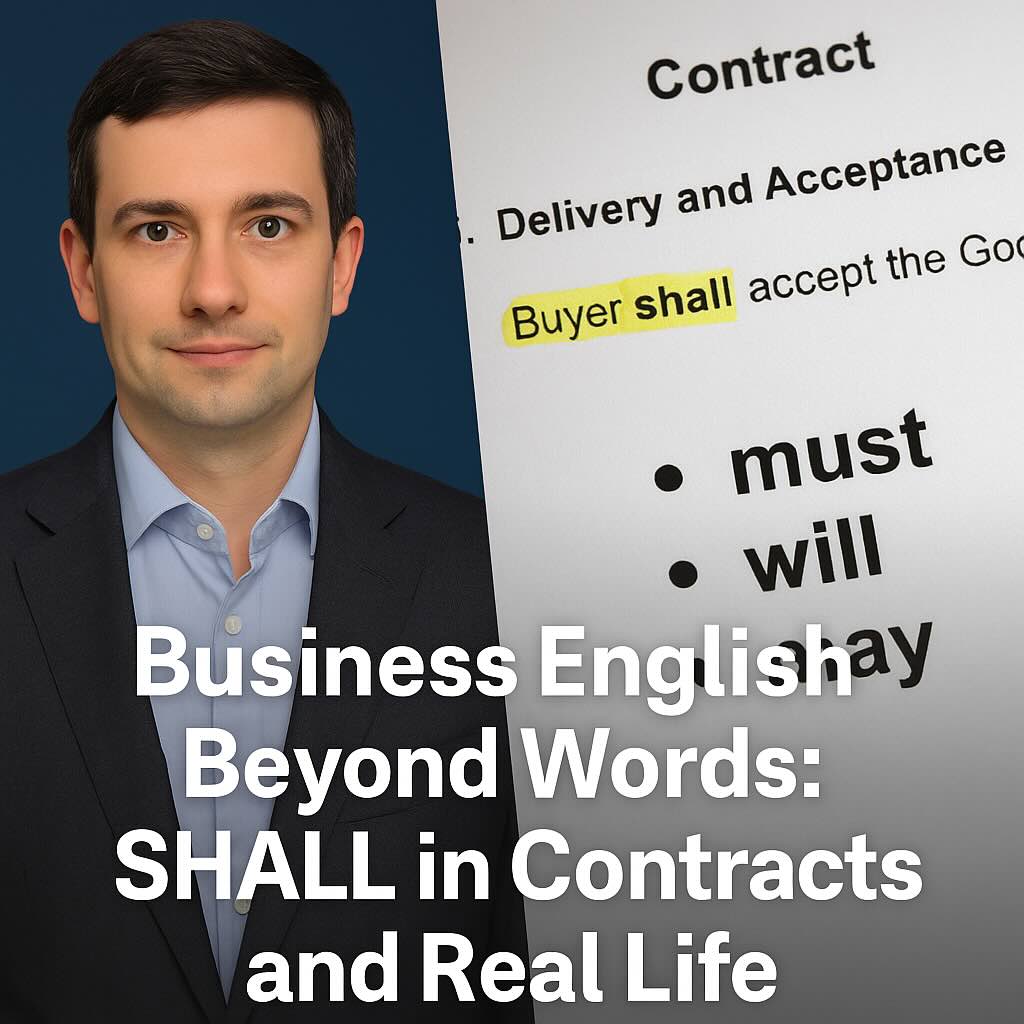

In Business English, tiny words decide big outcomes. Shall is one of those words.
Schoolbooks often say shall = will. Real business doesn’t. In contracts, emails, and at the negotiating table, using (or avoiding) shall changes meaning, leverage, and risk.
Key takeaways (read this first)
- In contracts, shall traditionally signals a binding obligation on the subject (The Buyer shall pay…). Many modern drafters replace it with must for clarity. World Institute on DisabilityGOV.UKHolland & Knight
- In everyday business English, shall is rare (except fixed polite British offers like Shall we begin?). Prefer will / should / would in speech and email.
- In EU legislation, shall (not) still appears to impose duties and prohibitions in English versions of legal acts; be careful translating. European Commission
- Use a decision matrix: must = obligation, will = future fact/promise, may = discretion/permission, should = recommendation, shall = (only if your style guide allows) obligation on the subject. World Institute on DisabilityGOV.UKAdams on Contract Drafting
1) What grammar says vs what business needs
Traditional grammar: shall once marked the future with I/we; will with you/he/she/they. In modern usage, will dominates and shall is rare outside formal/legal contexts.
Business reality: modern drafting and government style guides in the US and UK recommend avoiding legislative shall; use must for obligations because it’s clearer and harder to misuse. World Institute on DisabilityGOV.UK
EU note (English text): EU legislative English still uses shall not for prohibitions and shall in some duty formulas; check the latest EU English Style Guide before changing legacy language. European Commission
2) The decision matrix (use this when you draft)
- MUST — duty/obligation (best plain-English choice in many jurisdictions and corporate styles).
- The Supplier must deliver within 10 days.
- UA: Постачальник зобов’язаний поставити протягом 10 днів.
- RU: Поставщик обязан поставить в течение 10 дней.
- WILL — future fact, promise, or allocation of risk (not an obligation by itself).
- Payment will occur by wire transfer.
- UA: Оплата відбудеться банківським переказом.
- RU: Оплата будет осуществлена банковским переводом.
- MAY — discretion/permission (don’t use for obligations).
- The Buyer may inspect the Goods within 5 days.
- UA: Покупець має право оглянути Товар протягом 5 днів.
- RU: Покупатель вправе осмотреть Товар в течение 5 дней.
- SHOULD — recommendation/best practice (not enforceable on its own).
- The Parties should promptly notify material changes.
- UA: Сторонам варто невідкладно повідомляти про істотні зміни.
- RU: Сторонам следует незамедлительно сообщать об существенных изменениях.
- SHALL — use only if your style guide requires/permits it, and only to impose duty on the subject (avoid shall be for future facts). Adams on Contract Drafting
- The Buyer shall pay the Price by 30 September.
- UA: Покупець зобов’язаний сплатити Ціну до 30 вересня.
- RU: Покупатель обязан уплатить Цену до 30 сентября.
Why this matrix?
US federal and UK parliamentary guidance: prefer must over shall to impose duty; reserve will for futurity/facts. This reduces disputes over whether a clause was merely predictive. World Institute on DisabilityGOV.UK
3) Contract hotspots where shall breaks (and how to fix)
- Obligation vs future fact
- Weak: The Parties will comply with all applicable laws.
- Strong: The Parties must comply with all applicable laws. (or shall, if required) World Institute on Disability
- “Shall be liable” vs clear allocation
- Vague: The Seller shall be liable for defects.
- Clear: The Seller is liable for defects that… / The Seller must indemnify the Buyer against…
- Prohibitions
- Risky: The Supplier may not disclose Confidential Information.
- Safer: The Supplier must not disclose… or …shall not disclose… (for EU legislative English). European Commission
- Entitlements
- Wordy: The Buyer shall be entitled to a refund if…
- Clean: The Buyer may receive a refund if… / The Buyer is entitled to a refund if…
- “Shall ensure / shall procure that” (common in English law)
- Often better as: The Supplier must ensure that its Subcontractors comply with… (Avoid bare shall procure that unless your house style requires it.)
- Definitions & recitals
- Don’t use shall in definitions/recitals: those sections describe reality, not duties. Use present simple: “Agreement” means…
🔎 Background and style guidance on dropping legislative shall in favor of must: US Federal Plain Language Guidelines; UK drafting guidance. For contracts, see Ken Adams’ analysis of using shall only to impose duty on the subject. World Institute on DisabilityGOV.UKAdams on Contract Drafting
4) Emails, meetings, trade fairs: what sounds right
British offers (polite/formulaic):
- Shall we begin? / Shall I send the draft?
American/neutral alternatives: - Should we get started? / Would you like me to send the draft?
Avoid in speech/email:
- We shall discuss it tomorrow. → sounds stiff.
- Prefer: We’ll discuss it tomorrow. / Let’s discuss it tomorrow.
Micro-translation tip (offer → permission):
- Shall we schedule the site visit? →
- UA: Можемо запланувати виїзд на об’єкт?
- RU: Можем запланировать выезд на объект?
5) EU/UK/US/Ukraine — how styles collide
- US (gov’t & many corporates): drop shall, use must for duties; will for future facts. World Institute on Disability
- UK (legislation office): policy is to avoid legislative shall; there may be legacy exceptions. GOV.UK
- EU legislative English: still uses shall/shall not in many provisions; check the current EU English Style Guide before redrafting legacy EU-derived text. European Commission
- Ukraine (translation practice): map must/shall → зобов’язаний / має; map may → має право; prefer present for facts (is liable, is entitled) to avoid mixing obligation with prediction.
Practical rule for cross-border contracts: pick one obligation verb across the document (must or shall, per house style) and use it consistently; reserve will strictly for non-obligatory futurity. This mirrors best-practice drafting guidance and reduces ambiguity. World Institute on DisabilityAdams on Contract Drafting
6) Translator’s corner (micro-glossary with context)
- shall / must (duty) → UA: зобов’язаний / має; RU: обязан
- will (future fact/promise) → UA: буде / відбудеться; RU: будет / состоится
- may (permission) → UA: має право; RU: вправе
- must not / shall not (prohibition) → UA: не має права / забороняється; RU: не вправе / запрещается (choose per doc style) European Commission
7) Mini-workshop for your learner (5 minutes)
- Rewrite to impose obligation (not prediction):
- The Distributor will submit monthly reports. → must/shall submit…
- Turn a prohibition that uses may not into a clear ban:
- The Consultant may not share… → must not / shall not share…
- Fix this “entitlement spaghetti”:
- The Buyer shall be entitled to be given a refund… → The Buyer is entitled to a refund…
8) Quick audit checklist (before you sign)
- One obligation verb across the document (must or shall) — no mixing. World Institute on DisabilityAdams on Contract Drafting
- Prohibitions use must not / shall not, not may not, unless your legislative style requires otherwise. European Commission
- Facts use is/are/will, not shall be.
- Entitlements use is entitled to / may, not shall be entitled to.
- Definitions/recitals have no shall.
- Email & speech avoid stiff shall; use natural offers/requests.
9) Further reading (authorities & style guides)
- US: Federal Plain Language Guidelines — “use must instead of shall.” World Institute on Disability
- UK: Drafting guidance (Bills for Parliament) — policy “avoid the legislative ‘shall’.” GOV.UK
- EU: English Style Guide (2025) — notes on using shall not for prohibitions. European Commission
- Contracts practice: Ken Adams on disciplined use of shall in contracts. Adams on Contract Drafting
🔗 Recommended articles on our site
- Understanding Realia in Translation: Cultural Nuances Across Languages
- English Conversation Practice: Overcome Fear and Speak with Confidence
- English for Job Interviews: How to Prepare (Real Practice, Real Results)
🌍 Learn with us (program pages)
👤 Author
Author’s profile: Tymur Levitin
Founder, Director, and Senior Teacher at Levitin Language School / Start Language School by Tymur Levitin
© Tymur Levitin