
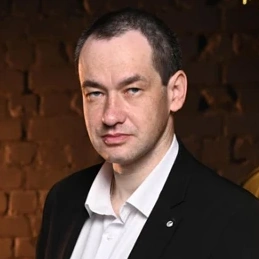
You hear a person speaking your native language.
You understand the story. You understand the emotion. You understand whether he is mocking, humiliating, threatening, bragging, joking or complaining.
And yet, if someone asks you:
“What exactly does that word mean?”
—you suddenly realize you cannot explain it.
Not because you do not know your language.
But because what you heard was not just a language.
It was a code.
I recently listened to a short video where a man was speaking in a mixture of Russian, Ukrainian, regional slang, street speech, internet language and his own personal style. Formally, I understood almost everything. I knew exactly what he meant. I knew which moments were supposed to sound funny, cruel, bitter or ridiculous.
But then I stopped at several words.
“Сипуха.”
“Сипун.”
“У меня в кабинете диссонанс.”
“Дал в кабину.”
“Рогатый демон.”
If a foreign student had asked me to translate these expressions, I could have explained the situation. I could have explained the emotion. I could have even explained what kind of person the speaker was talking about.
But I could not have given a neat dictionary definition.
Because there is none.
This Is Not Vocabulary. This Is Social Code.
Most people imagine language as a list of words and grammar rules. They believe that if they know enough vocabulary, they know the language.
They do not.
Inside every language there are hidden languages.
There is the language of teenagers. The language of taxi drivers. The language of gamers. The language of the army. The language of migrants. The language of businessmen. The language of TikTok. The language of prison slang. The language of certain cities, districts, schools, families and generations.
Sometimes two native speakers formally speak the same language — and still do not fully understand each other.
Because they belong to different codes.
The man in that video was not simply speaking Russian. He was speaking a very narrow social dialect: part Russian, part Ukrainian, part street slang, part internet performance, part regional masculinity.
That is why even a native speaker can understand the general meaning and still be unable to explain individual words.
“Сипуха” Does Not Mean Anything — And Means Everything
The most interesting words are often the ones that do not really have a fixed meaning.
Take a word like “сипуха”.
I cannot tell you exactly what it means in a dictionary sense. Neither can most people.
And yet, in context, everyone immediately understands it.
Why?
Because the word does not describe a person.
It expresses an attitude toward that person.
The speaker uses it as a container for contempt, mockery and emotional distance. The exact meaning is not important. The function is.
This is one of the reasons why slang and social speech are so difficult to translate. Foreigners often ask:
“So what does this word literally mean?”
But literal meaning is the wrong question.
The real question is:
“What is the speaker doing with this word?”
Is he insulting someone? Making himself look stronger? Showing that he belongs to a certain group? Trying to sound dangerous, ironic or “cool”?
Only then does the word begin to make sense.
“In My Cabinet There Is Dissonance”
One phrase in the video particularly fascinated me:
“In my cabinet there is dissonance.”
No one normally says that.
The speaker used the word “cabinet” as a metaphor for his head, mind or inner world.
Later he used another phrase:
“To give someone one in the cabin.”
In another version of the same idea, the phrasing may sound like:
“To give someone one in the cabinet.”
Nobody officially says either of these expressions. They are not standard phrases.
And yet everyone listening immediately understands that “cabin” or “cabinet” suddenly means “head”.
Why?
Because in such social codes, people constantly create meaning on the spot.
A neutral word becomes a metaphor.
The metaphor becomes understandable because of tone, rhythm and context.
The listener understands that the speaker means hitting someone — physically or symbolically — even though the exact wording is improvised.
Then, if the phrase sounds good enough, it may start living its own life.
This is exactly why language cannot be reduced to grammar. Native speakers do not simply “know words”. They constantly build new meanings together.
The Most Difficult Phrase To Translate
The phrase “horned demon” was probably the hardest one to explain.
Literally, it sounds absurd.
But in context, every native speaker immediately understands what kind of man the speaker means: a man who is being used, deceived, financially exploited, humiliated or manipulated — and still keeps accepting it.
The phrase is funny and cruel at the same time.
And this is where translation completely fails.
Because the problem is not the words.
The problem is that another culture may not have the same image, the same social stereotype, the same emotional reaction.
You can translate the sentence.
You cannot translate the instinctive feeling behind it.

Why Foreigners Often Make Dangerous Mistakes
This is exactly why I always tell my students:
Do not speak in a style you cannot carry.
Many students learn a few slang expressions and think they now sound natural. They repeat phrases they heard in films, on TikTok, in songs or in the street.
At first, it may even work.
But then one day they meet real native speakers who actually live inside that code.
And suddenly the student sounds strange, artificial, rude or even offensive.
Because in every language there are expressions that require something more than vocabulary.
They require:
- social experience;
- intuition;
- the right tone;
- the right environment;
- the right to say them.
One of the most dangerous language mistakes is not a grammatical mistake.
It is using the right words in the wrong social role.
A person may pronounce everything correctly and still sound completely wrong.
You Do Not Speak The Language. You Speak The Group.
This is true in every culture.
An American street rapper, a German teenager from Berlin, a Polish football fan, a French suburban teenager, a British construction worker and a Ukrainian man from a certain social environment may all be speaking their “native language”.
But in reality, they are speaking the language of their group.
That language has its own rules, values, taboos and emotional codes.
And if you do not belong to that world, you may understand the words — but you still will not fully understand the meaning.
Or worse: you may think you understand it, repeat it, and suddenly realize that language can be dangerous.
Because the most dangerous mistakes in language are not grammatical.
They are social.
And perhaps this is the hardest truth about language learning:
Sometimes even native speakers do not fully understand their own language.
Because language is never only words.
Language is access.
Language is identity.
Language is permission.
Author: Tymur Levitin — Founder & Director, Levitin Language School / Language Learnings
https://levitintymur.com/
https://languagelearnings.com/
© Tymur Levitin