
In many conversations, silence is uncomfortable.
People rush to fill it.
They add words.
They repeat themselves.
They soften statements.
They try to maintain the flow.
But in German communication, silence often has a different function.
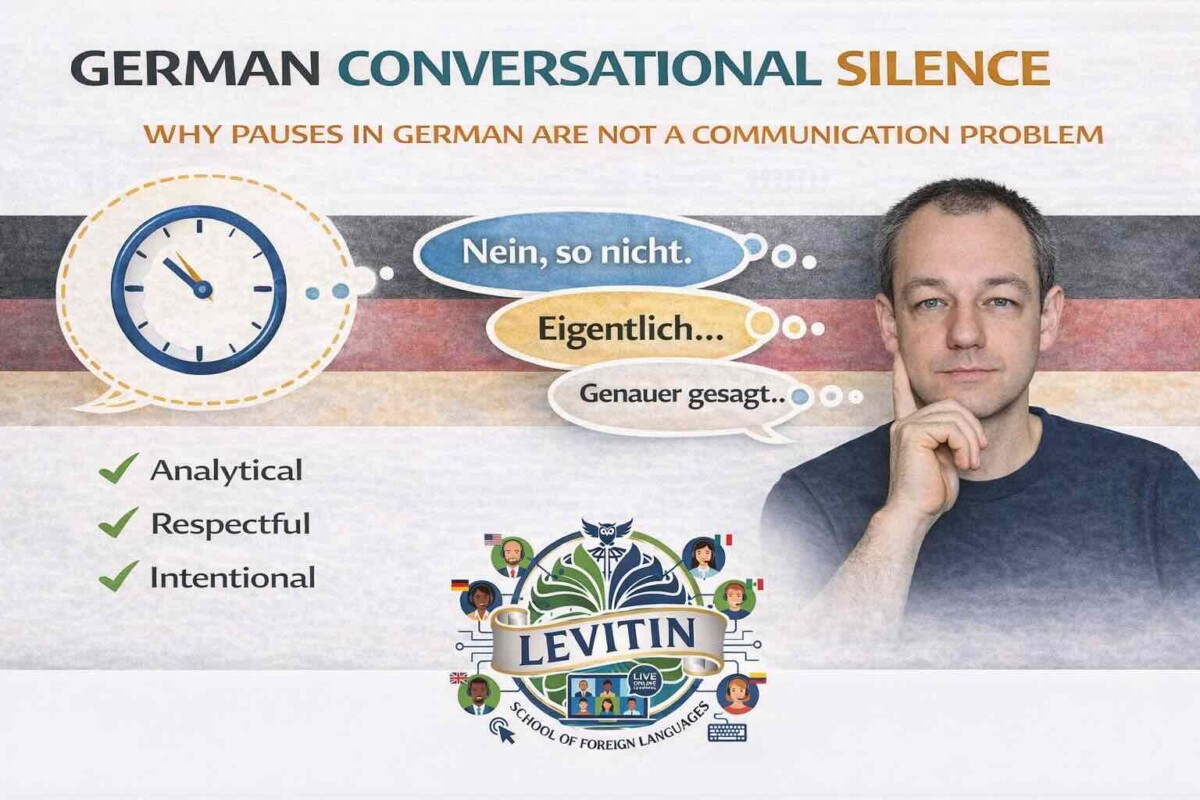
A pause is not necessarily a problem.
Sometimes, it is simply thinking.
This article continues our German communication series and explores one of the most misunderstood elements of German interaction: the role of silence in conversation.
Silence Is Not Always Discomfort
In many cultures, silence signals tension:
- something went wrong
- someone is offended
- the conversation is collapsing
In German communication, silence often signals something else:
processing.
A short pause may mean the listener is:
- evaluating what you said
- structuring a response
- deciding how precise the answer should be
It is not necessarily emotional.
It is cognitive.
The Thinking Pause
You may hear short pauses before responses like:
Hm.
Also…
Moment…
These are not filler sounds in the same sense as in many other languages.
They often indicate that the speaker is organizing information before speaking.
In many German-speaking environments, speaking too quickly without thinking can even appear careless.
Why Fast Responses Are Not Always Expected
In some communication cultures, speed signals intelligence.
A fast reply shows engagement.
In German communication, a carefully considered answer often carries more weight than a fast one.
A short pause can signal:
- responsibility
- seriousness
- accuracy
It shows the speaker is thinking before committing to a statement.
Silence in Professional Contexts
In meetings, negotiations, and academic discussions, silence is often normal.
If someone presents an idea and the room becomes quiet for a few seconds, it does not necessarily mean disagreement.
It may mean participants are:
- analyzing implications
- considering practical consequences
- preparing precise feedback
Silence can be part of the decision process.
Why Foreigners Often Misinterpret It
Learners sometimes assume silence means:
- rejection
- criticism
- boredom
- lack of interest
But very often, the opposite is true.
Silence may indicate that the listener is taking the idea seriously.
When people care about accuracy, they pause.
The Relationship Between Silence and Precision
German communication often prioritizes:
- clarity
- structure
- responsibility for statements
Speaking immediately without reflection can introduce inaccuracies.
A short pause protects the structure of the conversation.
Silence becomes a tool for precision.
When Silence Actually Means Disagreement
Of course, silence is not always neutral.
Sometimes it may signal hesitation or doubt.
But even then, the silence often precedes a structured response such as:
Ich bin mir nicht sicher.
Das sehe ich etwas anders.
Das müsste man genauer prüfen.
Again, the pause is part of the preparation.
Learning to Be Comfortable With It
Many language learners try to eliminate pauses completely.
They believe fluency means constant speech.
But natural communication often includes rhythm:
- statement
- pause
- response
Accepting pauses can actually make you sound more confident.
It signals control rather than anxiety.
Final Thought
Silence in German conversation is not emptiness.
It is structure.
A pause may simply mean that the speaker respects the weight of what is being said.
And once you stop fearing those pauses, communication becomes easier.
You stop filling the space.
You start thinking inside it.
Author: Tymur Levitin
Founder & Director
Levitin Language School
Global Learning. Personal Approach.
© Tymur Levitin
Learn German with analytical clarity:
https://levitintymur.com/languages/learning-german/
International language programs:
https://languagelearnings.com/
Explore more articles from the German communication series on the blog.