Skip to content

German pragmatics

German Communication Transparency — Why Germans Often Tell You the Real Reason
German Communication Transparency — Why Germans Often Tell You the Real Reason | LEVITIN SCHOOL
German

German Communication Transparency — Why Germans Often Tell You the Real Reason

Many foreigners are surprised by how often Germans explain the actual reason behind a decision. In many cultures, explanations are softened. People may provide a socially comfortable answer. They may avoid discussing the real cause. They may choose diplomacy over transparency. German communication often follows a different principle. Many German speakers prefer explaining the actual […]

Tymur Levitin | LEVITIN SCHOOL Tymur Levitin
• 02.06.2026 • 3 min read
Read full article

German pragmatics

German Communication Predictability — Why Germans Prefer Clear Expectations | LEVITIN SCHOOL
02.06.2026

German Communication Predictability — Why Germans Prefer Clear Expectations

German

Many foreigners describe German communication as predictable. At first, this sounds like criticism. People often associate predictability with boredom, rigidity, or lack of spontaneity. But in German communication, predictability usually serves a different purpose. It creates trust. When people know what to expect, cooperation becomes easier. Misunderstandings become less frequent. And communication becomes more efficient. […]

Tymur Levitin | LEVITIN SCHOOL Tymur Levitin
Read more →
German Precise Wording — Why Germans Carefully Choose the Exact Formulation | LEVITIN SCHOOL
05.04.2026

German Precise Wording — Why Germans Carefully Choose the Exact Formulation

German

In many conversations people speak quickly. Words appear almost automatically. The main goal is to keep the conversation flowing. In German communication, however, something slightly different often happens. Speakers may pause. They may reformulate a sentence. They may replace one word with another. This is not hesitation. It is an attempt to find the most […]

Tymur Levitin | LEVITIN SCHOOL Tymur Levitin
Read more →
German Logic Series: When a Sentence Is Not Information but an Action | LEVITIN SCHOOL
26.03.2026

German Logic Series: When a Sentence Is Not Information but an Action

German

(Choose your language here: https://levitintymur.com/#languages) A student says in German: Du kannst mir helfen. Grammatically — perfect.Vocabulary — correct.Pronunciation — clear. And yet the native speaker pauses. Not confused. Careful. Because the German did not hear a statement. He heard an action. Why Germans React to Meaning You Didn’t Say Many learners believe language transmits […]

Tymur Levitin | LEVITIN SCHOOL Tymur Levitin
Read more →
German Definition Culture — Why Germans Often Stop the Conversation to Define a Word
21.03.2026

German Definition Culture — Why Germans Often Stop the Conversation to Define a Word

German

During a discussion in German something interesting can happen. The conversation suddenly pauses. Not because of disagreement. Not because someone is confused. But because someone asks a question like: Was genau meinst du mit „effizient“? For many learners this moment feels unexpected. Why stop the conversation just to define a word? But in German communication […]

Tymur Levitin | LEVITIN SCHOOL Tymur Levitin
Read more →
German Fact Orientation — Why Germans Prefer Data Over Impressions in Discussion
18.03.2026

German Fact Orientation — Why Germans Prefer Data Over Impressions in Discussion

German

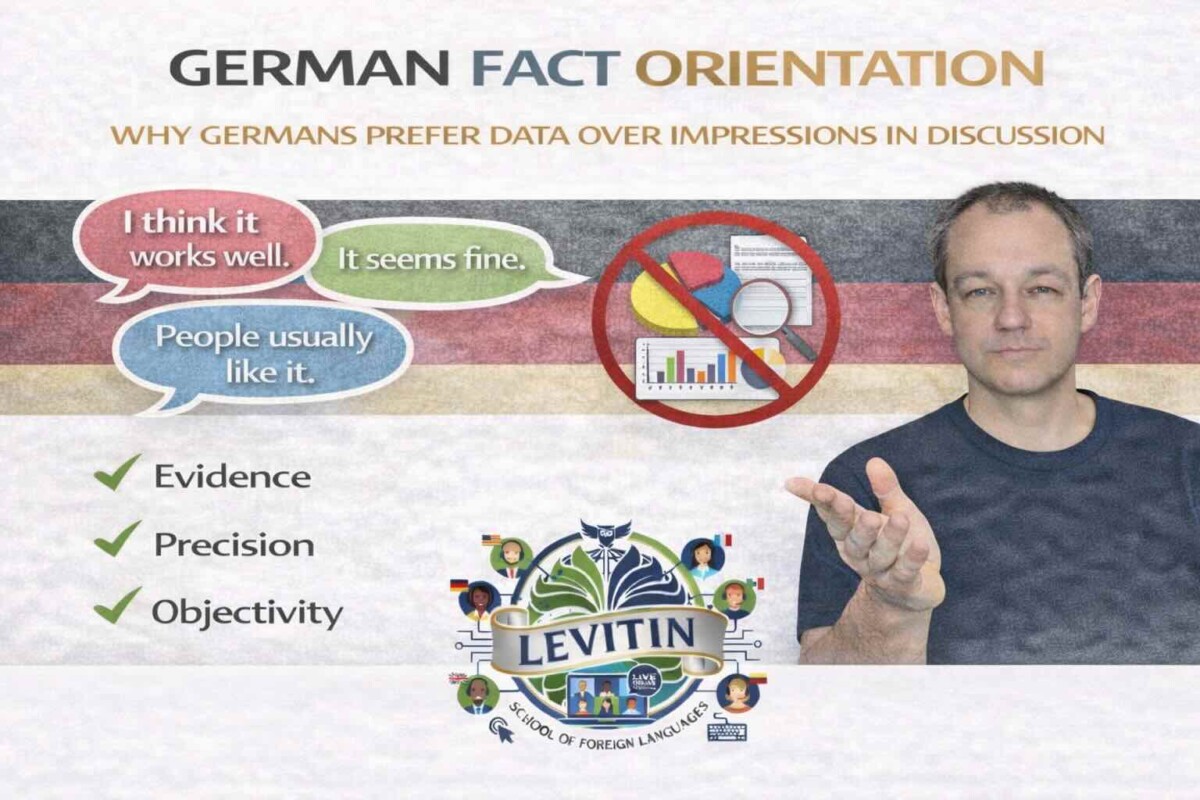
In many conversations people rely on impressions. They describe how something feels. They talk about general tendencies. They say things like: I think it works well.It seems fine.People usually like it. In German communication this approach often feels incomplete. Instead, speakers frequently look for something more concrete. Numbers. Examples. Evidence. This reflects an important feature […]

Tymur Levitin | LEVITIN SCHOOL Tymur Levitin
Read more →
German Disagreement Culture — Why Germans Say “I Don’t Agree” More Directly Than You Expect
14.03.2026

German Disagreement Culture — Why Germans Say “I Don’t Agree” More Directly Than You Expect

German

In many conversations people try to avoid open disagreement. They soften their responses. They change the topic. They say things like: Maybe…I’m not sure…That’s interesting… In German communication, disagreement often appears more directly. Someone may simply say: Das sehe ich anders. For many language learners this moment can feel uncomfortable. But in German communication culture, […]

Tymur Levitin | LEVITIN SCHOOL Tymur Levitin
Read more →
German Uncertainty Avoidance — Why Germans Prefer Clear Statements Instead of “Maybe”
10.03.2026

German Uncertainty Avoidance — Why Germans Prefer Clear Statements Instead of “Maybe”

German

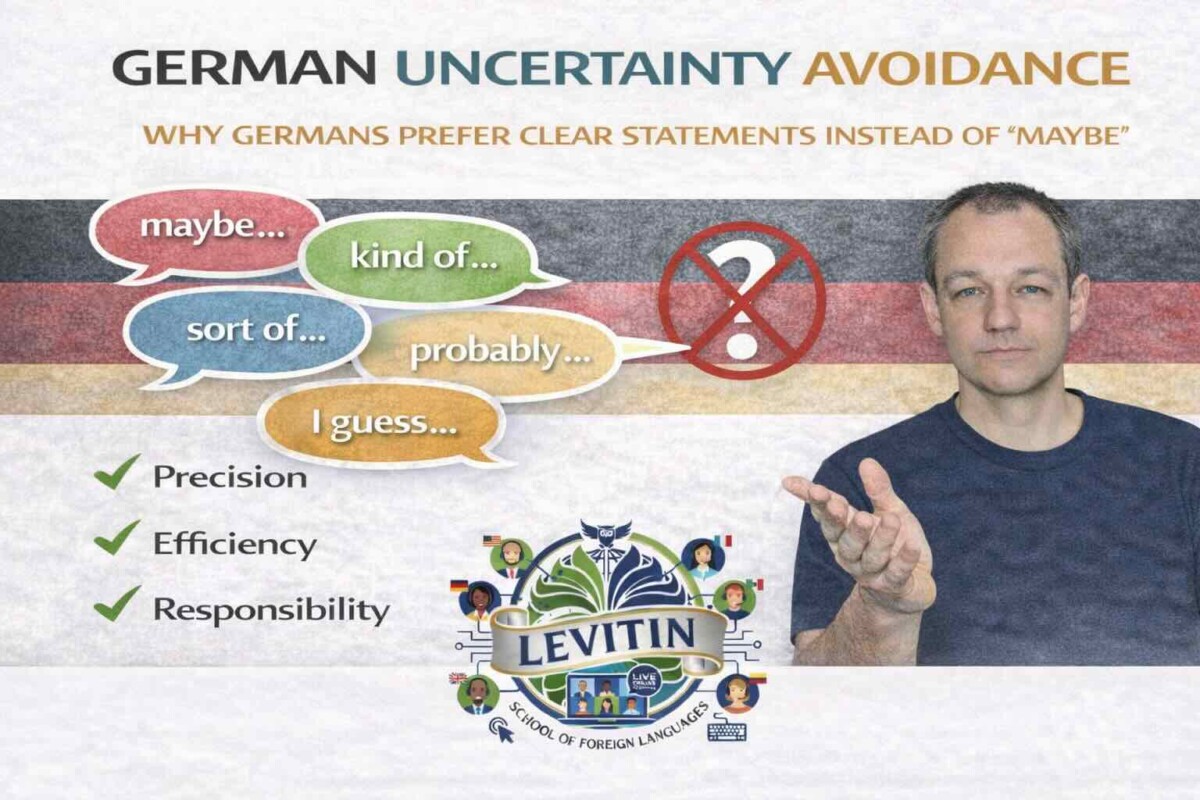
Many language learners notice something interesting when talking with German speakers. Conversations often sound more definite. Statements appear clear.Opinions sound structured.Answers feel precise. What is often missing are the soft expressions common in many languages: maybekind ofsort ofprobablyI guess In German communication, excessive uncertainty can sound confusing. This reflects an important cultural tendency: preference for […]

Tymur Levitin | LEVITIN SCHOOL Tymur Levitin
Read more →
German Argument Structure — Why Germans Explain the Reason Before the Opinion | LEVITIN SCHOOL
10.03.2026

German Argument Structure — Why Germans Explain the Reason Before the Opinion

German

Many language learners notice something unusual in German conversations. When someone expresses an opinion, it rarely appears alone. Instead, the speaker often starts with the reasoning. Only after that comes the conclusion. For example, instead of saying: I disagree. A German speaker may say something closer to: Wenn man die Kosten betrachtet, dann sehe ich […]

Tymur Levitin | LEVITIN SCHOOL Tymur Levitin
Read more →