
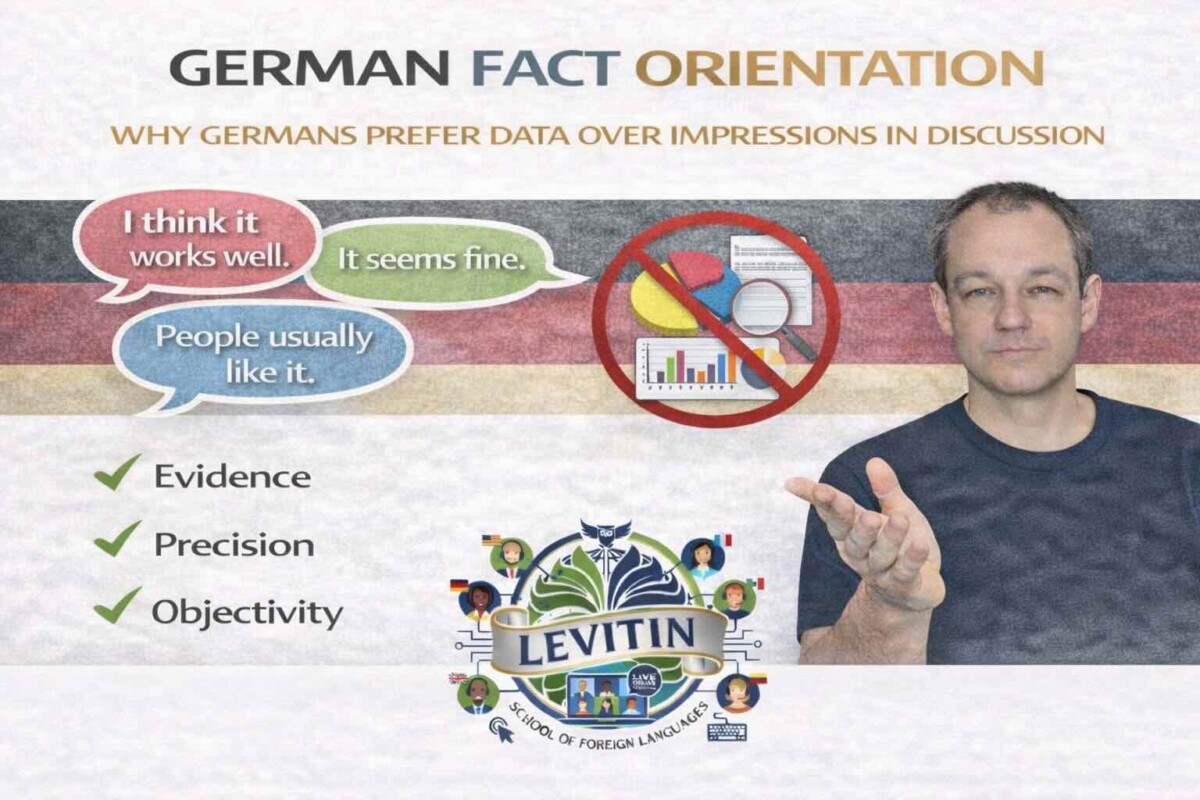
In many conversations people rely on impressions.
They describe how something feels.
They talk about general tendencies.
They say things like:
I think it works well.
It seems fine.
People usually like it.
In German communication this approach often feels incomplete.
Instead, speakers frequently look for something more concrete.
Numbers.
Examples.
Evidence.
This reflects an important feature of German discussion culture: fact orientation.
Opinions Often Need Support
In many German discussions, a statement is rarely left unsupported.
A simple opinion may trigger a follow-up question:
Warum?
Or:
Worauf basiert diese Einschätzung?
These questions are not necessarily confrontational.
They are requests for the reasoning behind the statement.
From Impression to Information
Consider two statements.
First:
Ich glaube, das Projekt läuft gut.
Second:
Die letzten drei Berichte zeigen, dass das Projekt im Zeitplan liegt.
The second statement feels stronger because it provides a factual basis.
German communication often favors the second type.
Why Facts Matter in German Discussions
Fact-based communication provides several advantages:
- it reduces ambiguity
- it supports logical argumentation
- it allows decisions to be justified
Facts create common ground.
When data is visible, the discussion becomes more objective.
Typical Signals of Fact-Based Reasoning
German speakers often introduce factual arguments with phrases such as:
- Die Zahlen zeigen…
- Die Daten bestätigen…
- Statistisch gesehen…
- Die Ergebnisse deuten darauf hin…
These expressions frame the statement as evidence rather than opinion.
Professional Communication
In professional environments fact orientation becomes even stronger.
A statement like:
Ich denke, wir sollten die Strategie ändern.
may sound weak.
A stronger version might be:
Die aktuellen Verkaufszahlen zeigen, dass wir die Strategie ändern sollten.
The argument becomes measurable.
Why This Can Surprise Learners
Learners sometimes expect conversations to rely more on impressions.
When Germans ask for numbers or examples, it can feel like skepticism.
But the intention is usually practical.
Facts help everyone evaluate the situation more clearly.
When Facts Are Not Available
Of course, not every situation provides data.
In those cases German speakers often acknowledge the limitation directly:
Es gibt dazu noch keine klaren Zahlen.
Or:
Das ist bisher nur eine Einschätzung.
The uncertainty itself becomes explicit.
Learning to Communicate More Factually
If you want to sound more natural in German discussions, it helps to support your ideas with concrete elements.
Instead of:
I think people prefer this option.
Try:
Viele Kunden haben diese Option in der letzten Umfrage bevorzugt.
Specific information strengthens the message.
Final Thought
German fact orientation is not about being cold or impersonal.
It is about making communication reliable.
Facts allow discussions to move beyond impressions.
They make arguments visible.
And when conversations become evidence-based, decisions become easier to understand.
Author: Tymur Levitin
Founder & Director
Levitin Language School
© Tymur Levitin
Explore the German communication series:
https://levitintymur.com/german/
International language learning programs:
https://languagelearnings.com/