
You explain something.
You think it is clear.
A German listener responds:
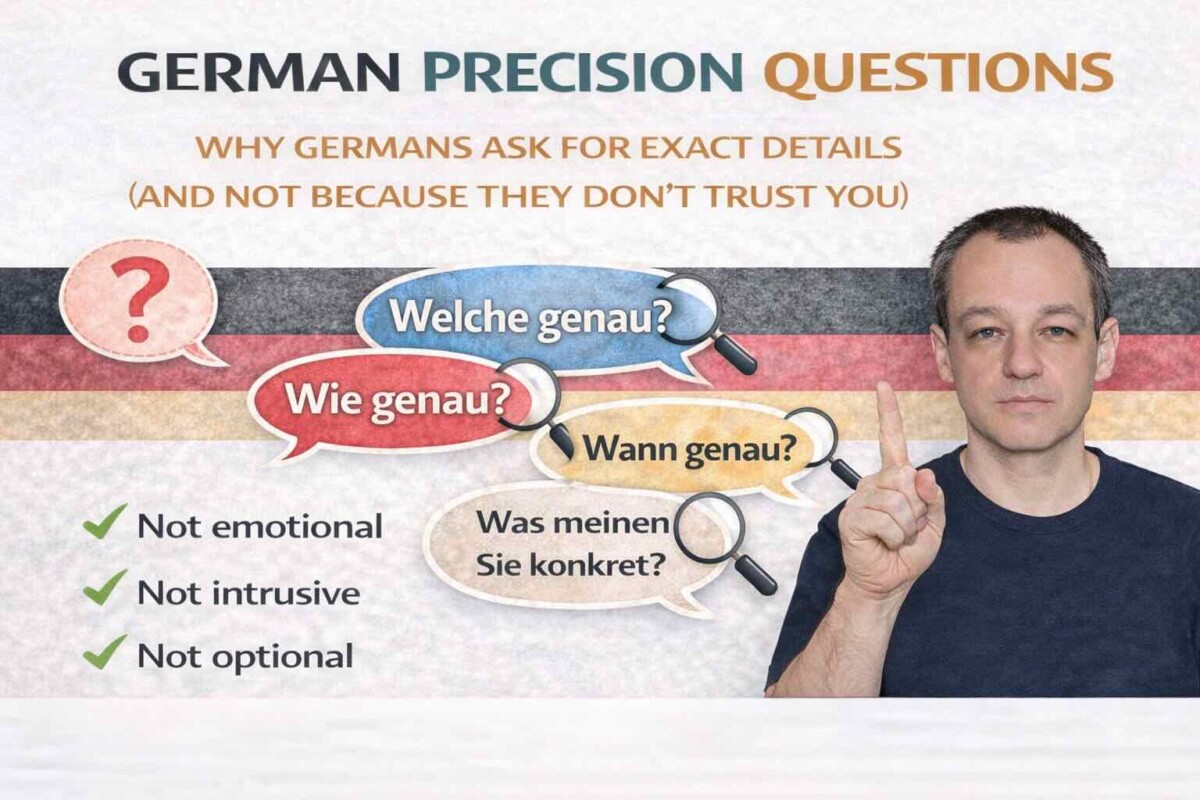
- Welche genau?
- Wie genau?
- Wann genau?
- Was meinen Sie konkret?
And suddenly, you feel interrogated.
Are they doubting you?
Are they challenging you?
Are they suspicious?
In most cases — no.
This article continues our German communication series and explores one of the most misunderstood features of German interaction: precision questioning.
The Cultural Reflex Toward Specificity
In many language cultures, communication tolerates approximation:
- “around”
- “kind of”
- “more or less”
- “somewhere”
- “a bit”
- “soon”
In German communication, approximation often triggers clarification.
If you say:
“I’ll send it soon.”
A German may ask:
Wann genau?
(Exactly when?)
Not because they distrust you.
Because “soon” is not operational.
German communication often moves from abstract to concrete automatically.
Why “Genau” Appears Everywhere
You may notice how often Germans use:
- genau
- konkret
- präzise
- exakt
- im Detail
This is not obsession.
It is structural preference.
Clarity reduces risk.
Detail reduces ambiguity.
Precision prevents misunderstanding.
In professional contexts especially, precision is not optional — it is expected.
The Emotional Misinterpretation
Learners sometimes interpret precision questions as:
- criticism
- skepticism
- confrontation
- passive aggression
But in many cases, it is simply information alignment.
If someone asks:
Wie meinen Sie das genau?
They may genuinely want to understand your model, not challenge your authority.
Precision vs Politeness
In some cultures, politeness means avoiding too many questions.
In German communication, politeness often means asking the necessary question clearly.
Indirectness can create confusion.
Clarity can create stability.
A direct follow-up question is often considered efficient — not rude.
The Professional Environment
In business or academic contexts, German precision questioning serves practical purposes:
- defining responsibility
- defining deadlines
- defining scope
- defining conditions
- reducing legal ambiguity
If you present a proposal and hear:
Unter welchen Bedingungen genau?
It is not hostility.
It is structural analysis.
The Linguistic Structure Behind It
German syntax supports precision.
Compound nouns compress detail:
- Lieferterminbestätigung
- Vertragsbedingungen
- Projektumfang
Subordinate clauses refine conditions:
- … sofern die Voraussetzungen erfüllt sind
- … unter der Voraussetzung, dass …
The language itself favors specification.
The questioning culture mirrors that structure.
Why Foreigners Feel Pressured
Learners from more narrative or relational communication cultures may experience:
- stress
- defensiveness
- the feeling of being evaluated
But precision questions are often neutral tools.
They are not emotional attacks.
They are alignment mechanisms.
How to Respond Naturally
Instead of reacting defensively, respond structurally:
If asked:
Wann genau?
Answer:
Am Mittwoch um 14 Uhr.
If asked:
Was meinen Sie konkret?
Specify:
Ich meine die Kostenstruktur im zweiten Quartal.
Precision invites precision.
And when you provide it, communication stabilizes immediately.
The Real Distinction
German questioning is not about distrust.
It is about predictability.
Ambiguity creates friction.
Detail creates orientation.
In many cases, the more exact your answer, the more comfortable the interaction becomes.
Final Thought
German precision questions are not interrogations.
They are structural adjustments.
Once you stop hearing them emotionally and start hearing them functionally, your conversations change.
You no longer feel challenged.
You feel aligned.
And that is where real fluency begins — not in vocabulary, but in interaction logic.
Author: Tymur Levitin
Founder & Director
Levitin Language School
Global Learning. Personal Approach.
© Tymur Levitin
Learn German with structural depth:
https://levitintymur.com/languages/learning-german/
International programs and analytical language training:
https://languagelearnings.com/
Explore the full German communication series on our blog.