
At first glance, Future Perfect Continuous looks intimidating:
will have been + verb-ing
Students usually memorize the formula and move on.
But the structure is not about grammar difficulty.
It is about measuring duration from a future perspective.
And that difference changes everything.
The Real Function
Future Perfect Continuous answers one question:
How long will something have been happening by a certain future moment?
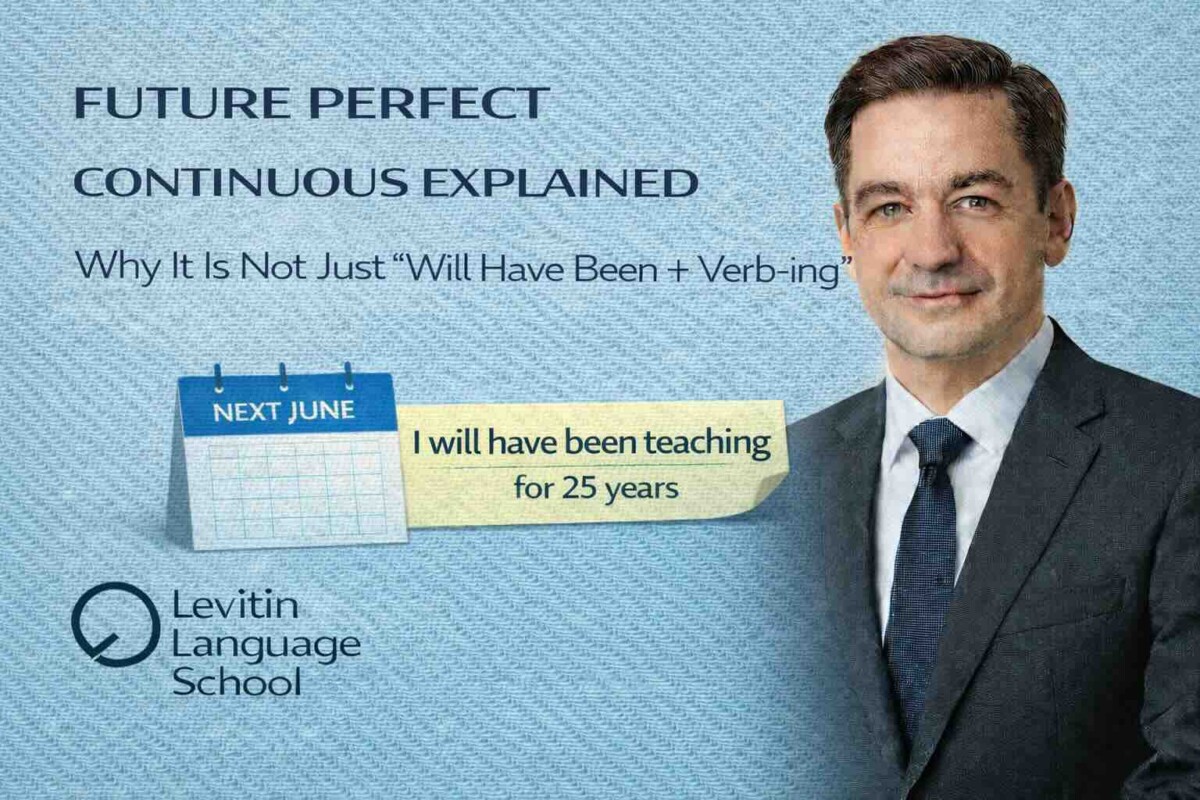
By next June, I will have been teaching for 25 years.
You are not speaking from today.
You are standing in next June.
And from that point, you look backward
at a duration.
The tense does not describe an action.
It describes accumulated time.
Compare the Future Structures
Future Simple
→ I will teach.
Future Continuous
→ I will be teaching.
Future Perfect
→ I will have taught.
Future Perfect Continuous
→ I will have been teaching for 25 years.
Notice the shift.
The last one measures experience, continuity, and progression.
Not just completion.
It Is About Duration, Not Completion
Future Perfect focuses on result.
Future Perfect Continuous focuses on process length.
By 10 p.m., she will have finished the report.
By 10 p.m., she will have been working for eight hours.
The first sentence highlights outcome.
The second highlights effort.
That difference is structural — not stylistic.
The Structural Anchor
This tense almost always needs:
- for + period
- since + starting point
- by + future moment
Without a time frame, the tense loses purpose.
❌ I will have been working.
✔ By Friday, I will have been working here for five years.
The reference point is essential.
Mirror With the Past
Past Perfect Continuous:
She had been working there for five years before she quit.
Future Perfect Continuous:
By next year, she will have been working there for five years.
The logic is identical.
Only the direction of time changes.
Why It Feels Rare — But Isn’t
In conversation, it appears less frequently than other tenses.
But in professional and reflective contexts, it is powerful:
By the end of this course, you will have been studying English for two years.
Next month, we will have been living in Berlin for a decade.
It gives language depth.
It shows continuity.
It signals awareness of long-term progression.
The Psychological Layer
Future Perfect = It will already be done.
Future Perfect Continuous = It will already have been going on for this long.
One measures completion.
The other measures commitment.
In business, education, relationships — this matters.
When Not to Use It
If you are not measuring duration, do not force it.
If there is no clear future reference point,
the structure becomes unnecessary.
Use it only when time accumulation is the focus.
Final Insight
Future Perfect Continuous is not “advanced grammar.”
It is a temporal lens.
You step into the future
and evaluate how long something has been happening
up to that moment.
It expresses continuity projected forward.
And once you understand that perspective shift,
the formula stops being heavy.
It becomes logical.
Author: Tymur Levitin
Founder & Director, Levitin Language School
Global Learning. Personal Approach.
© Tymur Levitin