
Sometimes during a German conversation you may notice something unusual.
Someone explains an idea.
Then they repeat it.
But not exactly the same way.
They say it again with slightly different wording.
For many learners this can feel strange.
Why repeat something that was already said?
But in German communication this behavior often serves an important function: clarity through rephrasing.
Repetition Is Not Redundancy
In many languages repeating the same idea can sound unnecessary.
But German speakers often restate information intentionally.
Not because they think the listener did not hear it.
But because they want to ensure the exact meaning is understood.
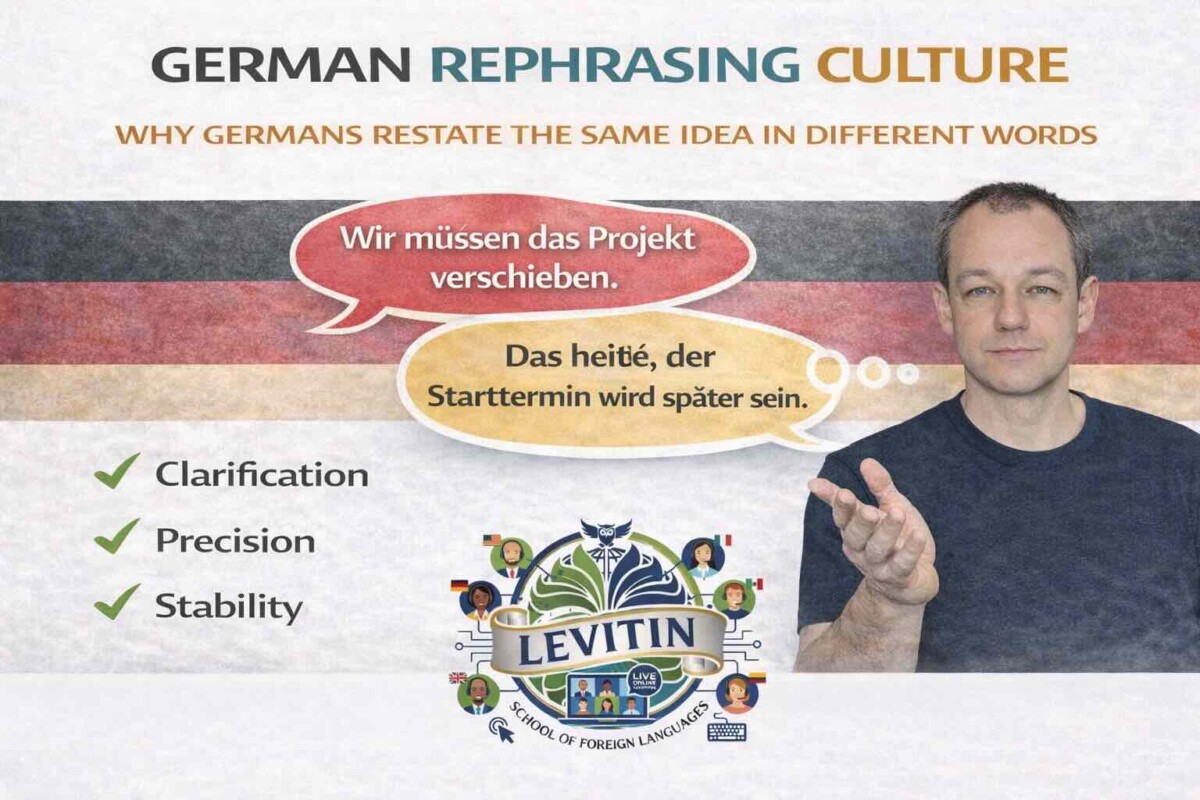
A typical pattern looks like this:
Wir müssen das Projekt verschieben.
Then immediately:
Das heißt, der Starttermin wird später sein.
The second sentence does not add new information.
It refines the interpretation.
“Das heißt…” — The Key Phrase
One of the most common German rephrasing signals is:
Das heißt…
Literally:
“That means…”
Functionally:
“Let me express the same idea more precisely.”
Other common phrases include:
- Anders gesagt…
- Mit anderen Worten…
- Genauer gesagt…
- Das bedeutet…
These expressions signal that the speaker is clarifying meaning.
Precision Through Multiple Angles
German communication often approaches clarity from several directions.
Instead of assuming the first explanation is sufficient, speakers may add:
- a definition
- a paraphrase
- an example
Each version stabilizes the idea.
This is not inefficiency.
It is structural communication.
Why Foreigners Sometimes Misinterpret It
Learners may interpret repeated explanations as:
- impatience
- doubt about comprehension
- over-explaining
But most of the time it is simply a habit of precision.
The speaker is not assuming you failed to understand.
They are making sure the idea cannot be misunderstood.
Academic and Professional Influence
German communication style is strongly influenced by academic traditions.
In academic writing and lectures, ideas are often structured like this:
- Statement
- Reformulation
- Explanation
- Example
This pattern also appears in everyday conversation.
It makes the message more robust.
Why This Helps Avoid Miscommunication
When an idea is expressed only once, interpretation can vary.
But when it is restated differently, ambiguity disappears.
For example:
Das Projekt ist komplex.
Then:
Das heißt, wir brauchen mehr Zeit für die Planung.
The second sentence explains the implication.
Now the meaning becomes practical.
Learning to Use Rephrasing Yourself
If you want to sound more natural in German discussions, learning to rephrase can help.
You can structure ideas like this:
Ich denke, wir sollten später anfangen.
Das heißt, wir verschieben den Termin um zwei Wochen.
This shows analytical communication rather than emotional reaction.
The Rhythm of German Explanation
German explanations often follow a rhythm:
statement → clarification → confirmation
For example:
Wir müssen effizienter arbeiten.
Das heißt, wir sollten die Prozesse vereinfachen.
Dann sparen wir Zeit.
Each step makes the thought clearer.
Final Thought
German rephrasing culture is not about repetition.
It is about stability of meaning.
By expressing the same idea from more than one angle, speakers reduce the chance of misunderstanding.
Once you recognize this pattern, German conversations start to feel more structured.
And when you begin using it yourself, your communication sounds clearer — and more natural.
Author: Tymur Levitin
Founder & Director
Levitin Language School
© Tymur Levitin
Explore more analytical articles about German communication:
https://levitintymur.com/languages/learning-german/
International language learning programs:
https://languagelearnings.com/