
Interesting Information
By Tymur Levitin Founder, Director and Senior Educator at Levitin Language School
Global Learning. Personal Approach.
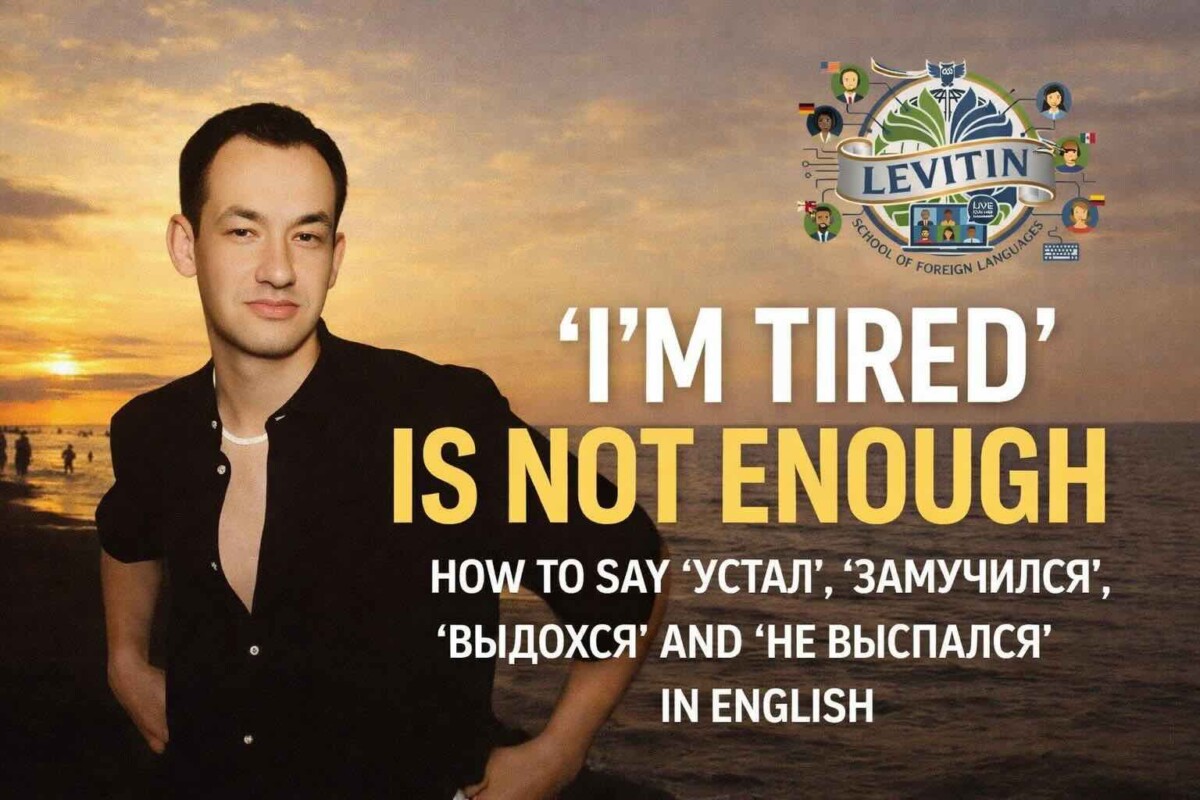
![Banner: A tired but thoughtful person sitting after a long day with the text “I’m Tired Is Not Enough”]
There is a moment every language learner experiences.
You come home after a long day and say one simple word:
“I’m tired.”
Grammatically, it is correct.
But sometimes it is not true.
Maybe you are not simply tired. Maybe you are emotionally empty. Maybe you are sleepy because you slept for only four hours. Maybe your body is exhausted, but your mind is still racing. Maybe you are not tired at all — you are burned out.
English separates these states much more clearly than many people expect.
Russian and Ukrainian do too — but in a different way.
That is why learners often translate one word literally and accidentally say something much weaker, stronger, or simply different from what they really mean.
And this is not only about vocabulary. It is about understanding yourself.
When a person cannot describe what exactly is happening to them, they often begin to think the problem is bigger, stranger, or more hopeless than it really is.
Language does not only describe reality. It organizes it.
Before we continue, if you are learning English and want to understand how people really speak — not just how textbooks translate words — explore our English courses:
You can also read the previous article in this series:
Why “I’m Tired” Is Often the Wrong Translation
In Russian and Ukrainian, people often use one broad word to describe many different states.
Russian:
- Я устал.
- Я замучился.
- Я вымотался.
- Я не выспался.
- Я уже никакой.
Ukrainian:
- Я втомився.
- Я змучився.
- Я виснажився.
- Я не виспався.
- Я вже ніякий.
In English, however, these are not the same.
If you always say “I’m tired,” native speakers will understand you. But they will not understand you precisely.
And sometimes precision matters.
There is a difference between:
- needing coffee
- needing sleep
- needing a weekend
- needing silence
- needing a new job
English often gives you a different word for each of these states.
Physical Tiredness: Tired, Exhausted, Worn Out
“I’m Tired”
This is the neutral, everyday expression.
It means:
- I had a normal day.
- I used energy.
- I need rest.
It does not sound dramatic.
Examples:
I’m tired. I think I’ll go to bed early.
I’m a little tired after work.
Russian
- Я устал.
- Я немного устал после работы.
Ukrainian
- Я втомився.
- Я трохи втомився після роботи.
This is the safest option. But it is also the weakest.
If you had a terrible day, saying “I’m tired” may sound strangely calm — almost as if nothing serious happened.
“I’m Exhausted”
“Exhausted” is much stronger.
It means you have almost no energy left.
You use it after:
- a difficult trip
- physical work
- a long exam
- a sleepless night
- an emotionally difficult day
I’m exhausted. I can’t even think anymore.
We were exhausted after the move.
Russian
- Я вымотался.
- Я совершенно без сил.
- Я ужасно устал.
Ukrainian
- Я виснажився.
- Я зовсім без сил.
- Я страшенно втомився.
“Exhausted” often sounds more serious and more adult than “tired.”
A child says:
I’m tired.
An adult who has been carrying too much for too long says:
I’m exhausted.
“I’m Worn Out”
This phrase is deeper and more emotional.
Literally, “worn out” means something that has been used so much that it no longer works properly.
You can use it for shoes.
My shoes are worn out.
But when you say:
I’m worn out.
You are speaking not only about physical tiredness, but about feeling used up.
Russian
- Я выжат как лимон.
- Я уже никакой.
- Я полностью измотан.
Ukrainian
- Я вичавлений як лимон.
- Я вже ніякий.
- Я повністю виснажений.
This is the language people often use after months of stress, not one difficult day.
There is something important here.
Russian and Ukrainian often describe tiredness through images:
- выжат как лимон
- еле живой
- без сил
- вичавлений як лимон
- ледве живий
- без сил
English also does this, but differently.
Instead of comparing yourself to a lemon, English often compares you to an object that has been used too much:
- worn out
- drained
- burned out
This difference is cultural.
Russian and Ukrainian often describe the body. English often describes the system.
Sleepiness Is Not the Same as Tiredness
Many learners confuse these ideas.
But in English:
- tired = low energy
- sleepy = ready to sleep
You can be tired without being sleepy. You can be sleepy without being tired.
“I’m Sleepy”
I’m sleepy. I didn’t sleep enough last night.
Russian
- Я сонный.
- Меня клонит в сон.
Ukrainian
- Я сонний.
- Мене хилить на сон.
Children often say “sleepy.” Adults use it too, especially late at night.
But if you say:
I’m tired.
instead of:
I’m sleepy.
You change the meaning.
“Tired” may sound like emotional or physical exhaustion. “Sleepy” means your body simply wants sleep.
“I Didn’t Get Enough Sleep”
English often avoids dramatic emotional words and describes the real reason directly.
I didn’t get enough sleep.
I only slept four hours.
Russian
- Я не выспался.
- Я почти не спал.
Ukrainian
- Я не виспався.
- Я майже не спав.
Notice something important.
Russian and Ukrainian have one convenient word:
- не выспался
- не виспався
English does not.
That is why many learners search for a direct translation and say strange things like:
I’m not slept.
or
I’m unslept.
These phrases do not exist.
The natural English version is:
I didn’t get enough sleep.
or:
I’m running on very little sleep.
The second phrase is especially useful because it sounds more natural and more expressive.
I’m running on three hours of sleep.
This means:
“I am functioning, but barely.”
Emotional Exhaustion: Drained, Burned Out, Overwhelmed
The most important difference is often not physical.
Many people say “I’m tired” when they are actually emotionally exhausted.
“I’m Drained”
“Drained” means that all your emotional energy is gone.
The image is simple: like a battery that is empty.
After that conversation, I felt completely drained.
Russian
- После этого разговора я был полностью опустошён.
- У меня не осталось никаких сил.
Ukrainian
- Після цієї розмови я був повністю спустошений.
- У мене не залишилося жодних сил.
“Drained” is often emotional, not physical.
You can be physically fine and still feel drained.
“I’m Burned Out”
This phrase is one of the most important in modern English.
“Burnout” is not just tiredness. It is what happens when a person lives under pressure for too long and no longer feels motivation, joy, or energy.
I’m burned out. I need a break.
She loved her job, but after two years without a vacation, she burned out.
Russian
- Я выгорел.
- Я эмоционально истощён.
Ukrainian
- Я вигорів.
- Я емоційно виснажений.
Notice the difference:
- tired = I need sleep
- exhausted = I need rest
- burned out = I need to change something in my life
This is not only language. This is self-understanding.
“I’m Overwhelmed”
This means there is too much happening at once.
Too many tasks. Too many emotions. Too many responsibilities.
I’m overwhelmed. I don’t know where to start.
Russian
- Я не справляюсь.
- У меня всё навалилось сразу.
Ukrainian
- Я не справляюся.
- На мене все навалилося одразу.
People often say “I’m tired” because it is easier.
But “overwhelmed” is more honest.
Expressions Native Speakers Actually Use
English speakers often use stronger, more vivid phrases.
I’m dead tired.
Russian
- Я смертельно устал.
- Я валюсь с ног.
Ukrainian
- Я смертельно втомився.
- Я валюся з ніг.
I’m running on empty.
Russian
- Я держусь из последних сил.
Ukrainian
- Я тримаюся з останніх сил.
I’m barely functioning.
Russian
- Я еле соображаю.
Ukrainian
- Я ледве щось розумію.
I can’t keep my eyes open.
Russian
- У меня глаза закрываются.
Ukrainian
- У мене очі самі заплющуються.
These phrases are especially useful because they sound natural and vivid.
Why This Matters Beyond Language
Many people grow up hearing:
- Don’t complain.
- Everyone is tired.
- Work harder.
As a result, they learn only one word:
“tired.”
But sometimes a person is not tired.
Sometimes they are:
- lonely
- burned out
- overwhelmed
- emotionally empty
- desperate for sleep
- carrying too much responsibility
The wrong word can make a real problem look small.
The right word can help a person understand what they actually need.
This is why language learning is never only about grammar.
When you learn new words, you do not simply learn how to speak.
You learn how to notice yourself more accurately.
And sometimes that changes everything.
If you want to learn English in a way that goes beyond translation and helps you understand how people really think, speak and feel, explore Levitin Language School:
You can also learn more about Tymur Levitin and his teaching approach here:
Author: Tymur Levitin
Founder, Director and Senior Educator at Levitin Language School
© Tymur Levitin