
Language does not only describe reality — it records the history of societies, conflicts, and identities.
Some words carry traces of entire eras. Others travel between cultures and return with completely different meanings.
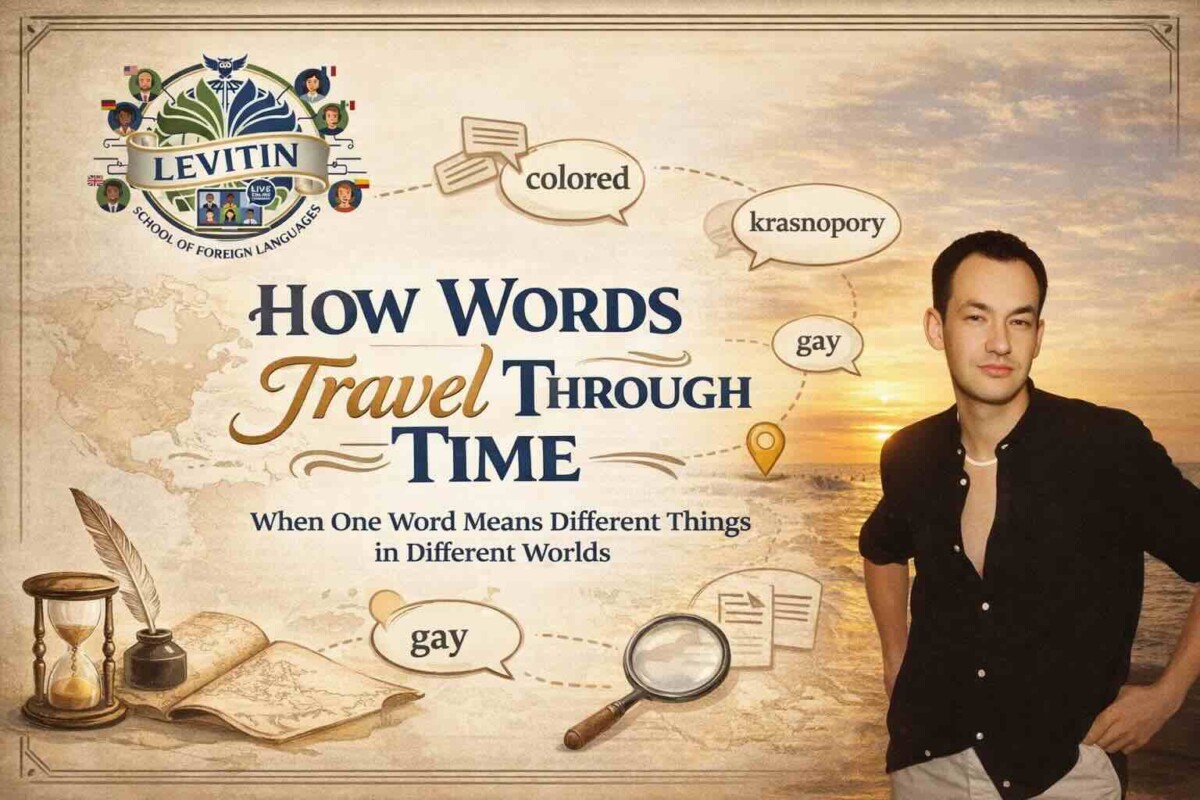
A fascinating example is the Russian word “цветной” (tsvetnoy) — literally “colored.”
Depending on the historical context, it has meant completely different things in different linguistic worlds.
Understanding how such words move through time is essential for anyone who studies languages seriously. It shows that vocabulary is never just vocabulary — it is culture, politics, and social structure encoded in words.
A Word That Exists in Different Worlds
At first glance, the word “цветной” simply means “colored” — something that has color.
But historically it has been used in three entirely different semantic systems:
- American racial terminology of the early 20th century
- Literal description of color
- Russian criminal slang referring to police
Each of these meanings emerged independently.
“Colored”: The American Historical Meaning
In the United States of the late 19th and early 20th centuries, the word colored was widely used in official and social language.
It referred to people who were not considered white under the racial classification system of the time.
The term could include:
- African Americans
- Native Americans
- People of mixed ancestry
One well-known historical example still exists today:
National Association for the Advancement of Colored People (NAACP)
Founded in 1909, the organization kept the historical wording in its name.
At the time, colored was not necessarily considered offensive. It was a standard administrative term.
However, after the civil rights movement of the 1950s–1960s, the perception changed.
Today:
- colored is widely seen as outdated or offensive
- modern terms include Black, African American, or people of color
Interestingly, the modern phrase “people of color” structurally resembles the older expression — yet socially it carries a very different tone.
Why Soviet Translations Used “Цветной”
When American crime novels were translated into Russian in the mid-20th century — including works by authors like James Hadley Chase — translators needed a Russian equivalent for the word colored.
The natural translation became:
цветной
As a result, Soviet readers encountered phrases such as:
- цветной бармен
- цветной водитель
- цветной парень
This translation reflected the vocabulary of the original English texts rather than any Russian social classification.
A Completely Different Meaning in Russian Criminal Slang
In Russian criminal slang, the same word “цветной” developed an entirely unrelated meaning.
In that environment, цветной could refer to:
- a police officer
- a representative of law enforcement
- a person associated with the authorities
The logic comes from uniform color.
Members of the criminal world often defined social groups through visible markers.
A police officer wearing a uniform was therefore described metaphorically through color.
In this semantic system:
- цветной meant someone connected to the state structure.
This meaning evolved independently from the American racial term.
“Краснопёрый”: Another Slang Word for Police
Russian criminal slang also contains another term:
краснопёрый
(literally: “red-feathered”)
This word has an interesting historical background.
It is believed to come from the red elements of Soviet police uniforms, particularly:
- shoulder boards
- insignia
- piping and decorations
The metaphor “feathers” refers symbolically to decorative uniform details, similar to how military decorations or epaulettes visually stand out.
Thus:
- краснопёрый became a slang word for someone wearing official authority insignia.
The image is almost ironic:
bright red decorations identifying someone as part of the state apparatus.
Why Words Split Into Different Meanings
Linguistically, what we see here is called semantic divergence.
One form of a word develops multiple meanings in different social environments.
Several forces drive this process.
Social groups create their own codes
Different communities build internal vocabularies:
- military
- criminal networks
- professional communities
- youth culture
Words become identity markers.
Political history reshapes vocabulary
Social changes redefine acceptable language.
For example:
colored → Black → African American → people of color
Language evolves alongside social movements.
Taboo and euphemism cycles
When a word becomes socially uncomfortable, a new expression replaces it.
Over time the cycle repeats.
Other Words That Have Traveled Through Time
The phenomenon is not unique.
Many common words have experienced dramatic semantic shifts.
Gay
Originally meant:
“joyful” or “carefree.”
Later became the standard term describing sexual orientation.
Queer
Historically meant:
“strange” or “peculiar.”
Then became a derogatory term — and later was reclaimed by communities as a neutral or positive identity label.
Fräulein (German)
For centuries it was the normal way to address an unmarried woman.
Today it is largely avoided because it implies marital status hierarchy.
Girl
In early English it could refer to any young person, regardless of gender.
Only later did it become specifically associated with females.
Baby / Sweetheart
In English these words can function both as:
- affectionate expressions
- potentially patronizing or inappropriate terms
Context determines interpretation.
What This Means for Language Learners
The most important lesson is simple:
Words cannot be understood outside their historical and social context.
A phrase may be:
- neutral in one era
- offensive in another
- technical in one culture
- slang in another
Language learners who only memorize vocabulary without understanding context risk serious misunderstandings.
Real fluency requires awareness of:
- cultural history
- social registers
- generational differences
- hidden meanings in everyday speech
Language Is a Living System
When we trace the life of a single word — like “цветной” — we see how language records the movement of society itself.
One word can carry echoes of:
- racial history in America
- translation traditions in Soviet literature
- underground slang of criminal subcultures
Words travel.
They change identities.
They adapt to new worlds.
Learning a language therefore means learning how societies think, classify, and remember their past.
And sometimes the most revealing stories in language begin with just one word.
Author: Tymur Levitin
Founder & Director, Levitin Language School
© Tymur Levitin